Is Your Duck Overweight? Duck Obesity, Overfeeding, and What to Do

To keep our research-backed guides free, this site uses ads and affiliate links (earning a small commission at no cost to you). Everything here is created by a duck mom and PhD scientist, combining academic rigor with hands-on experience to provide practical, trustworthy advice for duck keepers everywhere. 🦆 Learn more
Ducks are very good at convincing us they are starving. Mine can finish breakfast, spend the morning foraging, and still come running the second they suspect I might have a handful of treats. And when those little faces are staring up at you, saying no is not always easy.
But can ducks get overweight? Absolutely. Pet ducks can gain excess weight when they consistently consume more energy than they use, and our backyard ducks may be especially vulnerable. Unlike wild ducks, they do not have to fly or travel long distances in search of food. Their meals arrive reliably every day, treats are plentiful, and many have relatively limited space to roam.
The tricky part is that an overweight duck does not always look overweight. Feathers can hide a surprising amount of body condition, and healthy weights vary considerably among breeds and individual ducks. A big, fluffy duck is not necessarily obese, while a duck that looks perfectly normal may be carrying more body fat than is healthy.
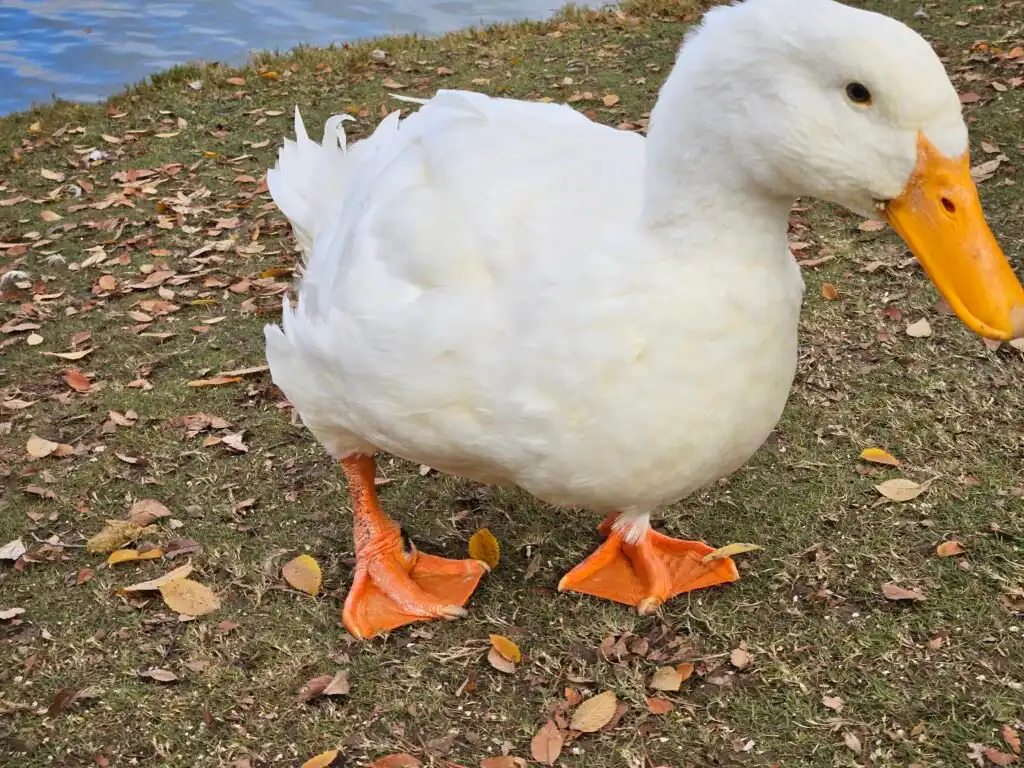
That matters because duck obesity is more than a cosmetic issue. Excess weight can put additional stress on the feet, legs, and joints and may contribute to other health and reproductive problems. At the same time, simply cutting back on food is not the answer. Ducks still need enough protein, vitamins, minerals, and other essential nutrients to maintain their feathers, muscles, bones, and normal body functions.
So, how can you tell if your duck is actually overweight? And if those snacks have gotten a little out of hand, how do you help your duck reach a healthier weight without compromising nutrition?
In this guide, I’ll show you how to evaluate your duck’s body condition, what commonly causes weight gain in pet ducks, how obesity can affect their health, and how to adjust their diet safely. Because the goal is not to have a skinny duck. It is to have a well-nourished, active duck in a healthy body condition.
Part of the Feeding & Nutrition Hub, Data-backed analysis of duck dietary requirements and foraging behavior.
Quick Navigation: Jump to a Section
[hide]
- Can Ducks Get Overweight?
- How to Tell If Your Duck Is Overweight
- Why Do Pet Ducks Become Overweight?
- When Weight Gain Is Not Simply Overfeeding
- How Obesity Affects a Duck’s Health
- How to Help an Overweight Duck Lose Weight Safely
- Should Ducks Have Food Available All Day?
- From Our Flock: Why I Track Weight Instead of Chasing a Number
- When Should You See an Avian Veterinarian?
- Frequently Asked Questions About Duck Obesity
- A Healthy Duck Is More Than a Number on the Scale
- Further Reading & Resources
Can Ducks Get Overweight?
Yes, ducks can become overweight or obese when they consistently consume more energy than their bodies use. Pet ducks may be particularly prone to weight gain because they have reliable access to food, receive calorie-dense treats, and often expend less energy than wild ducks.
However, determining whether a duck is overweight is not as simple as putting them on a scale.
A healthy weight can vary considerably depending on a duck’s breed, sex, age, body size, activity level, and individual build. A large breed duck will naturally weigh much more than a small breed, and even two healthy ducks of the same breed may not weigh exactly the same.
This is why I prefer to think in terms of healthy body condition rather than an ideal number on the scale.
Your duck’s weight is still incredibly useful, especially when you track it regularly. A gradual upward trend can alert you that something is changing. But that number should be considered alongside the duck’s body condition, particularly the amount of muscle and tissue surrounding the keel bone.
Weight Is Data, Not the Diagnosis
Feathers make ducks surprisingly deceptive. They can make a lean duck look wonderfully round and fluffy, while also hiding changes in body composition underneath.
That is why simply looking at your duck is not enough.
Instead, I recommend combining regular weigh-ins with hands-on body condition checks. Over time, you will learn what is normal for your individual ducks and are much more likely to notice meaningful changes early.
In our flock, I weigh everyone regularly and record their weights. I am less concerned about whether every duck matches a generic breed weight from a chart and much more interested in changes from that duck’s own normal baseline.
A sudden or unexplained increase in weight also should not automatically be blamed on too many snacks. Particularly in female ducks, abdominal enlargement or weight gain can sometimes have a medical cause. If your duck’s body shape or weight changes rapidly, or the change is accompanied by lethargy, difficulty walking, breathing changes, abdominal swelling, or other unusual symptoms, an avian veterinarian should evaluate her.
How to Tell If Your Duck Is Overweight
If you are wondering whether your duck is overweight, do not rely on appearance alone. Ducks are essentially walking pillows. Their feathers can make a perfectly healthy duck look wonderfully chunky, and they can also hide changes in body condition.
Instead, I recommend looking at several pieces of information together.
1. Feel Your Duck’s Keel Bone
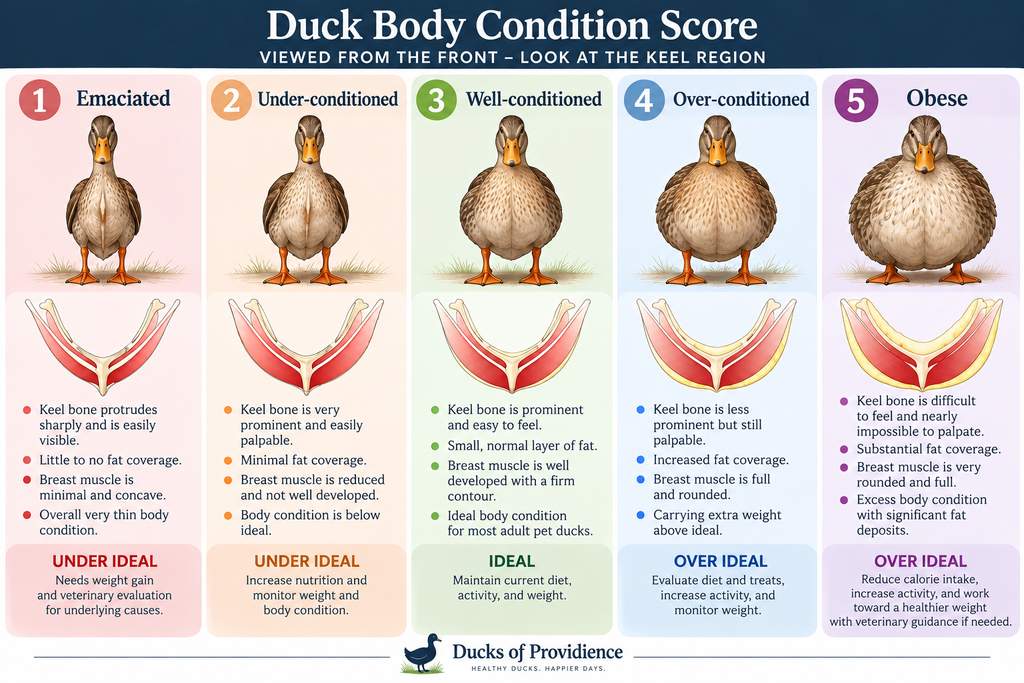
One of the most useful places to assess body condition is the keel, the prominent bone running along the center of the breast.
Gently hold your duck and run your fingers over the breast on either side of the keel. You are evaluating how much muscle and other tissue covers the bone. If the keel is too pointy and hard, the duck is underweight. At normal body condition, the keel should be almost flush with the muscles.
| What You Feel | What It May Mean |
|---|---|
| Keel is very prominent and the breast feels hollow on either side | Duck may be underweight or have poor muscle condition |
| Keel is easy to feel with good tissue coverage on both sides | Generally consistent with a healthier body condition |
| Keel is difficult to feel beneath substantial tissue coverage | Duck may be carrying excess body condition |
This is not an exact diagnostic test, and body shape varies among breeds. However, it gives you much more useful information than simply looking at your duck from across the yard.
If you have never felt your ducks’ keel bones before, check everyone in your flock. Comparing ducks of similar breeds and builds can help you learn what different body conditions actually feel like.
2. Weigh Your Duck
Next, get an actual weight.
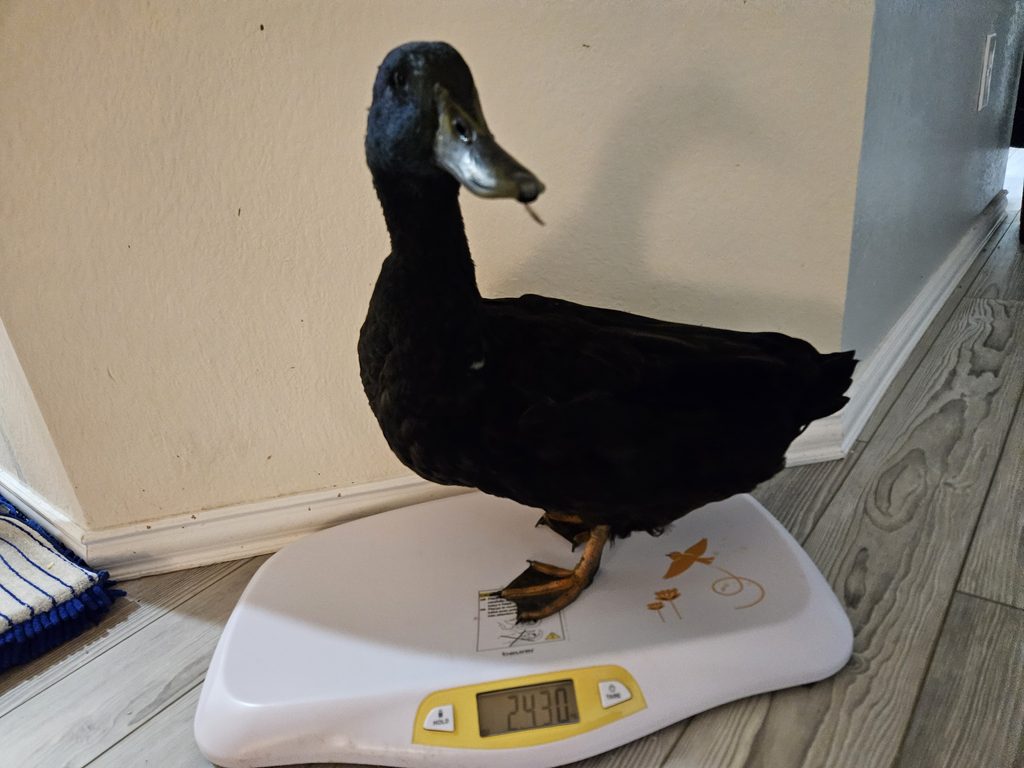
I recommend weighing pet ducks regularly even when they appear healthy. We love using a baby scale for our ducks because the wide, low platform gives them enough room to stand comfortably and makes getting a reliable weight relatively easy.
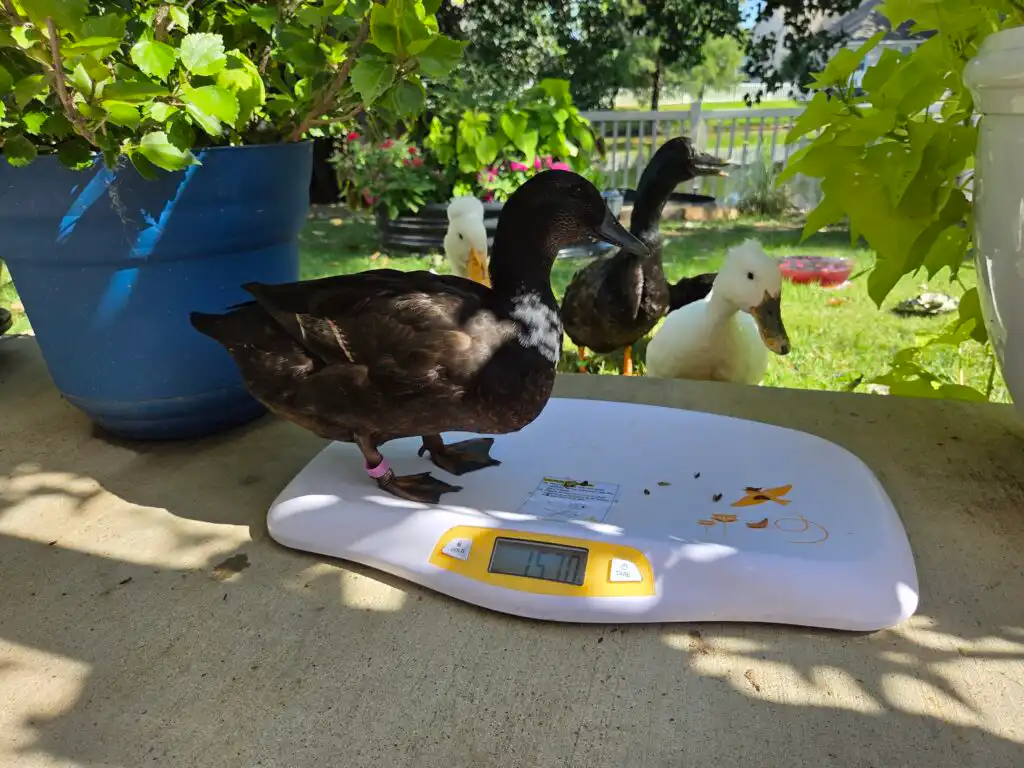
Our Flock Favorite: Baby Scale
A simple digital baby scale has become one of those duck care tools I would not want to be without. We use ours for routine weigh ins and whenever I want to monitor one of our ducks more closely. Baby Scale (Affiliate Link)
Whichever scale you use, record the weight rather than trusting yourself to remember it.
| Date | Weight | Body Condition | Notes |
|---|---|---|---|
| October 5 | 4.3 lb | Keel easily felt | Normal activity |
| November 5 | 4.5 lb | Slightly fuller | Molting finished |
| December 5 | 4.8 lb | Keel less distinct | Treat intake increased |
One measurement tells you where your duck is today. A series of measurements tells you where your duck is going.
That trend is often far more valuable.
3. Compare the Weight With Your Duck’s Normal
Breed weight charts can provide a useful reference, but I would not use them as a strict cutoff for obesity.
Instead, ask:
Has my duck been steadily gaining weight?
If your adult duck has historically maintained a stable weight and is now becoming progressively heavier without an obvious explanation, take a closer look at diet, treats, activity, and body condition.
This is also why establishing a baseline while your ducks are healthy is so helpful. You cannot go back and collect last year’s weight once something changes.
4. Watch How Your Duck Moves
Body condition is not only about what you see on the scale.
Watch your duck walking around the yard. An overweight duck may become less active, tire more easily, or have greater difficulty moving comfortably. Excess body weight also means the legs and feet have to support additional load with every step.
Pay attention to changes such as reduced activity, reluctance to walk, difficulty getting up, or worsening foot problems.
However, do not automatically assume that reduced mobility means your duck needs to lose weight. Pain and illness can also make a duck less active, which can subsequently contribute to weight gain.
5. Look at the Whole Duck
Finally, put all of your observations together.
Do not label a duck overweight based on one number or one visual impression. Consider:
Body weight + weight trend + keel and breast condition + activity + breed and body size + overall health
For example, a duck weighing more than the typical breed range but maintaining good body condition and a stable weight may simply be a larger individual. A duck whose weight has steadily climbed while the keel becomes increasingly difficult to feel deserves a closer look at her diet.
A Simple Monthly Weight Check
For most healthy adult pet ducks, I like making weighing part of a regular husbandry routine. Pick approximately the same time each month, weigh each duck, record the number, and do a quick hands-on body condition check at the same time.
It takes only a few minutes, but over the course of a year, you build an incredibly useful record of what is normal for your duck.
And if you discover that your duck really is carrying a little too much fluff underneath all that fluff, the next question is obvious: How did it happen?
That is where we need to look at food, treats, activity, and the everyday habits that can quietly turn into chronic overfeeding.
Why Do Pet Ducks Become Overweight?
At its simplest, weight gain occurs when a duck consistently consumes more energy than it uses. But in a backyard flock, there is rarely just one culprit.
Pet ducks live very differently from their wild relatives. They do not need to spend hours searching for enough food to survive. We provide nutritionally dense feed every day, keep water conveniently nearby, and, if your household is anything like ours, there is a good chance someone occasionally appears with snacks.
That is wonderful for our ducks, but it also means we control much of their energy intake.
Here are some of the most common reasons pet ducks gain too much weight:
| Common Cause | Why It Matters |
|---|---|
| Too many treats | Mealworms, corn, seeds, fruit, and other favorites can add significant calories on top of an already complete diet. |
| Oversized portions | Even a nutritionally balanced duck feed provides excess energy when consistently fed in amounts greater than the duck needs. |
| Multiple people feeding treats | A few snacks from you, a few from your spouse, and another handful from the kids can add up quickly. |
| Limited activity | Ducks living in smaller enclosures may expend less energy than ducks with large areas to explore and forage. |
| Highly palatable foods | Ducks may preferentially eat calorie dense favorites when given the opportunity, especially when treats are offered frequently. |
| Seasonal changes | Activity, reproductive status, molting, and environmental conditions can change throughout the year, and energy needs can change with them. |
| Reduced mobility | Arthritis, foot problems, injuries, or other conditions may reduce activity and therefore energy expenditure. |
The Treat Trap
Treats deserve a little extra attention because they are probably one of the easiest ways to accidentally overfeed a pet duck.
We use treats for enrichment, bonding, training, getting reluctant ducks into the run, hiding medications, and occasionally just because they are standing there looking adorable.
There is nothing inherently wrong with that.
The problem begins when extras become a significant portion of the daily diet.
Mealworms and black soldier fly larvae, for example, can provide valuable protein and are treats we use with our own flock. Corn and peas can also be perfectly appropriate foods in moderation. But every treat provides additional energy.
And ducks generally do not say, “No thank you, I already met my caloric needs for today.”
They eat the snack.
Complete Feed Should Still Be the Foundation
For most pet ducks, a nutritionally complete waterfowl feed should make up the majority of the diet. This helps ensure that they receive appropriate amounts of protein, amino acids, vitamins, and minerals rather than filling up on extras that may be high in calories but nutritionally incomplete.
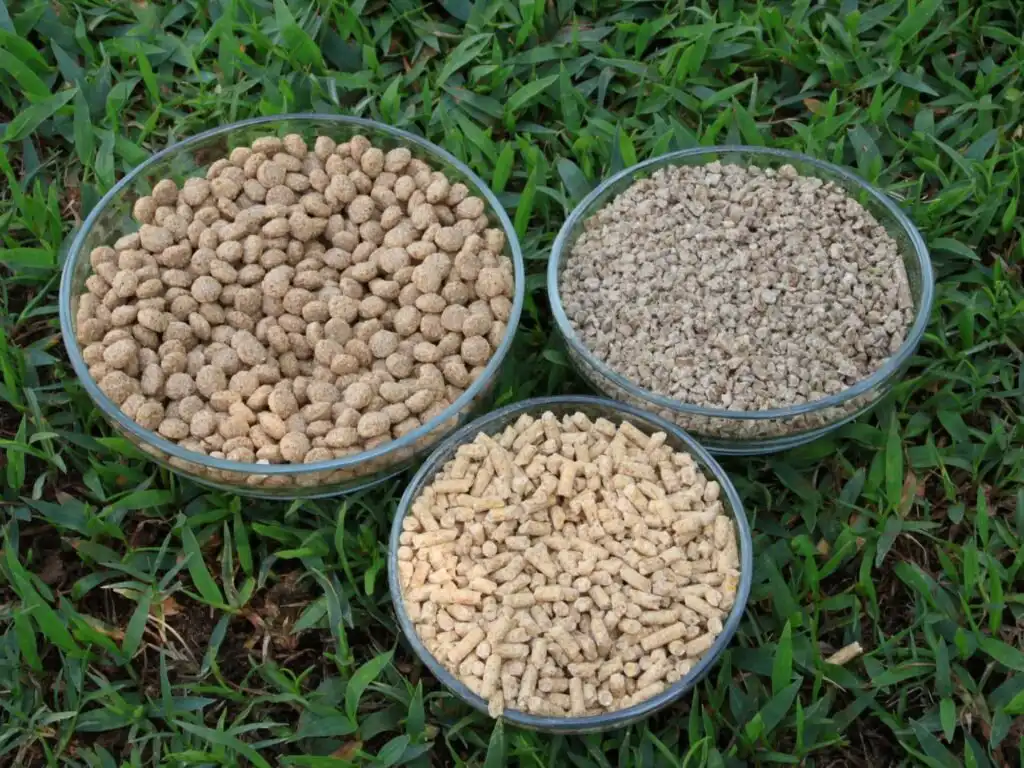
This is also why I do not like approaching duck obesity by simply feeding dramatically less food.
If we indiscriminately restrict a balanced diet while continuing to offer treats, we may reduce calories while also reducing essential nutrients.
A better first question is:
What is my duck eating in addition to their complete feed?
For many pet flocks, that is where the easiest changes can be made.
Do Not Forget About Foraging
Food your ducks find themselves counts, too.
A large yard or pond can provide insects, worms, plants, seeds, and other edible treasures throughout the day. That natural foraging is fantastic enrichment and encourages movement, but it also contributes to overall energy intake.
This is one reason there is no perfect feeding amount that works for every pet duck. A duck spending the day actively foraging over a large property has a very different lifestyle from a duck living primarily in a smaller enclosed run.
The goal is not to calculate every calorie your duck consumes. That would make feeding your flock unnecessarily complicated.
Instead, watch the outcome.
If your adult duck maintains a healthy body condition and relatively stable weight, your feeding routine is probably working well. If weight and body condition are steadily increasing, it is time to look at the entire diet and lifestyle, not just what is in the feed bowl.
When Weight Gain Is Not Simply Overfeeding
A higher number on the scale does not automatically mean your duck is getting fat. A duck’s body weight naturally fluctuates throughout the year, sometimes quite noticeably.
This is another reason I recommend keeping a weight record. Once you have tracked the same duck for a year or longer, you may begin to recognize that individual duck’s normal seasonal patterns.
Molting Can Change Body Weight
Molting is physiologically demanding. Ducks are replacing large numbers of feathers, which requires substantial amounts of protein and other nutrients. Their appetite, activity, and body weight may change during this period.
You may notice some weight fluctuation before, during, and after a major molt. Rather than reacting to a single measurement, look at your duck’s overall body condition and weight trend across several weeks.
Egg Laying Changes a Hen’s Nutritional Demands
Reproductive activity can also influence body weight and condition.
During the laying season, hens devote considerable nutritional resources to producing eggs. An egg contains protein, fat, minerals, and a substantial amount of water, all of which have to come from somewhere.
A laying hen may therefore have different energy and nutrient demands than that same hen during a period when she is not producing eggs. Changes in laying activity throughout the year can contribute to changes in appetite, weight, and body condition.
This is one reason I would never recommend putting a laying duck on a restrictive diet based solely on a number on the scale.
Summer and Winter Can Look Different
Seasonal changes matter too, although where you live makes a big difference.
Ducks may use more energy maintaining their body temperature during genuinely cold weather. Activity and foraging opportunities can also change with the seasons. Conversely, extremely hot weather can affect appetite and activity.
Here in North Texas, our seasonal pattern is very different from that of someone keeping ducks through a long northern winter. Our summers can be brutally hot, which can substantially change how much the ducks move around during the hottest part of the day.
So rather than assuming that every duck should maintain exactly the same weight year-round, consider your climate, temperature, activity level, food availability, and your individual duck’s normal seasonal pattern.
Broody Ducks Are a Special Case
Broodiness can create an especially interesting weight pattern.
A hen preparing to sit may increase her food intake and build body reserves before committing to the nest. Once she becomes fully broody, however, the pattern can reverse.
A determined broody duck may spend most of her day sitting on the nest and leave only briefly to eat, drink, bathe, and defecate. Over the course of incubation, she can lose body weight and condition because she is eating much less than she normally would.
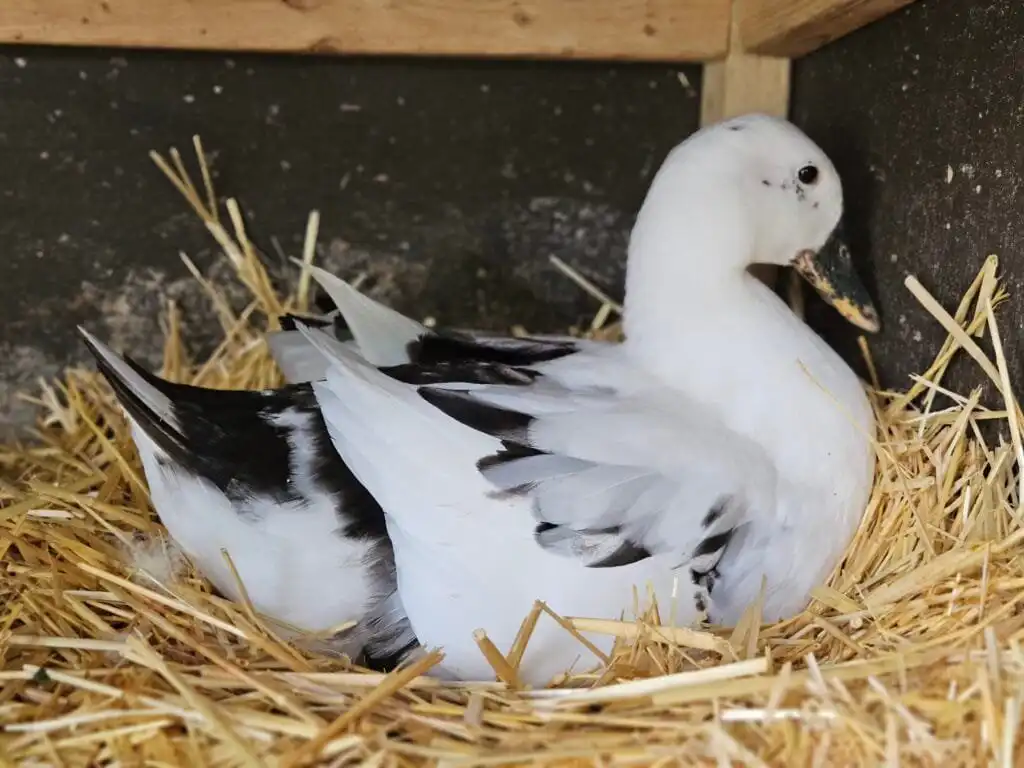
So if you weigh a hen shortly before she becomes broody and again after she has been sitting for several weeks, those numbers may look quite different.
This is also why I pay attention to how much condition a broody hen is losing, rather than assuming weight loss is acceptable simply because she is broody.
Sometimes Weight Gain Really Is a Medical Concern
Normal fluctuations tend to make sense when you consider what is happening in your duck’s life. Rapid, substantial, or unexplained weight gain is different.
A larger abdomen does not necessarily mean increased body fat either. Particularly in female ducks, reproductive problems, fluid accumulation, masses, or other medical conditions can change body shape or body weight.
Contact an avian veterinarian if weight or abdominal size changes rapidly or if you notice other concerning signs such as:
- Abdominal swelling or an unusual body shape
- Difficulty walking or standing
- Labored breathing
- Lethargy or weakness
- Reduced appetite
- Changes in laying
- A sudden change from your duck’s established weight pattern
Look for Patterns, Not Perfect Numbers
This is where your weight records become incredibly valuable.
If Emma, for example, weighs a little more every winter and returns to her usual baseline each spring while maintaining good body condition, that seasonal pattern tells us much more than comparing one winter measurement with a generic breed chart.
On the other hand, if a duck’s weight has been steadily climbing for six months, her keel is becoming increasingly difficult to feel, and the amount of treats she receives has crept upward, that pattern gives us a very different picture.
Think of your scale as an early warning tool rather than a pass or fail test:
Know your duck’s baseline. Track the trend. Feel the keel. Consider the season and reproductive status. Investigate changes that do not make sense.
That is a much more reliable way to distinguish normal fluctuations from true excess body condition.
How Obesity Affects a Duck’s Health
A chubby duck may look cute, but true obesity is a health concern, not simply a matter of appearance. Extra body fat changes how much weight the legs and feet must carry, can make movement more difficult, and may contribute to metabolic and reproductive problems.
At the same time, I want to be careful about how strongly we make some of these connections. Ducks are not as extensively studied as chickens and other poultry, so some of what we know about obesity comes from broader avian and poultry research rather than studies specifically involving pet ducks.
Extra Weight Puts More Stress on the Feet and Legs
A duck’s legs and feet already support its entire body on relatively small structures. When body weight increases, so does the mechanical load placed on them with every step.
This becomes particularly important for ducks that already have mobility problems.
An overweight duck may have more difficulty walking, getting in and out of a pool, navigating ramps, or moving around the yard. Reduced mobility can then create an unfortunate cycle:
Weight gain → movement becomes harder → duck moves less → energy expenditure decreases → additional weight gain becomes easier
Excess weight may also contribute to foot problems. Bumblefoot, or pododermatitis, is multifactorial, so I would not blame obesity alone. Substrate, moisture, injuries, pressure, infection, and husbandry all matter. However, carrying additional body weight can increase pressure on the plantar surface of the feet, making a healthy body condition one piece of good foot care.
Joints May Pay the Price Too
Additional body mass also increases the forces placed on the joints.
This can be especially problematic for older ducks, heavy breeds, and ducks with existing arthritis, previous injuries, or leg abnormalities. A little extra weight that causes no obvious problem in a young, active duck may become much more significant when mobility is already compromised.
This is why maintaining healthy body condition becomes increasingly important as our ducks age.
Obesity Can Affect Reproductive Health
Obesity is also relevant to reproductive health.
In poultry, excessive body weight and fat deposition are associated with altered reproductive performance and reproductive disorders. Pet ducks are not commercial laying hens, and we should be cautious about directly applying every finding from chickens to ducks. Still, maintaining an appropriate body condition is sensible for breeding and laying birds.
For female pet ducks, there is another important consideration: we cannot simply slash their food intake because they need to lose weight.
An actively laying hen still requires adequate protein, amino acids, vitamins, minerals, and calcium to support egg production. The goal is to reduce unnecessary excess calories while continuing to provide complete nutrition.
Excess Fat Can Affect the Liver and Metabolism
Birds store excess energy as fat just as other animals do. Some of that fat is stored in adipose tissue, while lipid metabolism also involves the liver.
Severe disturbances in lipid metabolism can contribute to hepatic lipidosis, commonly called fatty liver disease. However, fatty liver has multiple potential causes, and an overweight duck should not automatically be assumed to have liver disease.
This is another reason prevention is preferable to waiting until obesity becomes severe.
Overweight Ducks May Have More Difficulty in Hot Weather
Body condition can also matter when temperatures climb.
Birds do not sweat. Ducks primarily manage excess heat through behaviors and physiological mechanisms such as panting, altering activity, seeking shade, and spending time in water.
An overweight duck is carrying additional metabolically active and insulating tissue, and mobility may also be reduced. In very hot climates, keeping ducks at an appropriate body condition is one part of helping them cope with heat.
Here in North Texas, this is something I take particularly seriously. During our hottest summer weather, reducing heat load is already a major part of managing the flock. I certainly do not want excess body condition making thermoregulation any harder than it already is.
Obesity Can Make Other Problems Harder to Manage
One of my biggest concerns with excess weight is that it rarely exists in isolation.
Consider a duck that develops arthritis. Walking hurts, so she moves less. Because she moves less, she burns less energy. If her food and treat intake remains unchanged, she begins gaining weight. That additional weight makes walking even harder.
The same pattern can occur following an injury or during chronic foot problems.
That is why body condition should be part of routine health monitoring, not something we think about only when a duck becomes obviously obese.
| Potential Concern | Why Excess Weight Matters |
|---|---|
| Feet | Greater body mass increases the load and pressure placed on the feet |
| Legs and joints | Additional weight increases mechanical stress and may worsen existing mobility problems |
| Activity | Heavier ducks may move less, further reducing energy expenditure |
| Reproductive health | Excessive body condition may interfere with normal reproductive function |
| Metabolic health | Chronic excess energy intake promotes fat deposition and may contribute to metabolic problems |
| Heat tolerance | Excess body condition may make coping with high environmental temperatures more difficult |
| Existing disease or injury | Extra weight can complicate mobility and recovery |
The Goal Is Healthy Body Condition, Not a Thin Duck
I want to emphasize this because it is easy to swing too far in the opposite direction once we start talking about obesity.
Thin is not automatically healthy.
Ducks need adequate energy reserves, good breast musculature, and enough nutrition to support normal activity, feather production, thermoregulation, reproduction, and immune function. An underweight duck can have serious health problems of her own.
We are not trying to make the keel bone as prominent as possible or force every duck to the bottom of a breed weight range.
We are aiming for the middle: good muscle coverage, an appropriate amount of body fat, normal mobility, and a relatively stable weight pattern for that individual duck.
And if your duck is genuinely over conditioned, the solution should not be a crash diet. The next step is figuring out how to help an overweight duck lose weight safely without creating nutritional deficiencies.
How to Help an Overweight Duck Lose Weight Safely
If you have determined that your duck really is overweight, resist the temptation to simply cut her food dramatically. Weight loss should be gradual, and your duck still needs a nutritionally complete diet while losing excess body fat.
The first step is figuring out where those extra calories are coming from.
1. Start With the Extras
Before reducing your duck’s regular feed, take an honest look at everything she eats during the day.
Treats have a sneaky way of multiplying. A handful of mealworms in the morning, peas while you are outside, a little corn in the afternoon, and another snack before bedtime may not seem like much individually. Together, they can represent a substantial amount of additional energy.
For an overweight duck, I would reduce calorie-dense treats first while keeping a nutritionally balanced feed as the foundation of the diet.
That does not mean treats have to disappear completely. Use smaller portions and make them count. A few favorite treats can still be useful for bonding, training, enrichment, or convincing a stubborn duck that it really is time to go inside.
2. Measure the Feed
If you normally refill the food bowl whenever it looks empty, spend some time measuring how much feed your flock actually consumes.
You do not necessarily need to measure every meal forever. The goal is to establish a realistic picture of intake.
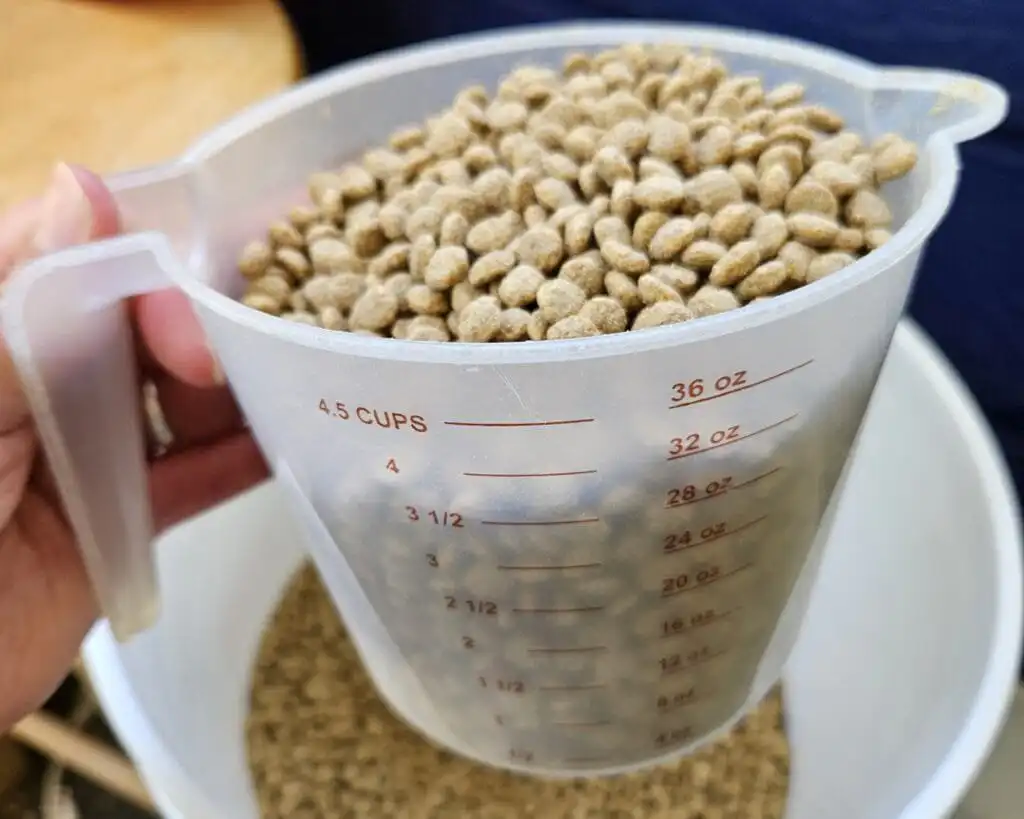
Also pay attention to waste. Ducks are remarkably talented at turning perfectly good food into wet mush, scattering it across the ground, and generally making it difficult to determine what was actually eaten.
Most importantly, do not dramatically restrict a complete feed based on an arbitrary feeding recommendation from the internet. Appropriate intake depends on the feed itself, body size, age, reproductive status, activity, climate, and access to other food sources.
3. Keep the Diet Nutritionally Complete
Weight loss should come from eliminating excess energy, not from creating nutritional deficiencies.
This is particularly important for laying hens. Producing eggs requires protein, amino acids, calcium, vitamins, minerals, and energy. A hen does not suddenly stop needing those nutrients because she is overweight.
I would much rather remove unnecessary extras from the diet before substantially reducing the balanced feed that supplies those essential nutrients.
4. Encourage More Natural Activity
Food is only one side of the energy balance equation. The other is activity.
Pet ducks do not necessarily exercise just because they have the opportunity. If the food bowl, water, favorite resting spot, and pool are all right next to each other, a duck can meet most of her daily needs without moving very far.
One simple strategy is to make your ducks walk a little farther for their meals. Instead of keeping the food bowl directly beside their favorite lounging area, place it farther away, perhaps inside the coop or at the opposite end of the run. Keep drinking water available with the feed, of course, so they can properly eat and rinse their bills.
These small changes can naturally add movement throughout the day without turning exercise into something stressful.
Enrichment matters too. Ducks may spend more time eating when they are bored and have little else to do. A duck with limited space and few opportunities to explore, forage, swim, or investigate her environment may repeatedly return to the feeder simply because it is one of the most interesting things available.
Give them reasons to do something other than eat.
Encourage your ducks to walk, swim, explore, dabble, and forage whenever they are physically able. You can scatter a small portion of their normal ration through a safe foraging area, move feeding locations occasionally, provide opportunities to search through grass and vegetation, or offer swimming and supervised exploration time.
The important distinction is that we are not adding more food for enrichment. Use part of what they would already be eating and make them work a little for it.
You can also think about the layout of your duck area:
| Instead of… | Try… |
|---|---|
| Food beside their favorite resting area | Place the feeder farther away so they have to walk to it |
| Food, pool, and resting area clustered together | Spread resources throughout the enclosure |
| All food served in a bowl | Use part of the normal ration for supervised foraging |
| Few activities in the run | Add safe opportunities to explore, swim, dabble, and forage |
| Giving treats whenever ducks appear bored | Redirect that behavior toward non food enrichment |
Of course, never force an overweight duck to exercise. If your duck has arthritis, bumblefoot, an injury, or difficulty walking, deliberately making food harder to reach could do more harm than good. In those cases, easy access to food and water may actually be necessary, and weight management should focus more heavily on appropriate nutrition and veterinary guidance.
For a healthy but slightly overconditioned duck, however, sometimes a surprisingly effective change is simply this: make the healthy choice the interesting choice. Give her more to do, more reasons to move, and fewer opportunities to spend the afternoon standing beside the buffet.
5. Managing Weight in a Multi Duck Flock
This is where things can get complicated.
You may have one overweight duck living with several ducks that are in perfectly good condition. Restricting everyone’s food because one flock member needs to lose weight is not necessarily appropriate.
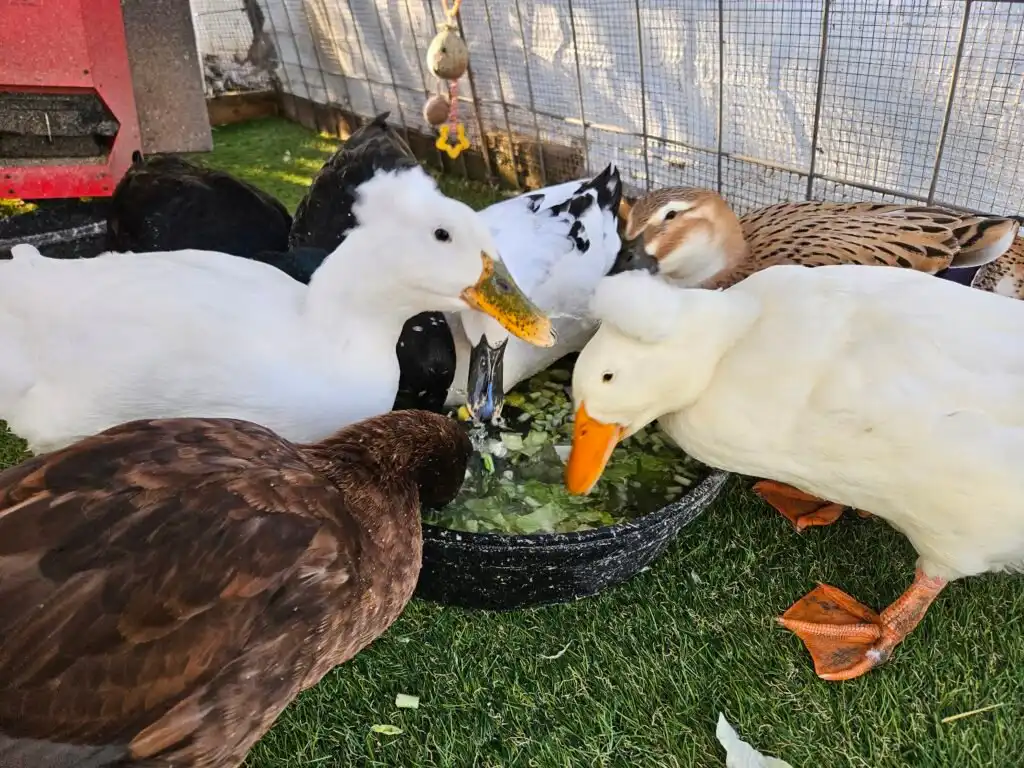
Watch how your ducks eat. Is one duck dominating the feeder? Does she finish quickly and move on to everyone else’s food? Is one duck getting significantly more treats because she is the boldest one standing at your feet?
Sometimes the solution is surprisingly simple.
You can feed ducks separately for part of a meal, use multiple feeding stations, supervise feeding, or temporarily separate an individual duck so you have better control over how much she eats.
This is especially important when another flock member is elderly, underweight, molting, laying heavily, recovering from illness, or otherwise has different nutritional needs.
6. Weigh, Feel, Record, Repeat
Once you make changes, monitor whether they are actually working.
Use the same scale whenever possible and weigh your duck under reasonably consistent conditions. At the same time, feel the keel and breast muscles rather than focusing exclusively on the number.
Keep a simple record:
| What to Monitor | What You Are Looking For |
|---|---|
| Body weight | A gradual trend toward a healthier weight |
| Keel and breast condition | Improving body condition without excessive loss of muscle |
| Mobility | Comfortable walking, swimming, and normal activity |
| Appetite | Normal interest in food |
| Droppings | No concerning changes |
| Overall behavior | Your duck remains bright, active, and behaving normally |
The goal is gradual improvement, not rapid weight loss.
7. Reassess Instead of Chasing a Target Number
Do not decide that your duck must reach a particular number simply because a breed chart says that is what she should weigh.
As body condition improves, reassess.
Can you feel the keel appropriately? Does she have good breast musculature? Is she moving comfortably? Has her weight stabilized? Does this seem consistent with her normal size, breed, sex, and life stage?
At some point, the goal changes from weight loss to weight maintenance.
And that is ultimately what we want. We are not putting our ducks on a diet for the sake of making the scale show a smaller number. We are adjusting their husbandry so they can maintain a healthy body condition while still receiving everything their bodies need.
Important: If your duck is significantly obese, has other health problems, or continues gaining or losing weight despite dietary changes, work with an avian veterinarian. A veterinarian can help determine whether there is an underlying medical problem and develop an appropriate weight management plan.
Should Ducks Have Food Available All Day?
One of the most common questions about managing a duck’s weight is whether food should be available all the time.
There is no single feeding schedule that works for every flock. Some duck keepers, including us, keep a complete duck feed available 24/7. Others provide food throughout the daytime but remove it overnight. Some offer measured meals at specific times.
Any of these approaches can work, depending on your ducks, their environment, and how you manage the rest of their diet.
Our Ducks Have Food Available 24/7
In our flock, the ducks have access to their regular feed around the clock, including inside their nighttime shelter. We do not automatically consider free choice access to a balanced feed a problem.
What matters is what happens alongside it.
If ducks maintain a healthy body condition, are active, and are not consuming excessive amounts of treats or other high calorie foods, having complete feed continuously available does not automatically mean they will become obese.
It also works well with the way we manage our flock. Ducks can eat when they want rather than having to consume a large amount during a short feeding window.
Of course, that does not mean 24/7 feeding is the only correct approach.
Daytime Feeding Can Work Too
Some keepers provide food when the ducks are let out in the morning and remove it when they are secured for the night.
That can also be a perfectly reasonable management strategy, provided the ducks have sufficient opportunity to eat throughout the day and receive enough complete nutrition.
If you remove feed overnight, I would pay particular attention to ducks with increased nutritional demands, such as actively laying hens, growing ducks, birds recovering from illness, or individuals struggling to maintain weight.
What About Feeding Only at Specific Meal Times?
Some duck keepers offer their flock a measured amount of feed once or twice a day rather than keeping a feeder continuously available.
I see this approach most often with ducks that free-range throughout the day. These ducks may spend hours grazing, dabbling, hunting insects and worms, eating vegetation, and finding other natural foods. Their commercial feed is therefore only one part of everything they consume during the day.
That is very different from a pet duck living primarily in an enclosed run where the feeder provides most of her daily nutrition.
Scheduled meals can give you greater control over how much commercial feed is offered and may be useful when managing an overweight duck. However, I would not use short feeding windows simply as a way to force weight loss, particularly for ducks that do not have substantial opportunities to forage between meals.
Ducks naturally eat multiple times throughout the day. In a flock setting, short feeding periods can also create competition. A dominant or fast-eating duck may consume more than her share while a timid duck does not get enough.
If you choose scheduled feeding, make sure every duck has adequate access to food and enough time to eat comfortably. Multiple feeding stations can be particularly helpful.
And remember that free-ranging does not automatically guarantee a nutritionally complete diet. What ducks can find depends heavily on the property, season, climate, and available forage. Their body condition, laying status, and overall health should help guide whether the feeding routine is actually meeting their needs.
Free Feeding Is Not the Same as Unlimited Treats
This distinction is important.
Keeping a nutritionally complete feed available is very different from providing unlimited access to corn, scratch grains, mealworms, seeds, bread, or other extras.
If an overweight duck has complete feed available all day, I would first evaluate:
| Ask Yourself | Why It Matters |
|---|---|
| How many treats are offered each day? | Extras may contribute substantial calories |
| Is everyone in the household giving treats? | Small portions from several people quickly add up |
| Does the duck forage elsewhere? | Those calories count too |
| How active is the duck? | Energy requirements change with activity |
| Is the duck actually overeating the complete feed? | Do not assume the feeder is the problem |
| Is body condition continuing to increase? | The trend tells you whether your current management is working |
For many pet ducks, reducing unnecessary extras may be a better first step than immediately taking away their regular food.
Choose a Feeding Schedule Based on Your Ducks
Rather than asking whether free feeding or scheduled feeding is universally better, I would ask:
Is my current feeding system maintaining healthy body condition in every member of my flock?
If your ducks have access to food 24/7 and maintain healthy weights, there may be no reason to change that system simply because another duck keeper feeds twice a day.
If one duck is steadily gaining excess body condition, however, you may need to adjust how that individual eats. That could mean reducing treats, measuring feed intake for a while, separating ducks during meals, changing feeder placement, or transitioning to more structured feeding.
Whatever schedule you choose, a complete diet, healthy body condition, and access for every member of the flock matter more than the clock.
And remember that feeding and drinking go together for ducks. Whenever ducks are eating, they should have access to clean water deep enough to adequately submerge and rinse their bills.
From Our Flock: Why I Track Weight Instead of Chasing a Number
With our own ducks, I do not have one number that I consider the “perfect duck weight.” Our flock includes different breeds, body sizes, sexes, and individual builds, so comparing everyone to the same standard would not tell me very much.
Instead, I weigh our ducks regularly and pay attention to each duck’s individual trend. We use a baby scale, record their weights, and combine that information with a hands-on body condition check.
Over time, this gives me something much more useful than a generic breed chart: a baseline for each individual duck.
If one of my ducks weighs a little more or less than she did at the previous weigh-in, I do not immediately change her diet. I consider what else is happening. Is she laying? Molting? Has the weather changed? Is she less active? Has someone been a little too generous with the treats?
I am much more interested in a persistent trend than a small fluctuation.
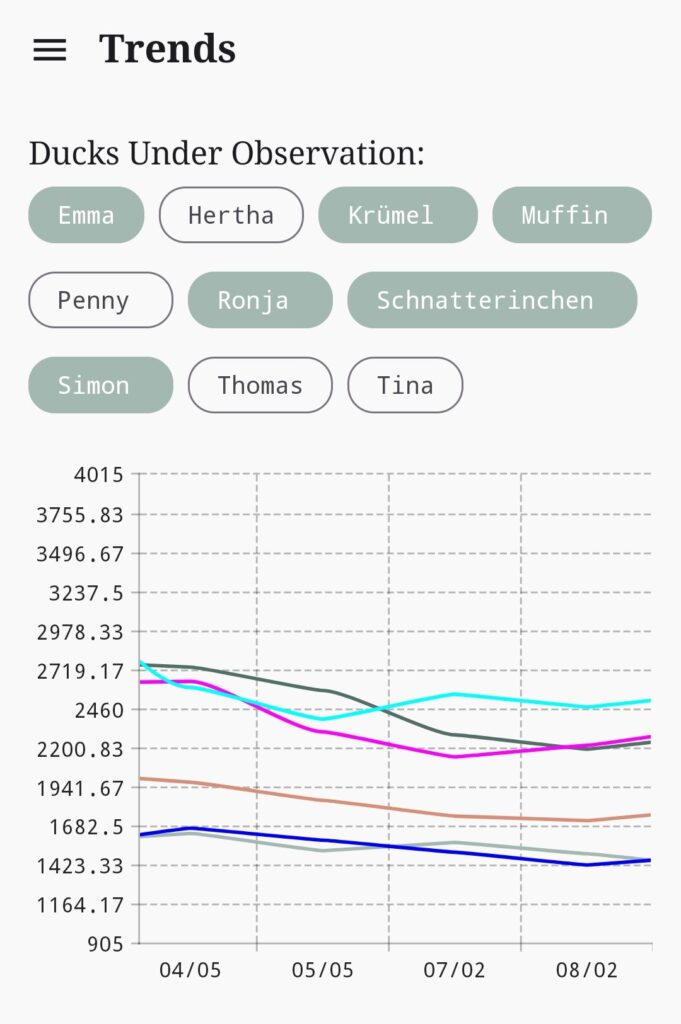
For example, if a duck gradually gains weight over several months and I also notice that her keel is becoming harder to feel, that would make me take a closer look at her diet and activity. If her weight fluctuates but her body condition remains good and the changes correspond with normal seasonal or reproductive changes, I am much less concerned.
This is also why I think weighing healthy ducks is so valuable. The best time to establish your duck’s normal weight is before you are worried about it.
Once you know what normal looks and feels like for Emma, Simon, Krümel, Muffin, or whoever happens to be waddling onto your scale, it becomes much easier to recognize when something genuinely changes.
My recommendation: Keep a simple weight record for every duck in your flock. You do not need complicated spreadsheets or daily weigh ins. Regular measurements combined with body condition checks can reveal trends that feathers alone will never show you.
When Should You See an Avian Veterinarian?
If your duck has gradually gained excess body condition and you can identify a likely cause, such as too many treats combined with limited activity, reasonable husbandry changes may be all that is needed.
But not every increase on the scale is obesity, and not every overweight duck should be managed without veterinary input.
I would contact an avian veterinarian if you notice any of the following:
| What You Notice | Why It Deserves Attention |
|---|---|
| Rapid or unexplained weight gain | Sudden changes are less consistent with simple overfeeding |
| A noticeably enlarged or distended abdomen | Abdominal enlargement is not necessarily body fat, especially in female ducks |
| Difficulty walking or standing | Pain, arthritis, foot problems, or another underlying condition may be reducing activity |
| Labored breathing | This warrants veterinary evaluation rather than assuming excess weight is the cause |
| Changes in egg laying | Reproductive problems can sometimes cause changes in weight or abdominal appearance |
| Lethargy or reduced appetite | These suggest something more than uncomplicated obesity may be occurring |
| Continued weight gain despite dietary changes | There may be another factor contributing to the change |
| Significant obesity | A veterinarian can help develop a safe weight management plan without compromising nutrition |
Pay Particular Attention to Abdominal Enlargement in Female Ducks
This is one situation where I would be especially cautious about assuming a duck is simply overweight.
Female ducks can develop reproductive problems that cause the abdomen to become enlarged, and fluid accumulation or other internal disease can also change body shape and weight.
Body fat generally develops gradually and is distributed across the body. A duck that suddenly develops a large, pendulous, firm, or unusually shaped abdomen deserves a closer look.
If you are unsure whether you are feeling normal fat and muscle or something abnormal, that is a perfectly good reason to have your duck examined.

Your Scale Can Help Your Veterinarian Too
Those weight records we have been talking about throughout this article can become incredibly useful when something goes wrong.
Instead of telling your veterinarian, “She seems heavier lately,” you may be able to say:
She normally weighs around 4.5 pounds. Three months ago she was 4.6 pounds, last month she was 4.9 pounds, and today she weighs 5.3 pounds.
That gives your veterinarian an actual timeline to work with.
Bring your weight records and, if relevant, information about your duck’s regular feed, treats, laying history, activity level, and any recent behavioral changes to the appointment.
Knowing what is normal for your duck makes it much easier to recognize when something is not.
Frequently Asked Questions About Duck Obesity
How can I tell if my duck is overweight?
Do not judge your duck by appearance alone. Feathers can hide both excess fat and weight loss. Feel the keel bone and surrounding breast tissue, weigh your duck regularly, and track changes over time. A keel that becomes increasingly difficult to feel together with progressive weight gain may indicate that your duck is becoming over conditioned. Breed, sex, age, season, reproductive status, and individual build should also be considered.
How much should I feed my duck each day?
There is no single amount that is appropriate for every duck. How much a duck needs depends on body size, age, activity, reproductive status, climate, access to forage, and the nutritional and caloric content of the feed itself.
Rather than relying on a universal number of cups per day, use a nutritionally complete feed and monitor your duck’s weight and body condition. If weight is steadily increasing, evaluate treats, extras, activity, and overall feed intake.
Should ducks have food available all the time?
They can. Our ducks have access to their complete feed 24/7, and this can work well when ducks maintain a healthy body condition.
Other keepers provide food only during the day or at scheduled meal times. Scheduled feeding is particularly common with free-ranging flocks that spend much of the day finding insects, plants, worms, and other foods on their own.
There is no single schedule that is right for every flock. What matters is that your ducks receive adequate complete nutrition without consistently consuming more energy than they need. Whenever ducks are eating, they should also have access to clean drinking water.
Are mealworms and other duck treats fattening?
They can contribute to weight gain when offered excessively. Mealworms, black soldier fly larvae, corn, seeds, peas, and other treats all provide additional energy, even when the food itself has nutritional value.
Treats do not necessarily need to disappear if your duck needs to lose weight, but portions may need to become much smaller. A nutritionally complete feed should remain the foundation of the diet.
Remember to count treats from the entire household. A little snack from several different people can quickly turn into quite a feast.
How can I help my overweight duck lose weight?
Start by reducing unnecessary treats and other calorie dense extras rather than dramatically restricting a nutritionally complete feed. Measure what you are feeding, encourage safe movement and foraging, provide plenty of enrichment, and consider placing resources farther apart so your duck naturally walks more throughout the day.
Then weigh your duck regularly and reassess body condition. Weight loss should be gradual, and the goal is an appropriate body condition rather than reaching an arbitrary number on a breed chart.
If your duck is severely overweight, has difficulty walking, has other medical conditions, or experiences rapid or unexplained weight changes, work with an avian veterinarian to develop an appropriate weight management plan.
A Healthy Duck Is More Than a Number on the Scale
Duck obesity is not about whether your duck looks a little round and fluffy. With all those feathers, appearances can be deceiving. What matters is body condition, weight trends, activity, nutrition, and what is normal for your individual duck.
That is why I am such a big advocate for weighing our ducks regularly. A single number tells us very little. But when we combine regular weigh-ins with feeling the keel, observing mobility, and paying attention to seasonal and reproductive changes, we get a much better picture of our ducks’ overall health.
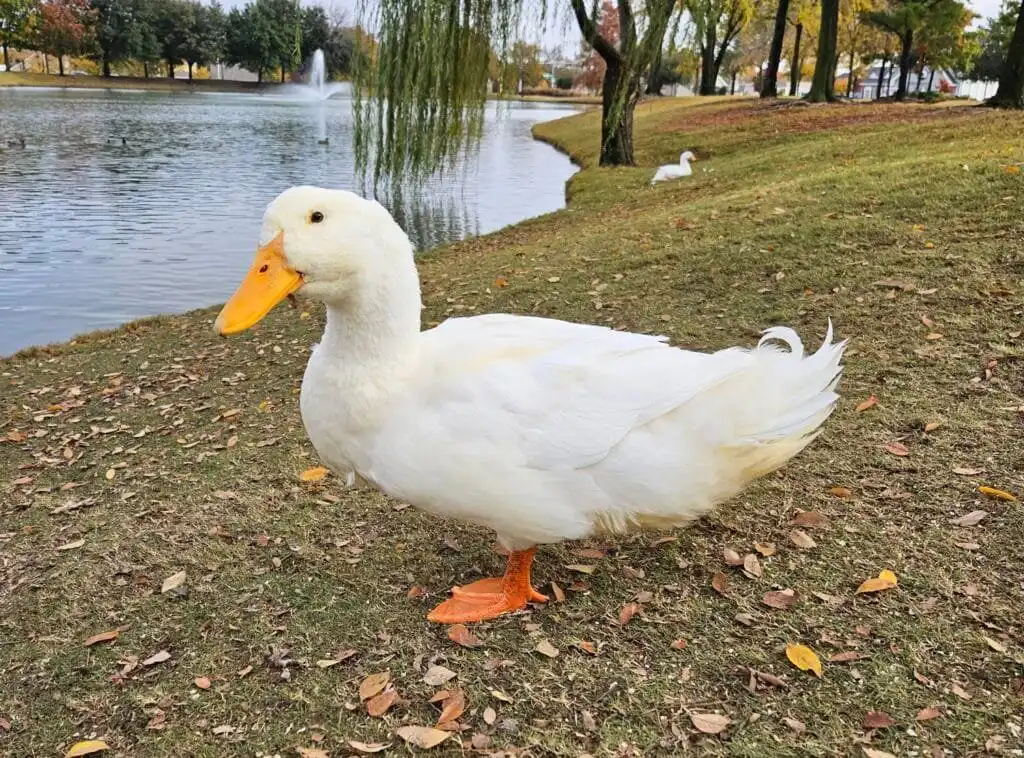
If your duck is carrying excess weight, you do not need to put her on a crash diet. Start with the simple things. Take an honest look at treats, measure what you are feeding, provide opportunities to forage and move, add enrichment, and continue offering a nutritionally balanced diet. Sometimes even moving the food bowl farther away can encourage a little more activity throughout the day.
And remember that weight naturally fluctuates. Molting, egg laying, broodiness, season, climate, and changes in activity can all influence what you see on the scale. Rapid or unexplained changes, however, deserve a closer look and sometimes a visit to your avian veterinarian.
Most importantly, the goal is not a skinny duck. It is a healthy duck.
Further Reading & Resources
- Essential Nutritional Needs of Ducks: A Complete Overview
- How to Conduct a Duck Health Check: A Comprehensive Guide
- The Ultimate Guide to Healthy Duck Snacks: Treats Your Ducks Will Love
- Commercial Duck Feed Comparison
- Feeding Ducks: A Guide to Keeping Your Flock Happy and Healthy
- Enrichment and Toys for Ducks
- Why Is My Duck Always Hungry? 9 Reasons Ducks Act Starving
Fuel your flock with precision. Visit the Feeding & Nutrition Directory for our latest research on bio-appropriate diets.