
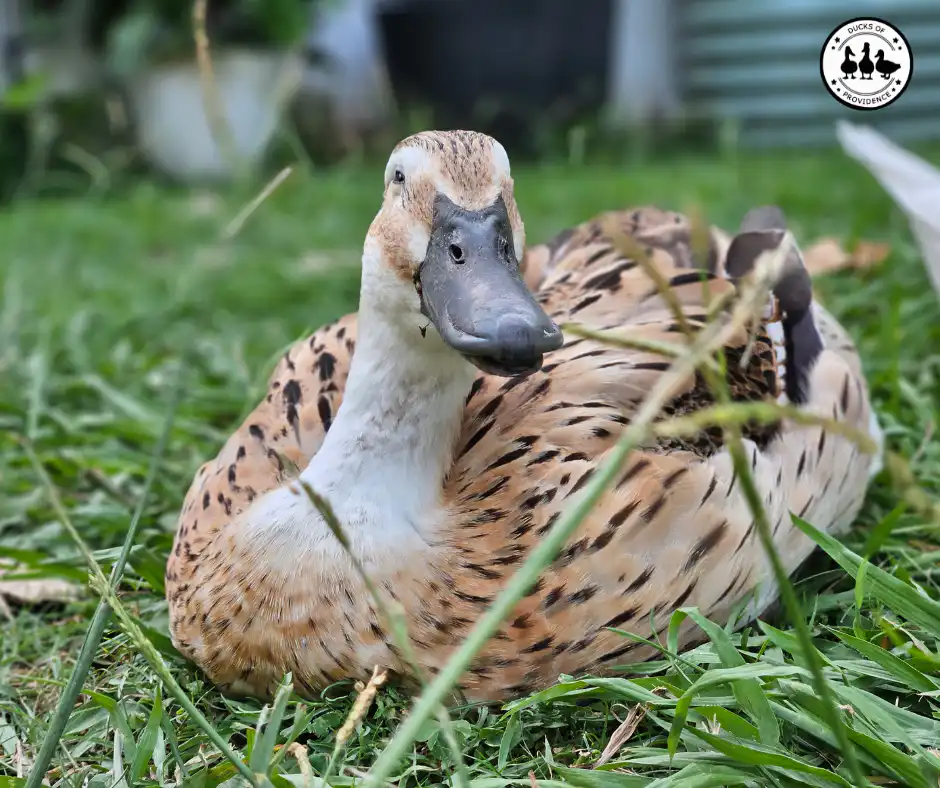
Why Is My Duck Sitting Down All the Time? 9 Reasons and When to Worry

To keep our research-backed guides free, this site uses ads and affiliate links (earning a small commission at no cost to you). Everything here is created by a duck mom and PhD scientist, combining academic rigor with hands-on experience to provide practical, trustworthy advice for duck keepers everywhere. 🦆 Learn more
If you have noticed that your duck is sitting down all the time, you may be wondering whether she is simply taking it easy or whether something is wrong. Ducks do spend a surprising amount of time sitting, resting, preening, and simply watching the world go by. In many cases, a duck plopped comfortably on the ground is perfectly normal.
But there is an important difference between a duck who chooses to sit and a duck who keeps sitting down because standing or walking is uncomfortable.
A duck that suddenly starts sitting more than usual, walks only a few steps before lowering herself to the ground, struggles to get back up, or seems reluctant to follow the rest of the flock may be experiencing foot pain, a leg or joint problem, arthritis, heat stress, reproductive trouble, illness, or generalized weakness.
As a duck owner, I pay particularly close attention to changes from an individual duck’s normal behavior. One duck may naturally be a champion lounger, while another is normally busy exploring the yard from morning until bedtime. If my normally active duck suddenly spends most of the day sitting, that change matters much more to me than the sitting itself.
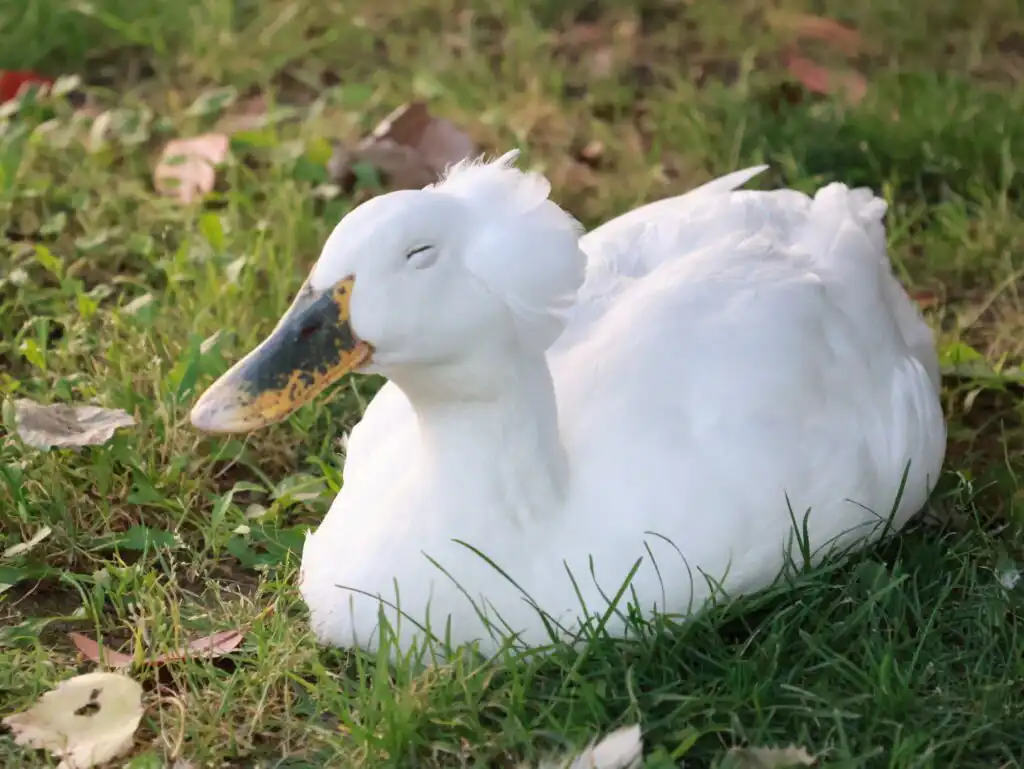
In this guide, we’ll look at why your duck may be sitting down a lot, how to tell normal duck resting from a potential health problem, what you can check at home, and the signs that mean it is time to contact a duck-savvy veterinarian.
The most important question is not simply, “Why is my duck sitting down all the time?” It is: Is my duck comfortably choosing to sit, or is something making it difficult or painful for her to stand?
Part of the Duck Health & Anatomy Hub, Evidence-based medical resources and anatomical research.
Quick Navigation: Jump to a Section
[hide]
- Quick Answer: Is It Normal for a Duck to Sit Down a Lot?
- 1. Your Duck Is Simply Resting
- 2. It Is Hot Outside
- 3. Your Duck Has Sore Feet or Bumblefoot
- 4. Your Duck Has a Leg or Joint Injury
- 5. Arthritis or Age-Related Joint Changes
- 6. Your Duck Is Overweight
- 7. Your Duck Is Laying, Broody, or Has a Reproductive Problem
- 8. Your Duck Is Sick or in Pain
- 9. Your Duck Is Weak or Has a Nutritional Problem
- Normal Sitting vs. Sitting Because Something Is Wrong
- What to Check When Your Duck Keeps Sitting Down
- When to Call Your Veterinarian
- From Our Flock: Penny and Arthritis
- Frequently Asked Questions
- Know What Is Normal for Your Duck
- Further Reading & Resources
Quick Answer: Is It Normal for a Duck to Sit Down a Lot?
Yes, it can be completely normal for a duck to sit down frequently. Healthy ducks naturally spend portions of the day resting, preening, sunbathing, or simply relaxing with their flock. A comfortable duck may tuck her feet underneath her body, settle her feathers, and happily remain in one spot for quite a while.
What matters most is whether the sitting behavior is normal for your individual duck.
If your duck suddenly starts sitting much more than usual, repeatedly walks a few steps and sits back down, falls behind the flock, has difficulty getting up, limps, or appears reluctant to put weight on one or both feet, something may be wrong.
Normal sitting: Your duck gets up easily, walks normally, eats and drinks, interacts with the flock, and willingly moves when something interesting happens.
Potentially concerning sitting: Your duck seems to need frequent breaks, hesitates to stand, walks abnormally, isolates herself, eats less, appears weak, or shows other changes in behavior.
A simple test I often use is to watch what happens when something normally gets my ducks excited, such as treats, fresh pool water, or the rest of the flock moving to another part of the yard. A duck who can get up but prefers to lounge is very different from a duck who wants to join in but seems physically unable or reluctant to do so.
1. Your Duck Is Simply Resting
Before assuming that something is wrong, remember one very important fact: ducks sit a lot.
Healthy ducks do not spend every waking minute waddling around the yard. Throughout the day, they naturally alternate between eating, foraging, swimming, bathing, preening, socializing, and resting. Sometimes the entire flock will settle down together, especially after a good meal, a bath, or an especially enthusiastic round of foraging.
A comfortably resting duck usually looks relaxed. She may:
- Tuck one or both feet underneath her body
- Fluff or slightly loosen her feathers
- Preen while sitting
- Rest her bill against her feathers
- Close her eyes or nap
- Stretch a leg or wing before settling back down
- Get up easily when she decides to move
You may also notice your ducks resting more at certain times of day. Mine often have periods when seemingly everyone decides that absolutely nothing productive needs to happen for the next hour. That is simply part of a duck’s normal daily rhythm.
Look at What Happens When Your Duck Gets Up
One of the best ways to distinguish normal resting from a mobility problem is to watch your duck transition from sitting to standing and then observe her first several steps.
A healthy duck should generally rise without obvious difficulty and walk with her usual gait. She should not repeatedly stumble, favor one leg, shift her weight dramatically, or immediately sit back down after taking only a few steps.
Also pay attention to motivation. If your duck has been lounging peacefully for 30 minutes but suddenly pops up and races toward a handful of peas, chances are she was simply enjoying a good rest.
By contrast, if she clearly wants to follow the flock or reach food but repeatedly sits back down, I would take a closer look.
Know Your Duck’s Normal
There is no single number of hours that tells us how much sitting is too much. Ducks have different personalities, ages, activity levels, and daily routines.
That is why I consider a change from normal behavior much more useful than comparing one duck with another.
If your duck has always been a professional lounger and otherwise walks normally, eats enthusiastically, maintains her weight, preens, swims, and participates in flock life, frequent sitting may simply be normal for her.
If your normally busy little troublemaker suddenly becomes a couch potato, however, that change deserves your attention.
2. It Is Hot Outside
If your duck seems to be sitting down more on a hot summer day, the temperature may be the reason.
Ducks can tolerate a range of environmental temperatures, but hot weather presents a particular challenge because birds do not sweat like we do. Instead, they rely on behavioral and physiological strategies to get rid of excess body heat. One of those strategies is simply reducing activity.
Walking, foraging, chasing flock mates, and other activities generate additional metabolic heat. When temperatures climb, it makes sense for a duck to slow down, find a shady spot, and conserve energy.
Here in North Texas, I see this change in my own flock every summer. During the hottest part of the day, my ducks are much more likely to sit quietly in the shade or near their water than wander around the yard. Once temperatures become more comfortable in the evening, activity often picks up again.
Signs Your Duck May Simply Be Hot
A duck responding to warm weather may:
- Spend more time sitting or resting
- Seek shade
- Stay close to drinking or bathing water
- Reduce activity during the hottest part of the day
- Hold her wings slightly away from her body
- Pant or breathe with an open bill when she becomes hotter
- Become more active again as temperatures decrease
Sitting itself can therefore be a normal behavioral response to heat. However, we need to distinguish a duck sensibly avoiding the afternoon heat from a duck developing heat stress.
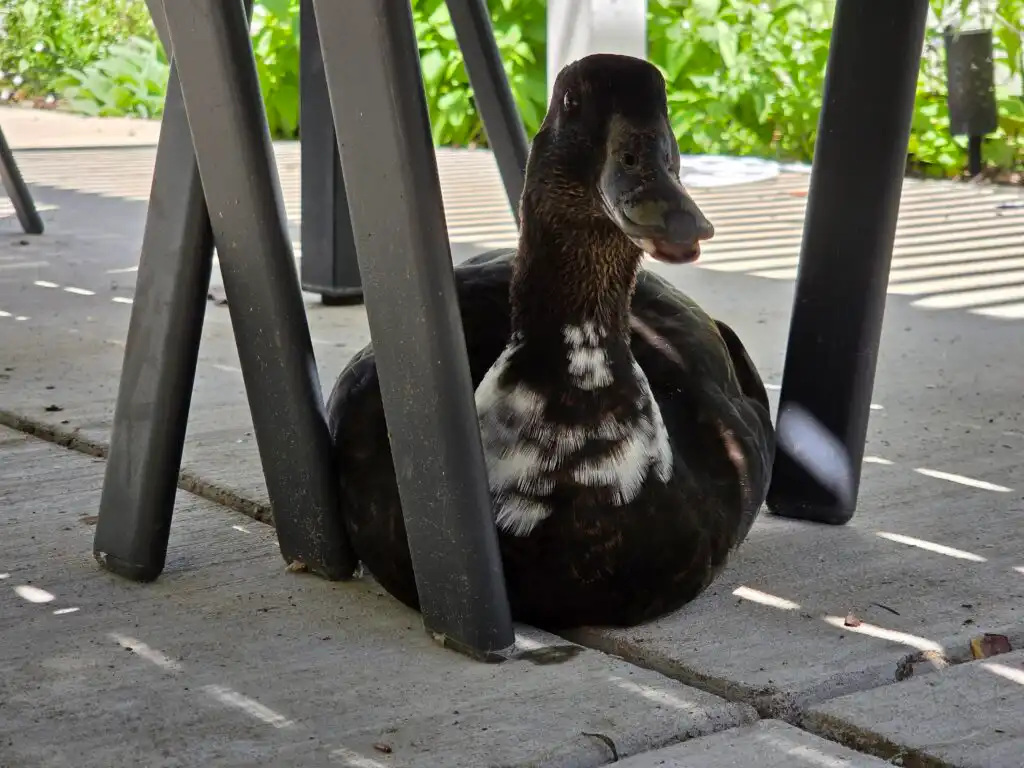
When Heat Becomes a Concern
A duck that is severely overheated may become increasingly weak and less responsive rather than simply relaxed. Persistent or pronounced open-bill breathing, significant weakness, loss of coordination, inability or reluctance to stand, drooping wings, or abnormal behavior should be taken seriously.
Pay particular attention when several signs occur together.
A duck sitting peacefully in the shade who gets up normally to drink or join the flock is very different from a duck who is panting heavily and appears too weak to move.
During hot weather, ducks should always have access to fresh drinking water, shade, good ventilation, and water that allows them to cool themselves. I also like to provide multiple water stations so a duck never has to compete for access when she needs it most.
From Our Flock
Texas summers have taught me that sometimes the smartest thing a duck can do is absolutely nothing. My flock may spend much of a scorching afternoon lounging in their favorite shady areas, only to come alive again once the sun starts going down. I pay less attention to the fact that they are sitting and more attention to how they look while they are sitting and what happens when they get back up.
If your duck’s increased sitting occurs primarily during the hottest part of the day and she otherwise eats, drinks, walks normally, and returns to her usual activity as temperatures cool, heat-related resting is a likely explanation. If the behavior continues during cooler periods or is accompanied by weakness, abnormal walking, or other symptoms, it is time to look for another cause.
3. Your Duck Has Sore Feet or Bumblefoot
If your duck repeatedly walks a short distance and then sits back down, check her feet. Foot pain is one of the first things I look for when a duck suddenly becomes less willing to stand or walk.
Ducks put a surprising amount of pressure on their feet. Unlike chickens, they spend much of their active time walking directly on the ground, often across wet, muddy, rough, or uneven surfaces. Even a relatively small area of irritation on the bottom of the foot can make weight-bearing uncomfortable.
One of the most common foot problems in domestic ducks is bumblefoot, also called pododermatitis.
What Is Bumblefoot?
Bumblefoot is inflammation and infection involving the foot pad. It can begin when the skin becomes damaged or chronically irritated, allowing bacteria to enter the underlying tissue. Pressure, inappropriate or abrasive surfaces, excessive body weight, poor sanitation, and small injuries can all contribute to its development.
Bumblefoot does not always begin as the dramatic swollen foot you may see in severe cases online. Early changes can be surprisingly subtle.
You may notice:
- A small dark spot or scab on the bottom of the foot
- Redness or irritation of the foot pad
- Thickened or callused skin
- Localized swelling
- Warmth
- Limping or an altered gait
- Shifting weight away from one foot
- Spending more time sitting
- Reluctance to walk long distances
As the condition progresses, deeper tissues can become involved, making treatment more difficult. This is one reason I strongly recommend regularly checking the bottoms of your ducks’ feet, even when nobody appears lame.
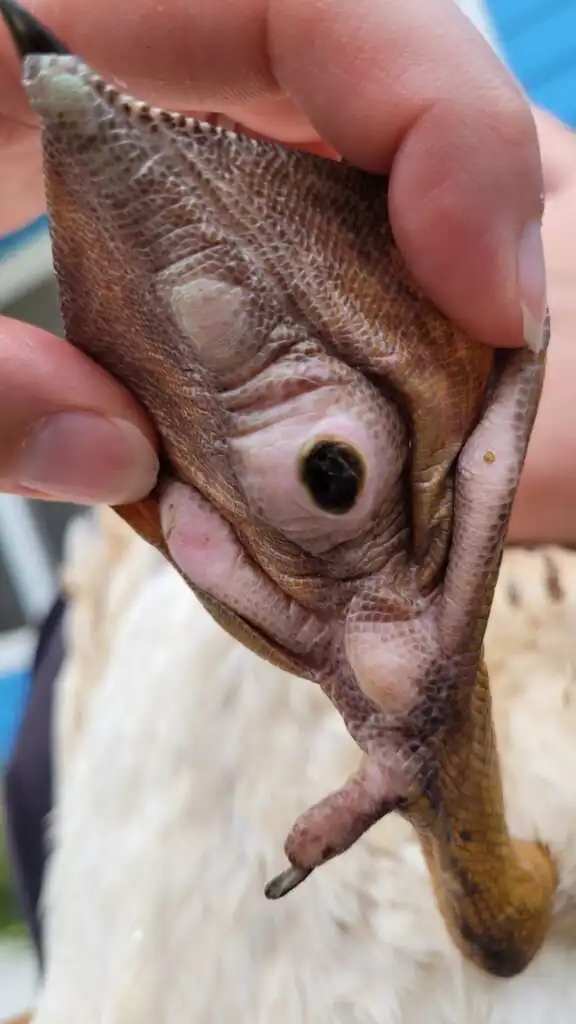
Why a Duck With Sore Feet May Keep Sitting Down
When standing hurts, sitting removes much of the pressure from the affected foot. A duck with mild foot pain may therefore still appear surprisingly normal when motivated.
She might get up for breakfast, hurry toward treats, take a swim, and follow the flock for a while. Then she sits down again.
That pattern can make an early foot problem easy to overlook. The duck is technically still able to walk, but she is choosing not to stay on her feet for very long because doing so is uncomfortable.
This is also why I would not rule out foot pain simply because your duck is not obviously limping.
Check Both Feet
If your duck has suddenly started sitting more, gently examine both feet, including the entire plantar surface, which is the underside of the foot.
Look closely at the central foot pad, toes, webbing, and nails. Compare the two feet for differences in swelling, temperature, color, or tenderness.
And do not stop looking once you find one abnormal spot. Ducks can develop problems on both feet, particularly when environmental conditions or excessive pressure contribute to the problem.
Duck Health Tip
Make foot checks part of your regular duck health routine rather than waiting until your duck starts limping. Catching a small area of irritation early is much easier than dealing with advanced bumblefoot later.
If you find redness, swelling, a suspicious scab, or another abnormality, the next step depends on how severe the lesion is. Do not automatically cut into or remove a bumblefoot scab at home. More advanced infections can extend into deeper structures of the foot and may require veterinary treatment.
For a detailed look at recognizing different stages, treatment options, bandaging, and prevention, see my complete Bumblefoot in Ducks guide.
And if your duck’s feet look completely normal but she continues to sit rather than walk, do not stop your investigation there. The problem may be higher up the leg or within a joint.
4. Your Duck Has a Leg or Joint Injury
If your duck’s feet look healthy but she keeps sitting down after walking, the problem may be farther up the leg. Injuries involving the legs, hips, or joints can make standing and walking uncomfortable even when there is nothing obviously wrong with the feet.
Ducks can injure themselves in surprisingly ordinary ways. They may slip on a wet surface, land awkwardly getting out of a pool, catch a leg on something, get stepped on, or hurt themselves during a disagreement with another flock member. Overmating can also cause leg or back injuries in female ducks, particularly when a drake repeatedly chases or mounts the same hen.
Possible signs of a musculoskeletal injury include:
- Limping
- Taking shorter or uneven steps
- Frequently sitting down while walking
- Favoring one leg
- Holding one leg slightly differently
- Standing with an unusual posture
- Reluctance to climb a ramp or step over obstacles
- Difficulty getting into or out of the pool
- Swelling around a joint
- Reduced activity
- Falling behind the flock
- Difficulty getting up after resting
However, not every injury produces an obvious limp.
Watch Your Duck Walk
If I suspect a leg problem, one of the first things I do is simply watch the duck walk on a flat, nonslip surface.
Look at her from behind as well as from the side. Are both legs moving symmetrically? Does she place equal weight on them? Does one foot turn differently? Is her body rocking more than usual? Does she take several normal steps and then suddenly sit?
It can also help to record a short video of your duck walking. Ducks have an adorably awkward gait even when completely healthy, and subtle abnormalities can be difficult to see in real time. Slowing down a video can make asymmetry much easier to spot. A video is also useful to show your veterinarian, particularly if your duck decides to walk perfectly normally the moment you arrive at the clinic.
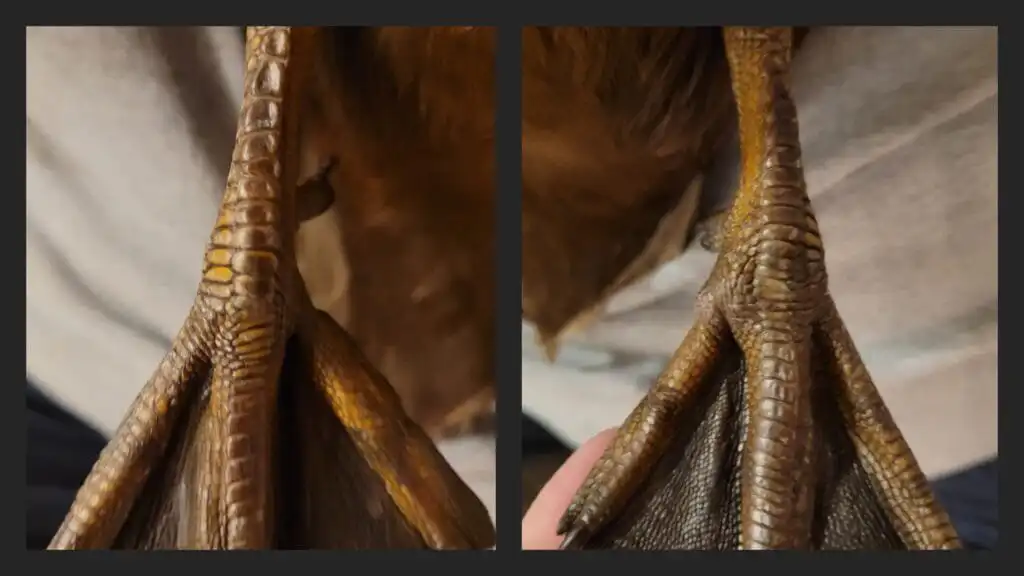
Gently Examine the Legs
After checking the feet, carefully work your way up each leg and compare one side with the other.
Look and feel for swelling, warmth, abnormal positioning, wounds, or obvious tenderness. Do not force a joint through its range of motion or repeatedly manipulate an area that appears painful.
Also remember that the visible portion of a duck’s leg is only part of the story. Problems involving structures higher in the limb or pelvis may not produce an obvious external abnormality.
Rest Can Help, but You Need to Know What You Are Treating
For a very mild suspected strain, reducing unnecessary activity and providing a small, safe space with good traction may help prevent further injury while you arrange appropriate care. Deep steps, slippery flooring, steep ramps, and difficult pool entrances should be avoided.
But prolonged confinement is not a substitute for determining why your duck cannot walk normally.
If your duck cannot bear weight on a leg, cannot stand, has significant swelling, an obviously abnormal limb position, severe pain, or suddenly loses the ability to walk, she should be evaluated by a veterinarian promptly. Fractures, dislocations, joint infections, tendon injuries, and neurological problems cannot reliably be distinguished from a simple sprain just by watching the duck at home.
Duck Mom Tip
When one of my ducks needs temporary activity restriction, I like using a soft sided playpen lined with towels or puppy pads. It limits running around while still giving the duck enough room to reposition herself comfortably. For a social animal like a duck, I also try to keep the recovery area where she can safely see or hear her flock whenever possible.
If the change happened suddenly, think back over the previous day or two. A fall, rough mating, predator encounter, flock fight, or awkward exit from the pool may provide an important clue.
If there was no obvious injury and the change has developed gradually, particularly in an older duck, we should consider another common cause of increased sitting: arthritis and chronic joint pain.
5. Arthritis or Age-Related Joint Changes
If your duck has gradually started sitting more as she gets older, arthritis or another chronic joint problem may be making prolonged standing and walking uncomfortable.
Arthritis involves inflammation and degeneration within a joint. Over time, changes to the cartilage and surrounding structures can result in pain, stiffness, and reduced mobility. Just as in people and other animals, these changes may develop slowly enough that they are easy to miss at first.
You may notice that your duck:
- Sits down more frequently
- Takes longer to get up after resting
- Appears stiff when she first starts walking
- Walks more slowly than she used to
- Takes shorter steps
- Has difficulty navigating ramps or obstacles
- Hesitates before getting into or out of the pool
- Falls behind the flock
- Is less interested in exploring or foraging
- Seems more active after she has been moving for a little while
One of the biggest clues is often a gradual change in activity rather than a dramatic limp.
Ducks Can Hide Chronic Pain
Ducks are prey animals, which means obvious weakness can make them vulnerable in the wild. As a result, they may continue eating, interacting with their flock, and participating in familiar routines despite discomfort.
This can make chronic pain surprisingly difficult to recognize.
An arthritic duck may still hurry over for her favorite treats. She may still swim enthusiastically. She may even walk normally for short periods. What changes is often how long she is willing to remain active before sitting back down.
That is why increased sitting can be an important clue.
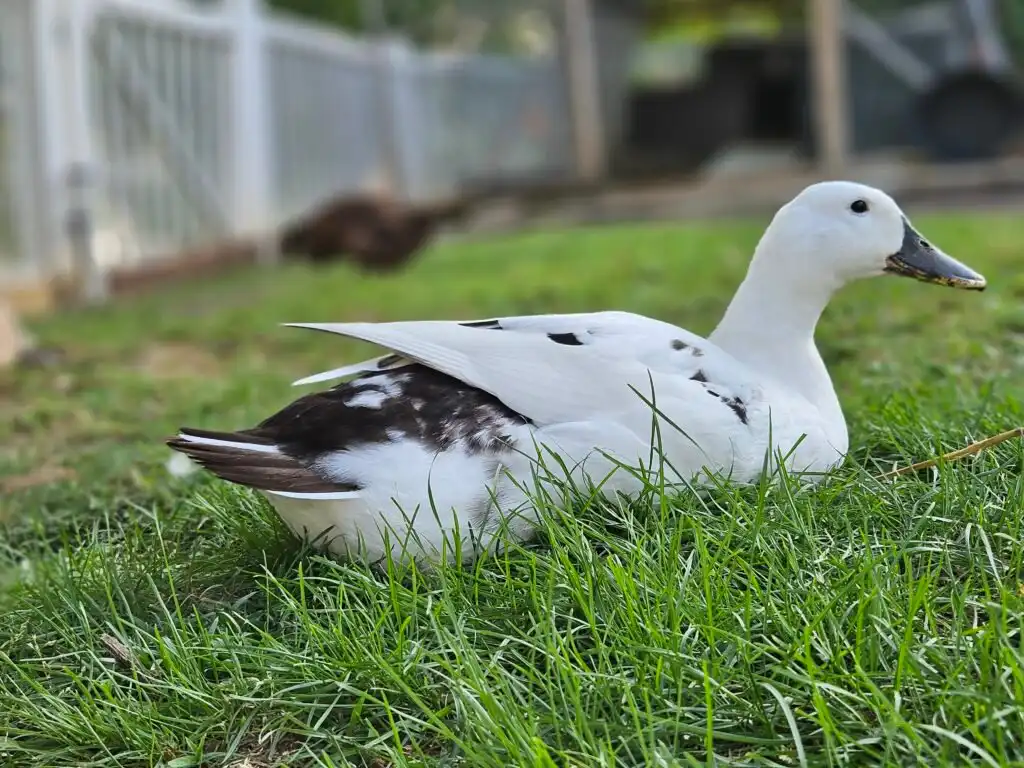
Make Daily Life Easier
Environmental changes can make a significant difference for a duck with reduced mobility. The goal is to allow her to continue behaving like a duck without requiring painful or difficult movements to do so.
Helpful modifications may include:
- Providing nonslip walking surfaces
- Using gentle ramps rather than steep steps
- Keeping food and water easily accessible
- Providing comfortable, dry resting areas
- Making pool entrances and exits easier
- Reducing unnecessary distances between important resources
- Keeping nails appropriately trimmed if they become overgrown
Swimming can be especially valuable for ducks with mobility problems because the water supports much of their body weight. However, an arthritic duck also needs to be able to enter and exit the water safely. A beautiful pool is not very helpful if getting out of it requires an Olympic-level climbing event.
Pain Management Matters
Chronic pain should not simply be accepted as an unavoidable part of getting older.
If arthritis is suspected, an avian veterinarian can help determine whether joint disease is actually responsible for the change in mobility and discuss appropriate treatment. Depending on the individual duck, management may include environmental modifications, weight management when appropriate, treatment of underlying conditions, and veterinary-prescribed pain medication.
Never give human pain medications such as ibuprofen or acetaminophen to a duck unless a veterinarian specifically directs you to do so. Medication choice and dosing in birds require veterinary guidance.
For a much deeper discussion of recognizing discomfort and the medications veterinarians may use, see my guide to Pain Management in Ducks.
From Our Flock
Penny developed arthritis as she got older, and one of the things that became increasingly obvious was that mobility is not simply a question of whether a duck can walk. A duck may still walk, eat, swim, and participate in flock life while quietly modifying how much she moves because movement has become uncomfortable. Pain management and making her environment easier to navigate became an important part of keeping her comfortable.
Older ducks may naturally slow down somewhat, but age alone should not be used to dismiss a significant change in mobility. If your senior duck is suddenly sitting much more, struggling to rise, or no longer participating in activities she previously enjoyed, it is worth investigating why.
The goal is not simply to keep an older duck moving. It is to help her remain comfortable, engaged, and able to enjoy the behaviors that make her life a good duck life.
6. Your Duck Is Overweight
Extra body weight can also make a duck sit down more frequently, particularly when excess weight places additional strain on the feet, legs, and joints.
Ducks already carry their bodies on relatively short legs, and every additional bit of weight increases the mechanical load those legs must support. Over time, excess body condition may contribute to reduced mobility and can make existing problems such as arthritis or bumblefoot even more uncomfortable.
An overweight duck may:
- Sit down frequently during periods of activity
- Tire more quickly when walking
- Fall behind more active flock members
- Be reluctant to walk longer distances
- Have difficulty navigating ramps or obstacles
- Spend more time resting
- Develop or worsen foot and joint problems
However, determining whether a duck is overweight is not always as simple as putting her on a scale.
Do Not Rely on Breed Weight Alone
Breed weight charts can provide a useful general reference, but they cannot tell you whether an individual duck is overweight.
There can be substantial variation between healthy ducks of the same breed. Sex, age, genetics, body size, muscle mass, and even whether your duck actually matches the breed you think she does can influence body weight.
This is especially important for rescued ducks and mixed breeds, where we may have no idea what their ideal breed weight is supposed to be.
Instead, I prefer to look at body condition together with weight trends over time.
Your veterinarian can assess the muscles around the keel and overall body condition to determine whether your duck is carrying excessive fat, has good muscle mass, or may actually be underweight despite appearing round and fluffy.
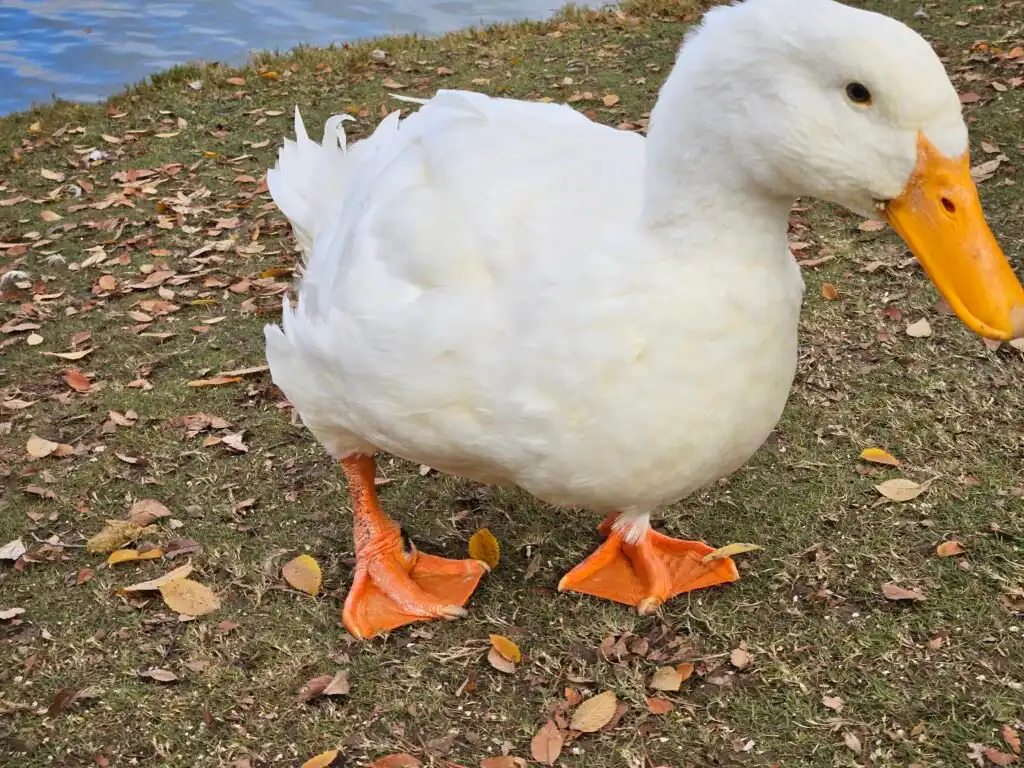
Regular Weigh Ins Give You a Better Baseline
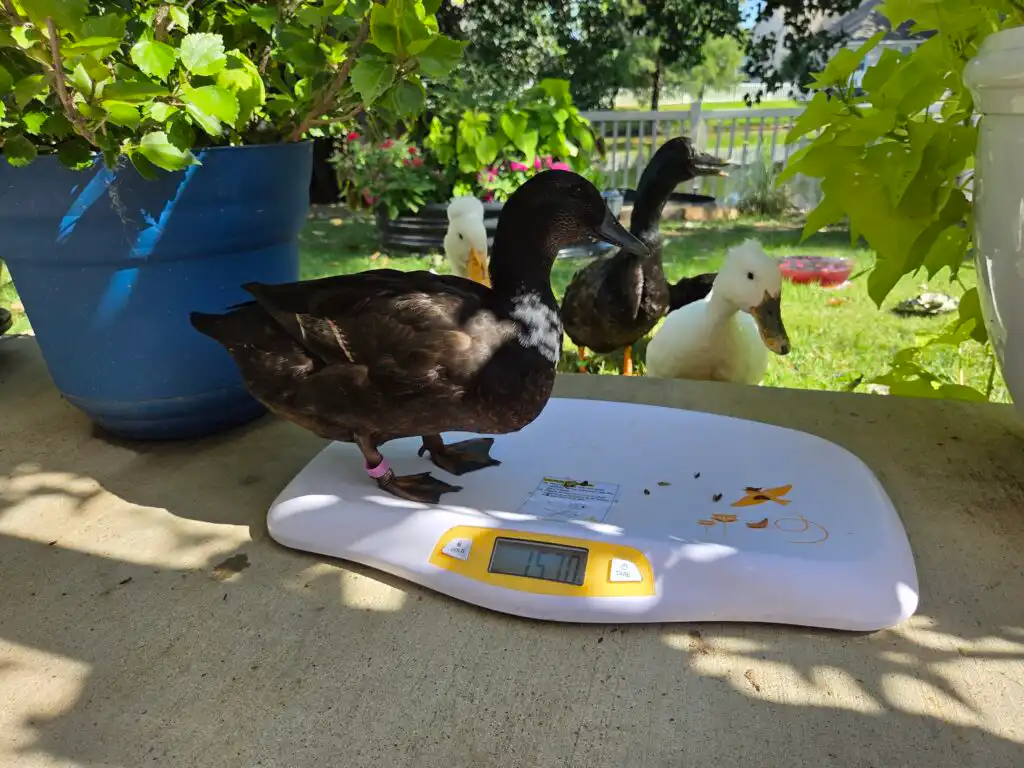
I recommend weighing pet ducks regularly and keeping a simple record for each bird. In our flock, I aim for monthly weigh-ins using a digital baby scale.
Over time, those measurements establish something much more useful than a generic breed chart: your duck’s individual baseline.
For example, a duck who consistently weighs around the same amount and maintains good body condition may be perfectly healthy at a weight that looks high or low compared with an online breed average. A gradual upward trend, however, can tell you that something is changing.
The same is true in the opposite direction. Unexpected weight loss is often more concerning than a duck being slightly heavier than a breed chart suggests.
Duck Mom Tip
A digital baby scale makes weighing adult ducks surprisingly easy. I place the duck directly on the scale, record the weight, and compare it with her previous measurements. Monthly weigh ins take only a few minutes and can reveal gradual changes that are very difficult to notice underneath all those feathers.
Treat the Cause, Not Just the Number on the Scale
If your duck truly is overweight, avoid dramatically restricting food without first looking at the entire diet and management routine.
Start by considering:
- What complete feed is she eating?
- Are treats contributing significant extra calories?
- Does she have opportunities to forage and move throughout the day?
- Is another health problem limiting her activity?
- Is she being fed alongside ducks with very different nutritional needs?
Any weight reduction should be gradual and nutritionally balanced. Ducks still require adequate protein, vitamins, minerals, and other nutrients, so simply feeding substantially less of a complete diet can create new problems.
And if an overweight duck suddenly starts sitting much more than usual, do not assume her weight explains everything. Excess body weight may contribute to discomfort, but a sudden mobility change still deserves investigation for foot problems, injuries, arthritis, or illness.
7. Your Duck Is Laying, Broody, or Has a Reproductive Problem
For female ducks, increased sitting can sometimes be connected to the reproductive system. The challenge is that reproductive behavior ranges from completely normal to potentially life-threatening, so the surrounding signs matter.
A laying hen may occasionally seem quieter or spend more time resting around the time she produces an egg. Hormonal changes can also alter behavior during the breeding season.
And then there are broody ducks, who take sitting to an entirely different level.
Is Your Duck Broody?
A broody hen wants to incubate a clutch of eggs. Once she commits to a nest, spending most of her time sitting is exactly what we would expect.
Signs of broodiness can include:
- Remaining on the nest for long periods
- Returning quickly when removed
- Flattening herself over the eggs
- Becoming unusually protective of the nest
- Hissing, vocalizing, or attempting to bite when approached
- Pulling down feathers to line the nest
- Leaving primarily to eat, drink, bathe, and defecate
A broody duck sitting for hours on her nest is very different from a duck who walks into the yard, takes five steps, and sits because she seems unable to continue.
Context is everything.
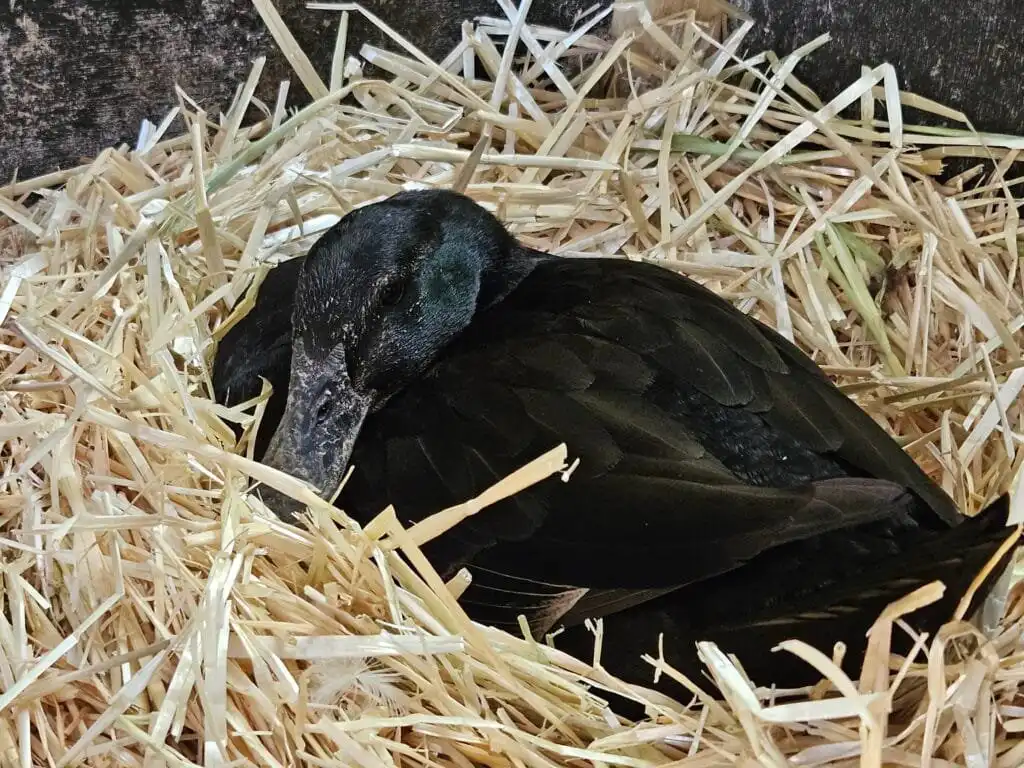
Reproductive Problems Can Also Cause Increased Sitting
Unfortunately, increased sitting can also occur when a hen is experiencing a reproductive problem.
Conditions involving the reproductive tract may cause pain, abdominal discomfort, weakness, or difficulty moving normally. Depending on the underlying problem, you may notice additional signs such as:
- Repeated straining
- Spending unusual amounts of time in the nest without producing an egg
- A widened or unusual stance
- Tail pumping
- Reduced appetite
- Abdominal enlargement
- Changes in droppings
- Lethargy
- Difficulty walking
- Spending considerably more time sitting
- A sudden reduction or change in egg production
These signs should not automatically be interpreted as egg binding. Ducks can develop several reproductive disorders, and you cannot reliably determine the cause from sitting behavior alone.
Pay Attention to Her Abdomen and Posture
If one of my hens suddenly begins sitting much more than usual, reproductive history is always part of what I consider.
Is she actively laying? When was her last egg? Has her laying pattern changed? Does her abdomen look or feel different? Is she repeatedly visiting the nest? Is she straining? Has her posture changed?
These observations can provide valuable information for your veterinarian.
However, avoid repeatedly pressing or squeezing the abdomen in an attempt to find an egg. Aggressive manipulation can cause injury, and not every reproductive problem involves an egg that can be felt externally.
Duck Health Tip
Keeping a simple record of your hens’ egg production can be surprisingly useful. When something changes, knowing what is normal for that individual duck gives you much better information than trying to remember whether she laid yesterday, three days ago, or sometime last week.
When Reproductive Signs Are an Emergency
A hen who is repeatedly straining, severely lethargic, unable to stand, having difficulty breathing, showing significant abdominal swelling, or rapidly declining needs prompt veterinary attention.
Reproductive disease can become serious quickly, and waiting for a duck to just lay the egg is not always safe.
Normal laying behavior and broodiness can certainly explain why a female duck is sitting more. But if your hen is sitting because she appears weak, painful, or physically unable to remain standing, treat that as a health concern rather than normal reproductive behavior.
8. Your Duck Is Sick or in Pain
Sometimes a duck sitting down all the time has nothing visibly wrong with her feet or legs. Instead, reduced activity may be one of the first signs that she is sick or in pain.
This is particularly important with ducks because they can be remarkably good at hiding illness. As prey animals, birds have an evolutionary advantage in concealing weakness for as long as possible. By the time a duck looks obviously sick, the underlying problem may already be significant.
That is why I take subtle behavioral changes seriously, especially when I know that duck well.
A duck who normally spends her mornings digging through the mud, following her flock mates, and investigating everything in sight but suddenly spends hours sitting in one place is telling you something, even if you cannot immediately see what is wrong.
Look Beyond the Sitting
Sitting more is a very nonspecific symptom. It does not tell us what is wrong, but it can tell us that we should look more closely.
Watch for other changes such as:
- Eating less than usual
- Drinking substantially more or less
- Changes in droppings
- Weight loss
- Spending less time preening
- Separating from the flock
- Sleeping more during the day
- Keeping the eyes partially or completely closed
- Fluffed or poorly maintained feathers
- Unusual breathing
- Tail bobbing while breathing
- Changes in vocalization
- Reduced interest in treats or favorite activities
- An unusual posture
- Weakness or difficulty standing
One isolated sign does not necessarily mean your duck is seriously ill. Several subtle changes occurring together are much more meaningful.
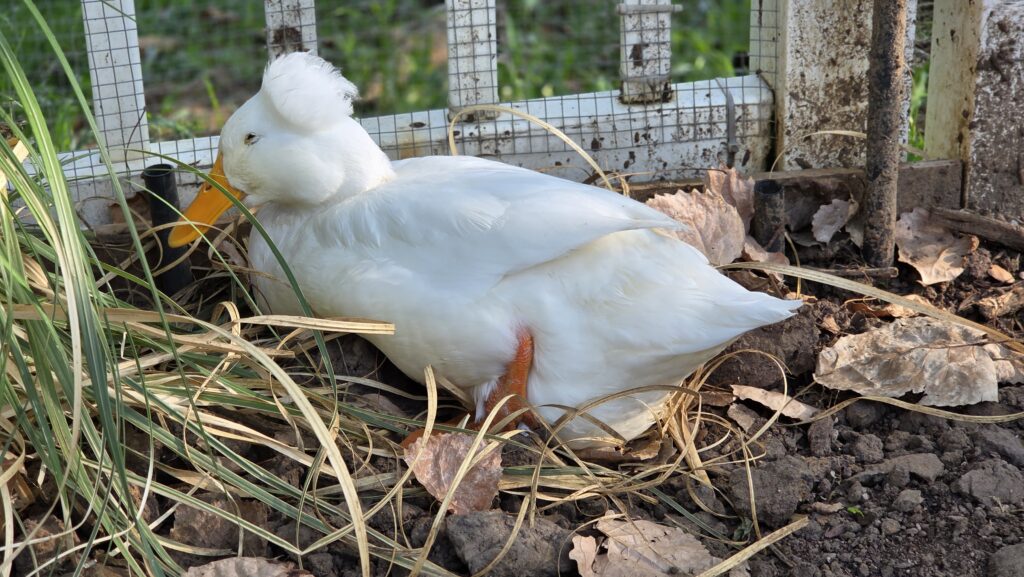
Pain Does Not Always Look Dramatic
Pain in ducks can also be easy to underestimate.
We often imagine that an animal in pain will cry out or make the source obvious. Ducks frequently do neither. Instead, pain may appear as a change in behavior.
A painful duck may simply move less, sit more, interact less, or avoid activities that have become uncomfortable.
The source of that pain could be musculoskeletal, reproductive, gastrointestinal, related to an injury, or associated with another underlying disease. This is why sitting more should be considered in the context of the whole duck, rather than focusing only on the legs.
For a deeper look at subtle signs of discomfort and how veterinarians manage it, see my complete guide to Pain Management in Ducks.
A Normal Appetite Does Not Completely Rule Out a Problem
One mistake I see frequently is assuming that a duck cannot be sick because she is still eating.
Appetite is certainly reassuring, and a duck who stops eating deserves prompt attention. But ducks can continue eating during the early stages of illness or while experiencing significant discomfort.
The same is true for treats. A duck enthusiastically accepting mealworms does not automatically receive a clean bill of health. Ducks can be remarkably committed to snacks.
Instead, look at the complete picture. Is she eating her normal amount of complete feed? Is she maintaining her weight? Is she interacting normally? Is she preening? Does she walk comfortably? Has anything else changed?
Duck Health Tip
This is why knowing your individual ducks matters so much. You do not need sophisticated equipment to notice that a duck who normally follows you everywhere suddenly stays behind. Behavior is health information. When something feels different, take a few minutes to observe your duck closely and perform a basic health check.
If your duck is sitting much more than usual and you cannot identify an obvious benign explanation, I recommend taking the change seriously. Check her from head to toe, weigh her if possible, monitor food and water intake, observe her droppings, and watch how she walks.
If she is becoming progressively less active, stops eating, isolates herself, has abnormal breathing, appears painful, cannot stand normally, or develops additional symptoms, contact a duck-savvy veterinarian promptly.
Sometimes the first clue that a duck is sick is not a dramatic symptom at all. It is simply that she is not behaving like herself.
9. Your Duck Is Weak or Has a Nutritional Problem
If your duck keeps sitting down because she does not have the strength or stamina to remain standing, it is important to consider generalized weakness and nutritional problems.
This is different from a duck who sits because one foot or joint hurts. A weak duck may appear unstable on both legs, tire very quickly, have difficulty rising, or simply seem as though supporting her own body requires more effort than it should.
Possible signs of weakness include:
- Frequently sitting or lying down
- Difficulty getting up
- Trembling or shaky legs
- Poor balance
- Walking only short distances
- Falling behind the flock
- Reduced appetite
- Weight loss
- Loss of muscle around the keel
- Spending more time sleeping
- Reduced interest in normal activities
Weakness itself is not a diagnosis. It is a sign that something else may be wrong.
Could It Be a Nutritional Deficiency?
Nutrition certainly can affect mobility in ducks, particularly during periods of rapid growth. Ducklings have substantial nutritional requirements while their bones, muscles, tendons, and nervous system are developing.
Niacin is especially important for ducks, and inadequate niacin can contribute to leg and mobility problems in growing ducklings. This is one reason I recommend feeding ducklings a complete feed formulated to meet their nutritional requirements rather than trying to construct a diet from individual ingredients.
However, there is an important distinction here.
Not every duck with weak legs has a niacin deficiency.
Niacin has become something of an internet catch-all for duck mobility problems. When a duck limps, sits frequently, or has difficulty walking, the immediate recommendation is often to give more niacin.
That can be misleading, particularly in an adult duck already eating a nutritionally complete diet.
Foot infections, injuries, arthritis, reproductive disease, systemic illness, neurological disorders, toxins, and other medical problems can all affect a duck’s ability to stand or walk. Automatically assuming niacin deficiency may delay the diagnosis of the actual problem.
Look at the Entire Diet
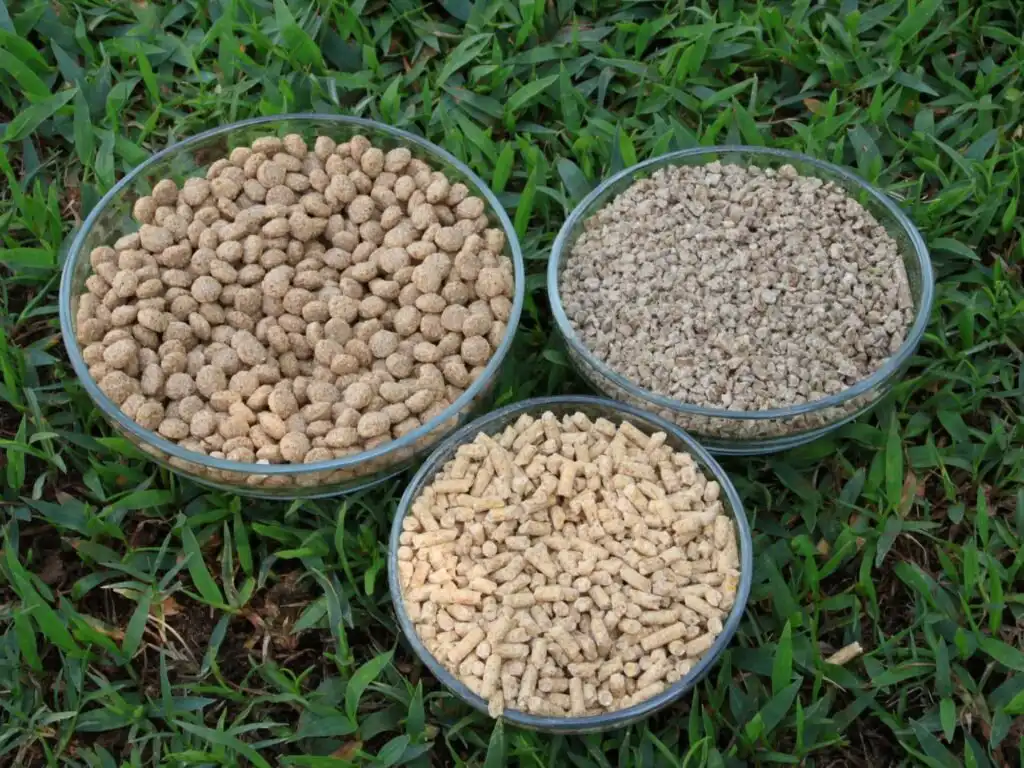
If nutrition is a concern, evaluate what your duck is actually eating over the course of the day.
A complete commercial duck or appropriate poultry feed should make up the foundation of the diet. Treats, scratch grains, mealworms, vegetables, fruit, and other extras can certainly have a place, but they should not displace so much complete feed that the overall diet becomes unbalanced.
This is particularly important with ducks who are exceptionally persuasive about snacks. A duck may confidently tell you that mealworms constitute a complete and balanced diet. Nutritionally speaking, she would be incorrect.
For a deeper look at what ducks actually require, see my guide to Duck Nutritional Needs, as well as my Commercial Duck Food Comparison for a closer look at commonly available feeds.
Weight Loss Is an Important Clue
One of the most useful things you can do when a duck appears weak is weigh her.
Feathers can hide substantial changes in body condition. A duck may look almost identical from the outside while losing meaningful amounts of body mass and muscle.
Compare her current weight with previous measurements whenever possible. This is another reason I am such a strong advocate for establishing an individual baseline with regular weigh-ins.
Also gently assess body condition around the keel. A prominent keel with reduced muscle on either side can indicate loss of body condition even when all those fluffy feathers make the duck look perfectly round.
Duck Health Tip
If your duck suddenly seems weak, do not rely only on whether she is still eating. Get an actual weight whenever possible. A measurable downward trend can provide an important early clue that something more significant is happening.
Sudden Weakness Deserves Prompt Attention
Nutritional deficiencies generally develop over time. A duck who suddenly becomes weak or unable to stand should not automatically be treated as a nutritional problem.
Sudden weakness can have many causes and may require urgent veterinary evaluation.
If your duck cannot stand, repeatedly falls over, develops neurological signs, stops eating or drinking, loses weight rapidly, has difficulty breathing, or becomes progressively weaker, contact a duck-savvy veterinarian promptly.
Ultimately, whether the cause is nutritional or something entirely different, a duck who repeatedly sits because she physically cannot remain standing is showing us something very different from a healthy duck enjoying an afternoon nap.
And that distinction brings us to the most useful question we can ask throughout this entire article: What does normal sitting look like, and how can you tell when it has become a warning sign?
Normal Sitting vs. Sitting Because Something Is Wrong
By this point, you have probably noticed that sitting itself is not the problem. Ducks sit for all kinds of perfectly normal reasons. What matters is how your duck behaves before, during, and after she sits.
This quick comparison can help you decide whether you are watching a relaxed duck or one who may need a closer look.
| What to Watch | Normal Resting | Potential Health Problem |
|---|---|---|
| Posture | Relaxed, comfortable, feet tucked underneath | Unusual posture, leaning, repeatedly shifting weight, or difficulty getting comfortable |
| Getting up | Stands easily when motivated | Hesitates, struggles, uses wings for support, or cannot stand |
| Walking | Normal gait once standing | Limping, stumbling, weakness, short steps, or repeatedly sitting after a few steps |
| Appetite | Eats normally and eagerly approaches food | Reduced appetite, stops eating, or only accepts favorite treats |
| Drinking | Normal for that individual duck | Noticeably increased or decreased drinking |
| Flock behavior | Rests with the flock and joins them when they move | Falls behind, isolates herself, or wants to follow but cannot |
| Preening | Continues normal grooming | Reduced preening or poorly maintained feathers |
| Breathing | Quiet and effortless | Open bill breathing unrelated to heat, pronounced tail bobbing, or increased respiratory effort |
| Feet and legs | No obvious abnormalities | Swelling, wounds, scabs, heat, tenderness, or abnormal positioning |
| Body condition | Weight and body condition remain stable | Unexplained weight loss or loss of muscle |
| Other symptoms | Alert and behaving normally when awake | Lethargy, abnormal droppings, reproductive signs, neurological changes, or other unusual behavior |
One sign by itself rarely tells us the whole story. A duck resting for several hours but otherwise eating, walking, swimming, preening, and arguing over snacks is very different from a duck who sits quietly while the rest of the flock walks away.
Look at the whole duck, not just the sitting.
What to Check When Your Duck Keeps Sitting Down
If one of my ducks suddenly starts sitting more than usual, I like to work systematically rather than immediately assuming the worst. A simple head-to-toe health check can reveal surprisingly subtle problems.
1. Watch Her Before You Pick Her Up
Observation is incredibly valuable because handling can change a duck’s behavior.
Watch her get up and walk. Does she rise easily? Is she bearing weight equally on both legs? Is there a limp? Does she stumble? Does she walk normally for several steps and then immediately sit again?
Also watch how she interacts with the flock. Does she voluntarily stay behind, or does she appear to want to follow but struggle to keep up?
2. Check Both Feet
Examine the bottoms of both feet for:
- Redness
- Swelling
- Dark spots or scabs
- Cuts or punctures
- Thickened areas
- Abnormal warmth
- Problems involving the toes, webbing, or nails
Even a relatively small foot lesion can make prolonged standing uncomfortable.
3. Examine the Legs and Joints
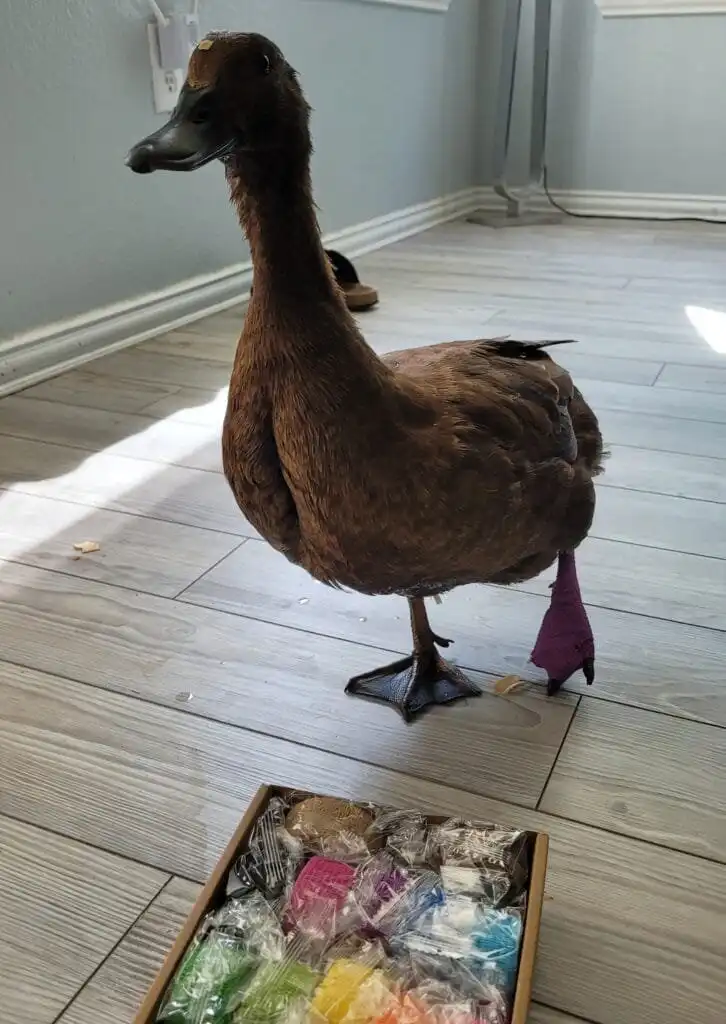
Gently compare both legs. Look for swelling, heat, wounds, abnormal positioning, or obvious tenderness.
Do not aggressively flex, extend, or manipulate a painful joint. If you suspect a fracture, dislocation, or significant injury, unnecessary manipulation can make matters worse.
4. Check Weight and Body Condition
This is one of the most useful objective measurements you can collect at home.
Feel the area around the keel and assess the muscle on either side. Then weigh your duck and compare that number with previous measurements if you have them.
A single number is useful. A trend is much more useful.
Duck Mom Tip
I weigh every duck in our flock about once a month using a digital baby scale. It gives me an individual baseline for each bird and makes subtle changes much easier to recognize.
Imagine a duck who seems to be just sitting more, but when you put her on the scale you discover that she has quietly lost 10 percent of her usual body weight. Suddenly, that behavioral change carries much more weight.
5. Look at the Droppings
Duck poop varies tremendously depending on diet, water intake, stress, and whether the duck has recently been eating or drinking.
You are looking primarily for changes from your duck’s normal pattern, especially when they occur alongside other symptoms.
Pay attention to unusual color, consistency, frequency, blood, undigested material, or a dramatic change in the amount of feces being produced.
6. Assess Appetite and Drinking
Do not ask only whether your duck accepts treats.
Watch whether she is eating her normal complete feed, and approximately how much she consumes. A duck who still grabs a mealworm but barely touches her regular food may already have a reduced appetite.
Also note significant changes in water consumption.
7. Watch Her Breathing
At rest, breathing should appear relatively effortless.
Watch for open bill breathing when your duck is not hot, increased respiratory effort, unusual sounds, or pronounced movement of the tail with each breath.
Respiratory difficulty combined with weakness or reluctance to stand deserves prompt attention.
8. Consider Reproductive Signs
For hens, think about recent egg production.
Has she laid normally? Is she repeatedly visiting the nest? Is she straining? Does her abdomen appear enlarged? Has her stance changed? Has egg production suddenly stopped?
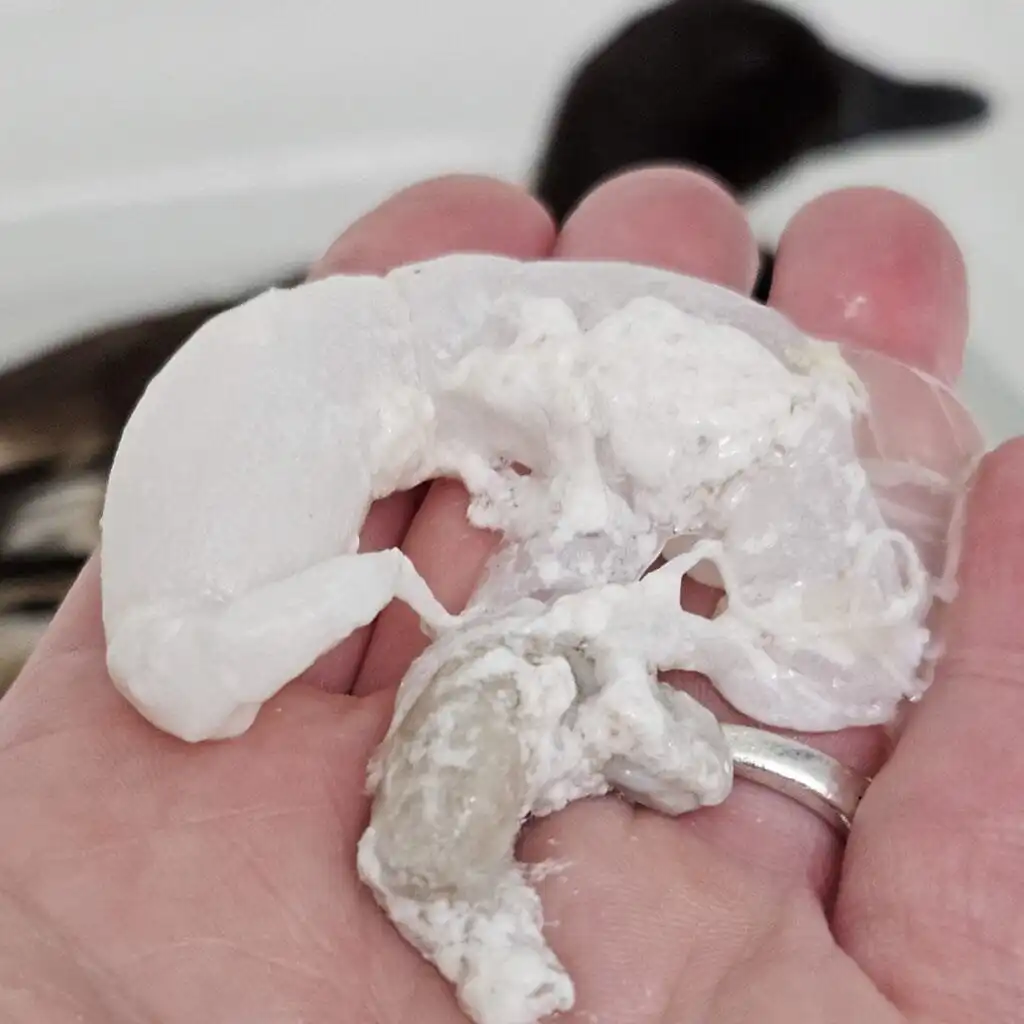
Reproductive problems can cause pain and weakness that initially appear simply as my duck keeps sitting down.
9. Step Back and Look at the Whole Duck
Finally, ask yourself a simple question:
Is she acting like herself?
You know your flock better than anyone who sees your duck for five minutes in an examination room. A subtle change in personality, activity, appetite, social behavior, or routine can be medically meaningful.
If something feels different, document what you are seeing. Record her weight, take photos of anything abnormal, and capture a short video of her walking. Those records can be extremely useful if veterinary care becomes necessary.
When to Call Your Veterinarian
Not every duck who sits more needs an emergency veterinary visit. But increased sitting becomes much more concerning when it occurs alongside other signs of illness, injury, or pain.
I would contact a duck-savvy veterinarian promptly if your duck:
- Cannot stand or repeatedly collapses
- Suddenly loses the ability to walk normally
- Has severe or worsening lameness
- Will not bear weight on one leg
- Has significant swelling or a hot, painful joint
- Has a deep wound, major injury, or suspected fracture
- Develops loss of balance, head tilt, seizures, paralysis, or other neurological signs
- Shows labored breathing
- Stops eating or drinking normally
- Loses a significant amount of weight
- Is repeatedly straining or showing other concerning reproductive symptoms
- Becomes markedly lethargic or unresponsive
- Experiences a sudden, major change from her normal behavior
I would also seek veterinary guidance when a mild mobility problem does not improve or continues to worsen, even if your duck is still eating and walking.
Ducks can compensate remarkably well. The fact that a duck can walk does not necessarily mean walking is comfortable.
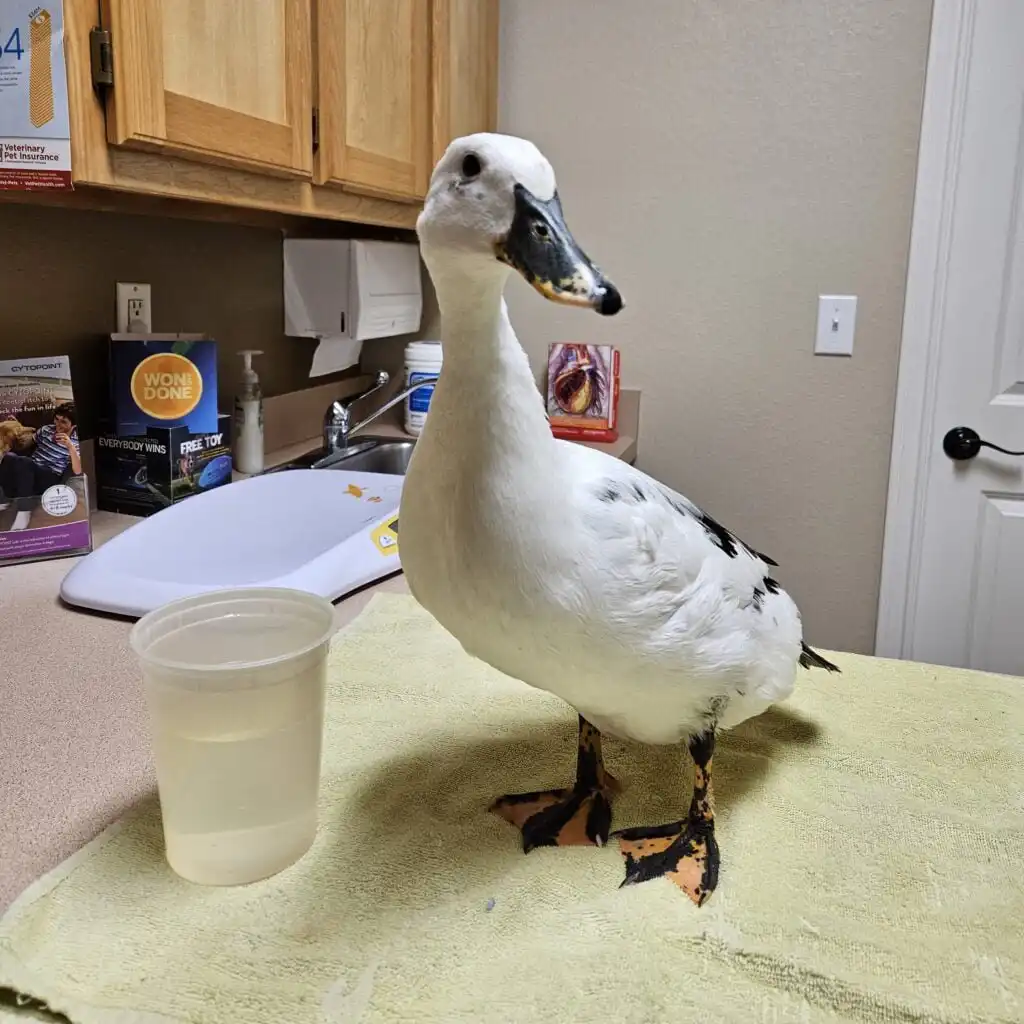
If possible, bring your veterinarian a recent weight, information about appetite and egg production, photos of any visible abnormalities, and a video showing how your duck walks at home. These little pieces of information can be extremely helpful when trying to determine what is going on.
Need a Duck Savvy Veterinarian?
Finding a veterinarian who is comfortable treating ducks can be challenging. The Association of Avian Veterinarians (AAV) offers a searchable Find a Vet directory that lets you look for avian veterinarians by location.
Find an avian veterinarian near you: AAV Find a Vet Directory
When you call, I recommend confirming that the veterinarian specifically sees ducks or backyard poultry, since not every avian practice treats all bird species.
From Our Flock: Penny and Arthritis
Penny taught me a lot about the difference between being able to walk and being comfortable walking.
As she got older, she developed arthritis. Her mobility changes were not necessarily dramatic. She could still get up. She could still walk. She still participated in flock life. But over time, we noticed that she was choosing to sit more frequently and was less willing to remain on her feet for long periods.
That is one of the challenges with recognizing chronic pain in ducks. It does not always look like an obvious injury.
There may be no dramatic moment when you suddenly realize your duck is in pain. Instead, you notice that she rests a little more. She does not walk quite as far. She takes longer to get up. Maybe she decides that whatever the other ducks are investigating across the yard simply isn’t worth the waddle anymore.
For Penny, those small changes mattered.
We worked with our veterinarian to manage her arthritis and pain, while also paying attention to her environment and daily comfort. The goal was never to force her to be as active as a younger duck. The goal was to make it easier and more comfortable for her to continue doing the things she enjoyed.
Her experience also reinforced something I now tell other duck owners frequently: do not dismiss mobility changes simply because a duck is getting older.
Slowing down may come with age, but pain deserves attention at any age.
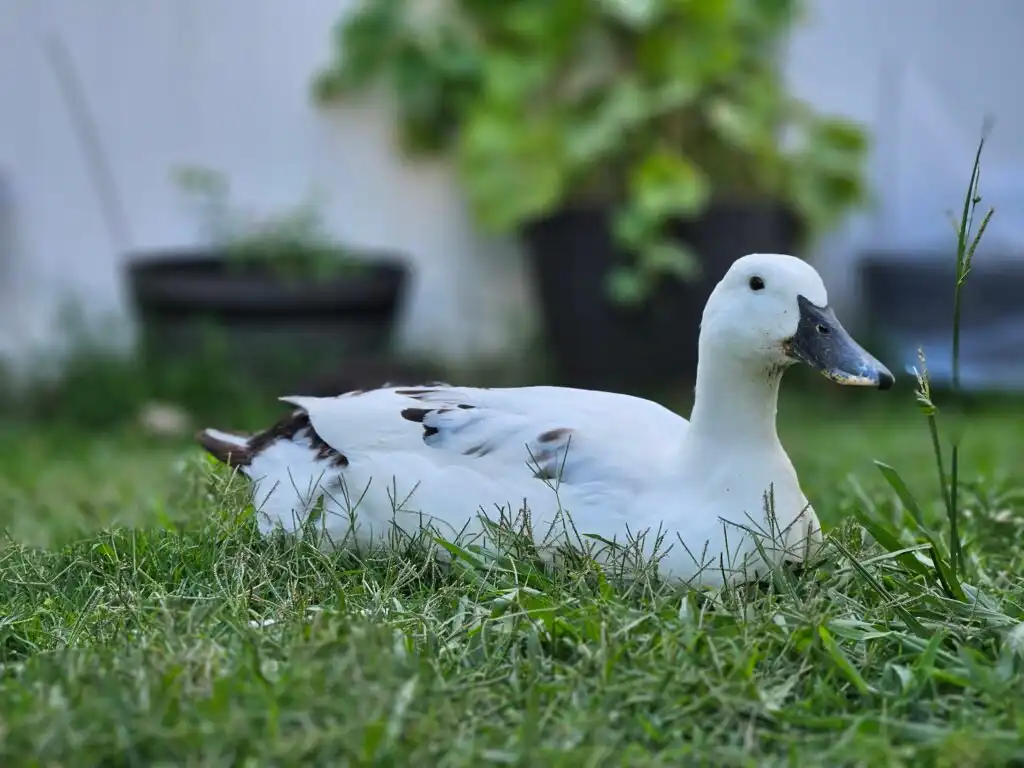
If you have an older duck who is sitting more, struggling to get up, or gradually participating less in flock activities, talk with your veterinarian about whether chronic pain or arthritis could be contributing. My guide to Pain Management in Ducks also explains the subtle ways ducks can show discomfort and the treatment options an avian veterinarian may consider.
Penny reminded me that quality of life is found in the little things: being able to get to the pool, enjoying a favorite snack, sitting comfortably beside flock mates, and choosing when to rest because you want to, not because standing hurts.
Frequently Asked Questions
Is it normal for ducks to sit down a lot?
Yes. Healthy ducks naturally spend a significant amount of time sitting and resting throughout the day. They may sit while sleeping, preening, sunbathing, digesting a meal, or simply relaxing with their flock.
The more important question is whether your duck is sitting more than usual or appears reluctant to stand. A duck who gets up easily, walks normally, eats well, and participates in flock activities is probably simply resting. A sudden change in activity deserves a closer look.
Why does my duck walk a few steps and then sit down?
A duck who repeatedly walks a short distance and then sits may be experiencing foot pain, a leg or joint injury, arthritis, weakness, heat stress, or another health problem.
Start by watching how your duck walks and examining both feet for redness, swelling, wounds, or signs of bumblefoot. If the behavior is new, persistent, or accompanied by limping, weakness, weight loss, or other symptoms, contact a duck-savvy veterinarian.
Why is my duck sitting down all the time but still eating?
A normal appetite is reassuring, but eating does not rule out pain or illness. Ducks may continue eating despite arthritis, bumblefoot, injuries, reproductive problems, and other conditions.
Look at the entire picture. Is your duck maintaining her normal weight? Does she walk comfortably? Is she preening and interacting with the flock? Is she eating her regular feed or only getting excited about treats? Changes in behavior and mobility can be important even when appetite remains relatively normal.
How can I tell if my duck’s legs or feet hurt?
Watch your duck get up and walk on a flat, nonslip surface. Signs of discomfort can include limping, shortened steps, shifting weight between the legs, frequently sitting down, difficulty rising, falling behind the flock, or reluctance to navigate ramps and pool entrances.
Examine both feet and legs for swelling, heat, wounds, scabs, or other abnormalities. Keep in mind that pain is not always accompanied by an obvious limp. A duck may simply reduce how much she walks.
Do older ducks sit down more?
Older ducks may become somewhat less active, but increased sitting should not automatically be dismissed as normal aging. Arthritis, chronic joint pain, bumblefoot, reduced muscle mass, and other health problems can all become more common as ducks age.
If your senior duck is gradually sitting more, taking longer to stand, walking more slowly, or participating less in activities she previously enjoyed, a veterinary evaluation can help determine whether pain or another medical problem is contributing.
When should I worry if my duck will not stand?
A duck who cannot stand or suddenly loses the ability to walk should be taken seriously. Contact a duck-savvy veterinarian promptly, particularly if the problem is accompanied by severe weakness, swelling, an injury, neurological signs, difficulty breathing, reproductive symptoms, loss of appetite, or rapid deterioration.
While a healthy duck may happily choose to spend hours sitting, being unwilling to stand and being unable to stand are very different things. If your duck wants to move but physically cannot, she needs further evaluation.
Know What Is Normal for Your Duck
So, why is your duck sitting down all the time? Sometimes the answer is wonderfully boring: she is comfortable, relaxed, hot, tired, or simply enjoying a good duck nap.
But increased sitting can also be one of the first clues that something is not quite right.
Bumblefoot, leg injuries, arthritis, excess weight, reproductive problems, illness, pain, and weakness can all make a duck spend more time off her feet. The sitting itself rarely tells us exactly what is wrong. The surrounding changes are what give us the clues.
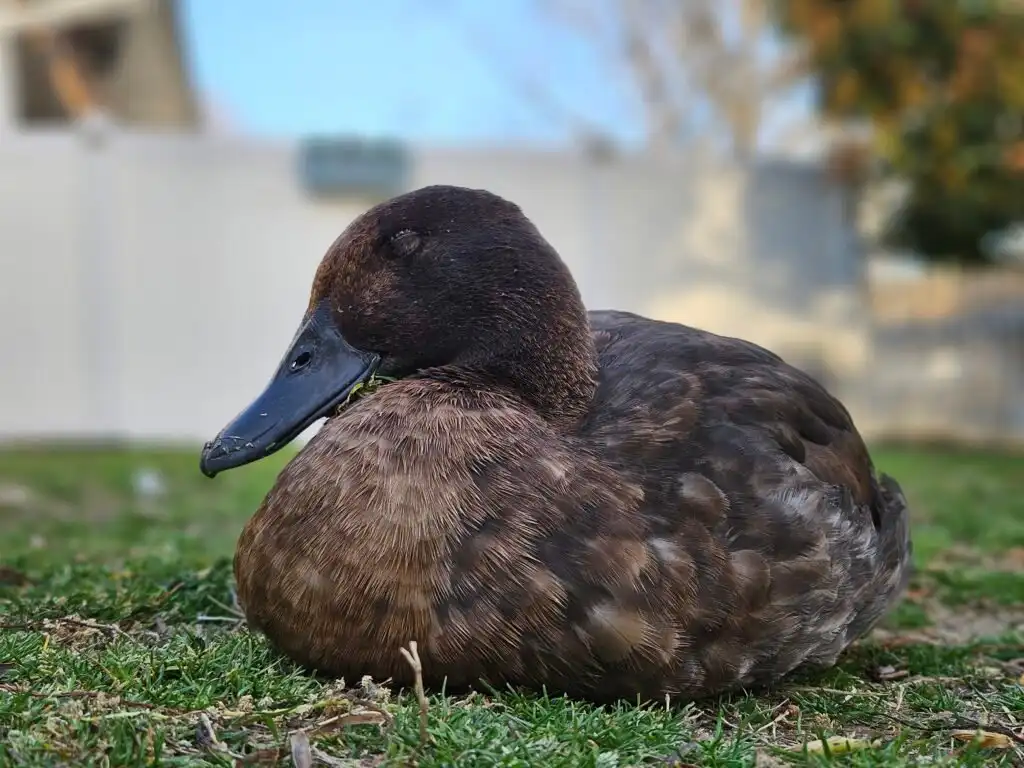
That is why I always come back to one question:
Is my duck choosing to sit, or does she need to sit?
A healthy duck who has been lounging for an hour but springs to her feet when the flock heads toward the pool is probably doing just fine. A duck who wants to follow but takes a few steps and sits back down deserves a much closer look.
Knowing what is normal for each individual member of your flock makes that distinction much easier. Regular health checks, monthly weigh-ins, foot inspections, and simply spending time watching your ducks give you a baseline that no breed chart or textbook can provide.
And trust your observations. You are the person who sees your ducks every day. You know who is normally first to the snack bowl, who prefers an afternoon nap, and who absolutely cannot resist investigating whatever you are doing. Those seemingly insignificant details can become incredibly valuable when something changes.
Your Next Step
If your duck has recently started sitting more, watch her walk today and give her a quick head-to-toe health check. Look at both feet, compare the legs, check her body condition, weigh her if possible, and pay attention to appetite, droppings, breathing, and behavior.
If everything looks normal and she happily gets up when something interesting happens, you may simply have a very comfortable duck.
If she seems painful, weak, reluctant to stand, or just not quite herself, keep investigating and contact a duck-savvy veterinarian when appropriate.
Because sometimes sitting is just sitting.
And sometimes it is your duck’s quiet way of telling you that she needs your help.
Further Reading & Resources
- 16 Common Duck Health Conditions You Should Know About
- Bumblefoot in Ducks: Symptoms, Causes, and Treatments
- How to Conduct a Duck Health Check: A Comprehensive Guide
- Duck Feet Facts: Key Anatomical Features And Functional Adaptations
- Arthritis in Ducks: Understanding, Managing, and Supporting Your Feathered Friends
- Limping Ducks? Understanding Leg Injuries in Ducks and How to Help
Deepen your understanding of avian wellness. Explore the full Duck Health & Anatomy Library for more specialized care guides.