How Ducks Digest Food: From Bill to Cloaca

To keep our research-backed guides free, this site uses ads and affiliate links (earning a small commission at no cost to you). Everything here is created by a duck mom and PhD scientist, combining academic rigor with hands-on experience to provide practical, trustworthy advice for duck keepers everywhere. 🦆 Learn more
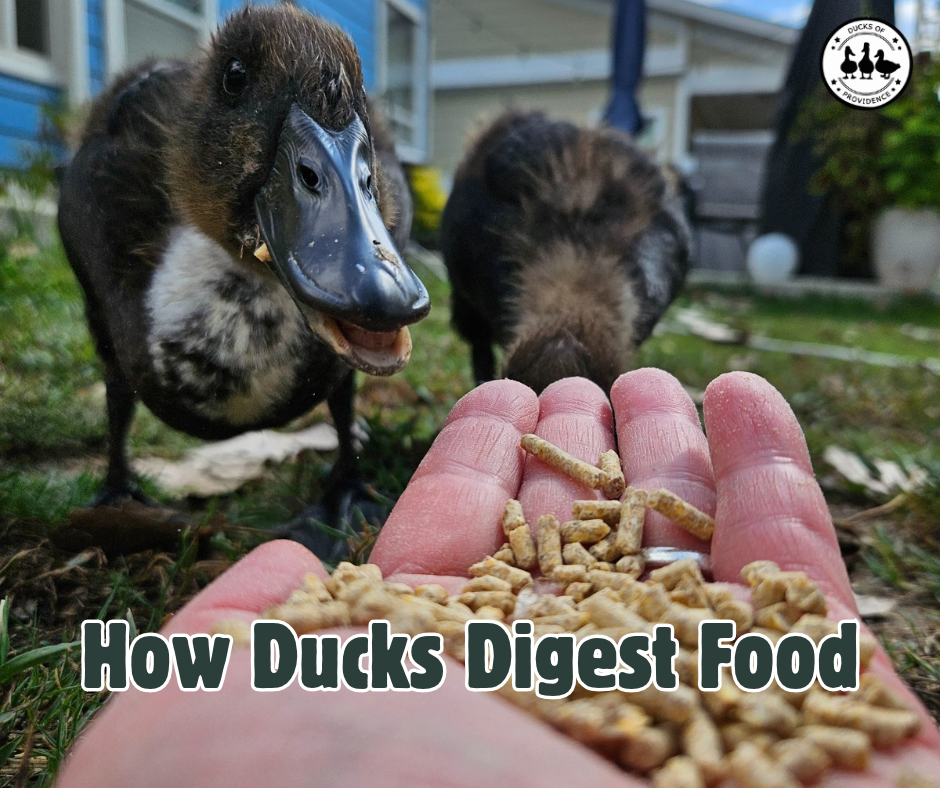
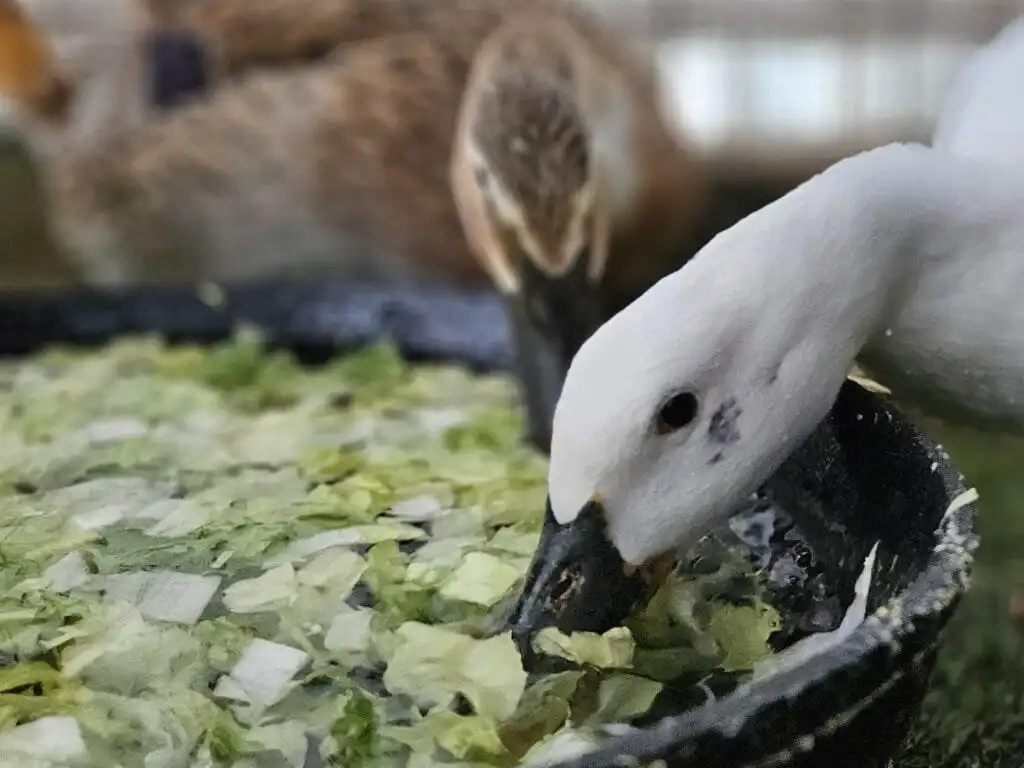
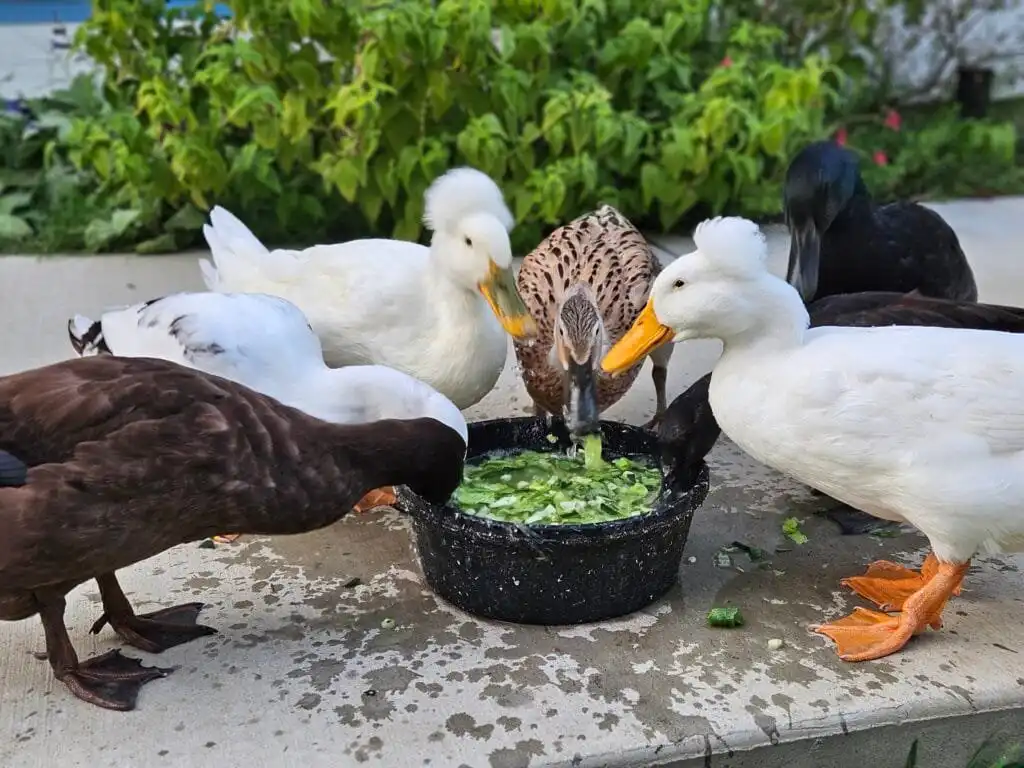
At our house, breakfast often includes what I call duck soup, a bowl of water with chopped greens and a few peas. If you watch Krümel or Muffin at the bowl, you can see the bill doing two jobs at once. It scoops up the good stuff and lets some of the water run right back out. A pea disappears, and a moment later the bill is back in the bowl looking for the next one.
That little pea still has quite a journey ahead. Ducks swallow food without chewing it with teeth. They have a two-part stomach, including a muscular gizzard that does the grinding, and their digestive and urinary waste come together just before it’s time to give the duck keeper something else to clean.
Understanding how ducks digest food puts some familiar flock habits in a new light. Why does Muffin go from a bite of pellets to a sip of water and back again? Why might she pick up a tiny stone while foraging? And when she poops right after breakfast, did that pea really go through her that fast? Let’s follow it from bill to cloaca and find out what happens between the first gulp and the next cleanup.
Part of the Duck Health & Anatomy Hub, Evidence-based medical resources and anatomical research.
Quick Navigation: Jump to a Section
How Do Ducks Digest Food?
When I watch Muffin fish a pea out of her duck soup, it seems to disappear in one gulp. How does she break it down without chewing? A duck’s bill gathers the food, and its gizzard does the grinding after the food is swallowed.
The pea travels down the esophagus, the muscular tube that carries food from the throat to the stomach. It first reaches the proventriculus, the glandular part of the stomach, where acid and enzymes begin breaking it down. Next comes the gizzard, the muscular part of the stomach. Its strong walls squeeze and grind the food, sometimes with the help of small stones called grit.
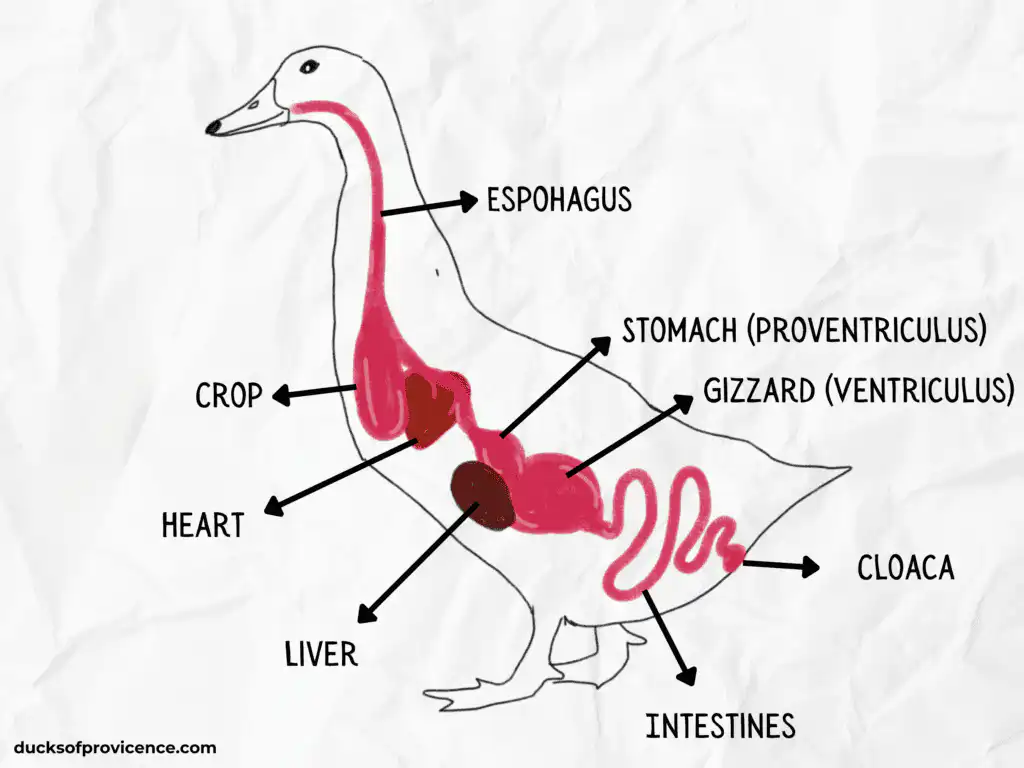
From there, the food moves into the small intestine, where digestion continues and most nutrients are absorbed. Near the junction with the large intestine are two pouches called ceca. Some of the material that escaped digestion enters these pouches, where microbes ferment part of it. Both the ceca and the large intestine help recover water.
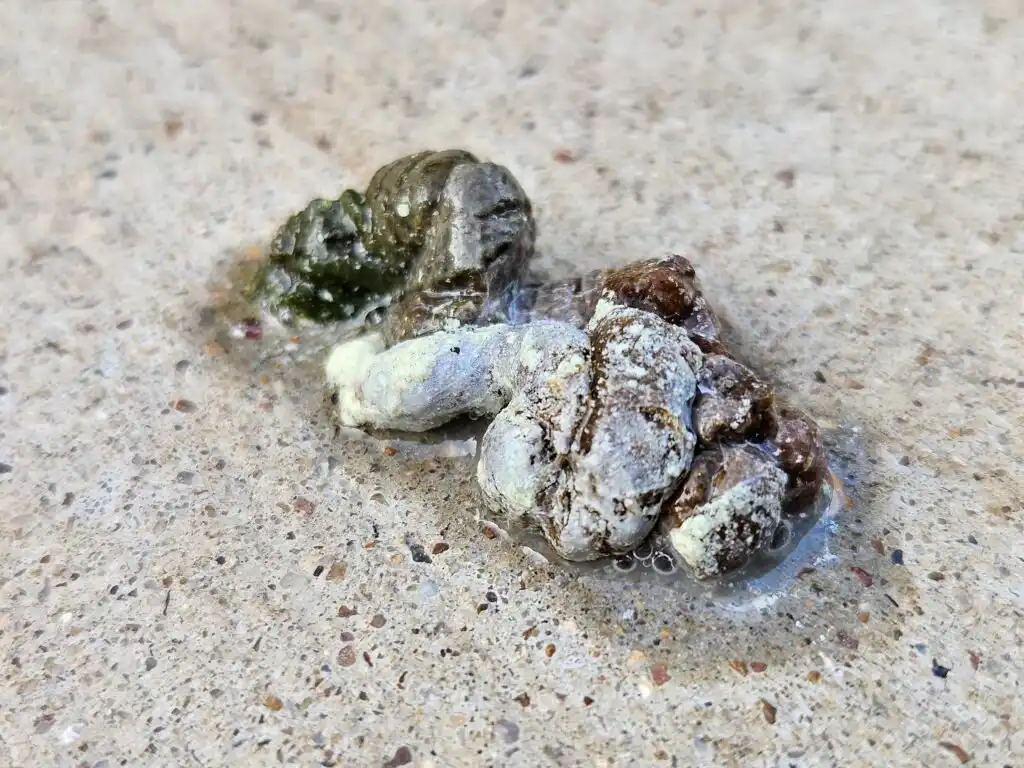
Finally, what’s left passes into the cloaca, an internal chamber where digestive waste meets waste from the kidneys. The dropping then leaves through the vent, the external opening. That’s why one duck dropping can have three visible parts: feces, creamy white urates, and a little clear liquid.
The Bill and Esophagus
1. The bill finds, grabs, and strains food
When I watch Muffin dabble in her duck soup, I can see water spill from the sides of her bill while a pea stays inside. The next time she dips her bill, she might pick up a piece of lettuce instead. That broad bill works as both a scoop and a strainer.
Along the inside edges of the bill are rows of fine, comb shaped ridges called lamellae. As a dabbling duck takes in a mouthful of water and food, the bill and tongue help move the water back out. The lamellae help retain edible bits, such as tiny seeds and aquatic invertebrates. Those little ridges can look like teeth up close. Their job is to sort food before swallowing.

The bill also helps a duck feel for food. Touch receptors in the bill and tongue help ducks detect what they’ve picked up, even when they’re probing muddy water and can’t see much. The tongue has small projections called papillae that help handle food inside the bill. Some work with the lamellae during straining, while others help guide food toward the throat. By the time Muffin swallows that pea, her bill and tongue have already found it, separated it from the water, and moved it into position. ·
2. The esophagus moves food and can hold it temporarily
Once the duck swallows, food enters the esophagus, a muscular tube that runs down the neck and leads to the glandular stomach. Waves of muscle contraction move food along. This process is called peristalsis. If you see a duck stretch her neck after taking a bite, there’s also work happening inside that you can’t see: the tube itself is moving the food along.
The inside of a mallard’s esophagus has folds that run lengthwise. These folds allow the tube to widen as food fills it, much like the pleats in an expandable bag. That extra room lets a duck hold some food temporarily as it moves toward the stomach.
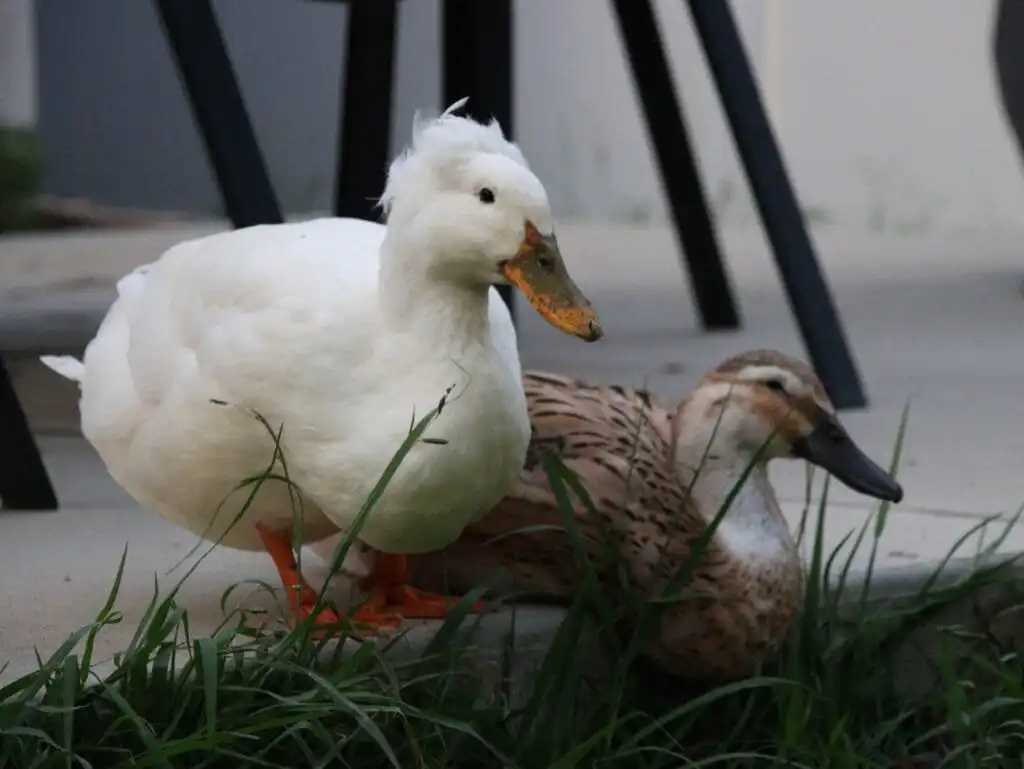
This is where the word crop can get confusing. A chicken has a distinct storage pouch that branches off the esophagus. In mallards and domestic ducks descended from them, the esophagus itself expands to provide temporary storage. When you hear a duck keeper say a duck has a full crop after a meal, that expandable area is usually what they mean. From there, the food reaches the proventriculus, where acid and enzymes begin the next stage of digestion.
The Stomach and Gizzard
Once Muffin swallows that pea, it reaches a stomach with two specialized parts. The first supplies the acid and enzymes that start breaking food down. The second uses muscle to crush it into smaller pieces. Together, they do the work that starts with chewing in animals like us.
3. The proventriculus adds acid and enzymes
The proventriculus is the glandular part of the stomach. It sits between the esophagus and the gizzard. Glands in its wall release hydrochloric acid and pepsinogen, the inactive form of a digestive enzyme. The acidic environment helps turn pepsinogen into pepsin, which cuts large proteins into smaller pieces.
This is chemical digestion. The pea may still look like a pea at this point, but the stomach juices are already starting to break down some of its proteins. Those juices travel with the food into the gizzard, so chemical digestion can continue while the food is being ground.
4. The gizzard grinds food
The gizzard, also called the ventriculus, is the muscular part of the stomach. Its thick walls contract repeatedly, squeezing and grinding the food against a tough inner lining called koilin. That lining protects the tissue underneath from wear as the gizzard works. Breaking a pea or seed into smaller pieces exposes more of the food to digestive juices, giving enzymes more surface to work on.
If you’ve ever watched your ducks pick up tiny stones while foraging, you’ve seen how they collect grit. Some of those stones stay in the gizzard for a time. As the muscles squeeze, the stones help crush harder foods like whole grains and seeds. The muscles provide the force, and the grit helps with the grinding.
By the time Muffin’s pea leaves the gizzard, it’s part of a mixture of smaller food particles and digestive juices. That mixture moves into the small intestine, where digestion continues and most nutrients are absorbed.

The Intestines and Ceca
By the time Muffin’s pea leaves the gizzard, it’s been ground into small particles and mixed with digestive juices. It now enters the intestines, where her body can absorb nutrients from the pea. Even some of the fiber that escapes digestion can be put to use by microbes farther along.
5. The small intestine breaks down food and absorbs nutrients
Food from the gizzard first enters the duodenum, the opening section of the small intestine. In a duck, the duodenum forms a loop around the pancreas. The pancreas releases enzymes into the intestine that help break down starches, proteins, and fats. Bile, made by the liver, disperses fat into tiny droplets so that digestive enzymes can reach more of it. I think of it like breaking up a pool of oil into many little droplets. There’s more exposed surface for the enzymes to work on.
Farther along, the lining of the small intestine is covered with tiny projections called villi. These give the intestine more surface area for absorbing nutrients. Once enzymes break down the pea’s starch and protein, the resulting sugars and amino acids can pass through the intestinal lining. Muffin can use those sugars for energy and those amino acids to build and repair tissues. The small intestine is where most nutrient absorption happens.
6. The ceca give gut microbes a chance to work
Near the junction of the small and large intestines are two narrow pouches called ceca. Each pouch has one opening and a closed end. Think of them as two side pockets along the main route. Some fluid and fine material enter the pouches, where microbes have time to ferment certain fibers and other carbohydrates that escaped digestion in the small intestine.
Fermentation produces compounds called short chain fatty acids. The duck can absorb some of these compounds and use them for energy. So even after Muffin’s own digestive enzymes have done their work, the microbes in her ceca can get a little more out of that pea.
7. The large intestine recovers water
Both the ceca and the large intestine help recover water from the material still in the gut. A duck’s large intestine is relatively short, and the remaining digestive waste travels through it to the cloaca. That’s where it meets waste from the kidneys, which helps explain why a duck dropping can have a solid portion, a creamy white portion, and a splash of clear liquid.
The Cloaca and Vent
8. The cloaca brings waste from two systems together
By the time the remains of Muffin’s pea leave the large intestine, they’re on the last leg of their journey. They enter the cloaca, a short internal chamber at the end of the digestive tract. The urinary and reproductive tracts also connect to this chamber. The cloaca is the chamber inside the body. The vent is the opening on the outside.
The cloaca has three sections. Their names sound complicated, but each tells us something about where material enters or exits.
| Section | What happens there |
|---|---|
| Coprodeum | The large intestine empties feces into this first section. |
| Urodeum | Two tubes called ureters carry waste from the kidneys into this middle section. The reproductive tract also opens here. |
| Proctodeum | This final section leads to the vent, where waste leaves the body. |
In a laying hen, an egg also passes through the cloaca on its way out through the vent. The same external opening serves all three systems.
9. The vent is where the dropping leaves the body
If I’m cleaning up after Muffin and spot a brown or green portion, a little white paste, and a splash of clear liquid, I’m seeing waste from two different systems in one dropping. The brown or green portion is feces, which comes from the intestines. The white or cream colored paste contains urates, a form of nitrogen waste excreted by the kidneys. The clear liquid is the watery portion of the urine.
These parts can blend together, so you won’t always see three neat sections. A puddle around a formed fecal portion can simply be urine. When I’m trying to tell whether a dropping is unusually loose, I look at the fecal portion itself as well as the liquid around it.
And that’s where Muffin’s pea ends its journey. For me, though, cleanup is often where the next question starts. Why is this dropping so watery? Is that green color from breakfast, or is it something I should pay attention to?
In The Science of Duck Poop, I share what healthy duck droppings can look like, how food and water can change their appearance, and which changes are worth a closer look.
How Long Does It Take a Duck to Digest Food?
If you’ve ever cleaned the duck run and found a fresh dropping before you even put the scoop away, you might wonder how food can possibly move through a duck that fast. I’ve wondered the same thing watching Muffin go from the feeder to the water bowl and then leave me a little cleanup job.
Food can start showing up in duck droppings within a few hours, but there’s no single digestion time for an entire meal. In a controlled feeding study with mallards, researchers fed the ducks seeds and checked their droppings for seeds that had passed through intact. The researchers recovered the most intact seeds two to three hours after feeding. That tells us how quickly some seeds moved through under those conditions. A pellet, a pea, and a tough seed can all behave differently in the gut. Mallard gut passage study in Oikos
Why Do Ducks Poop So Often?
One reason ducks seem to poop all the time is that they eat in many small bouts throughout the day. In our flock, Muffin might have a few bites of pellets, take a sip of water, wander off to see what everyone else is doing, and come back for another bite later. Ducks that forage can also pick up little bites between visits to the feeder. With food coming in throughout the day, there’s often something coming out at the other end, too.
How often a duck poops and how long food takes to pass through are two different things. Muffin can swallow a pea while food she ate earlier is still moving through her intestines. If she leaves me a dropping right after duck soup, I’m cleaning up the remains of an earlier meal. The pea I just watched her swallow is still at the beginning of its journey.
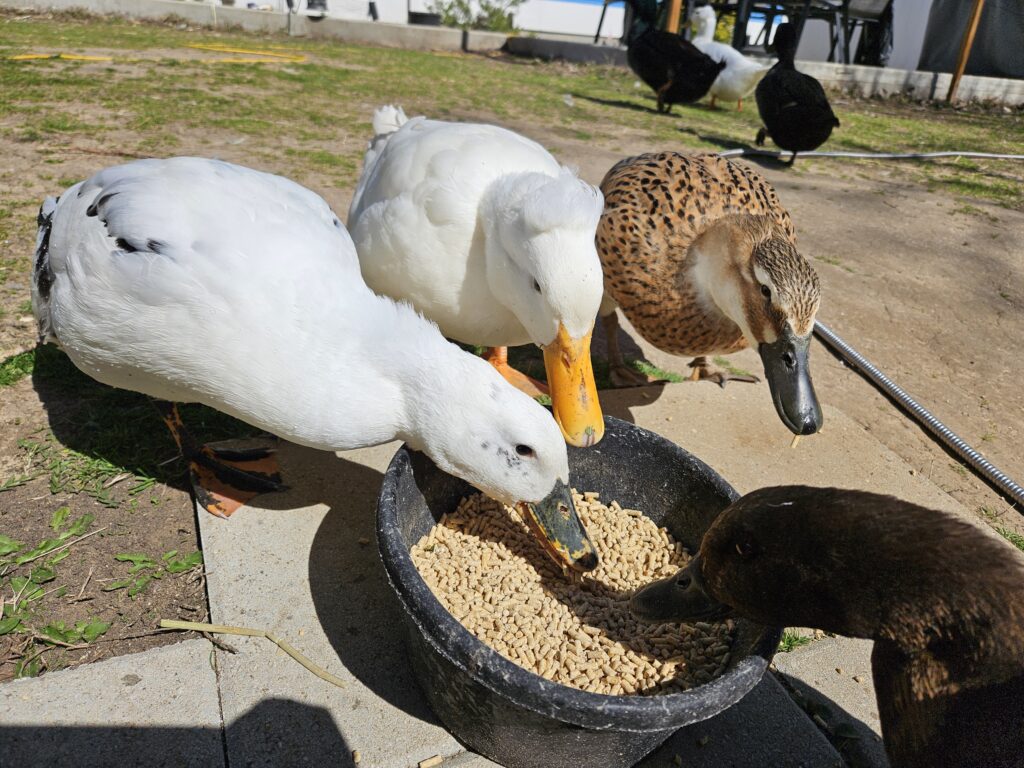
How those small meals are spaced depends partly on your feeding schedule. We keep pellets available around the clock, so our ducks can help themselves. Other keepers offer feed during daylight hours or at set times. Ducks that spend much of the day foraging may still eat plenty of small bites between scheduled feedings. I go into more detail about these routines and how they fit different flocks in my guide to duck obesity and feeding schedules.
What This Means for Your Flock
Once you know what happens to Muffin’s pea after she swallows it, it’s easier to see why I pay attention to three things at mealtime: where the drinking water is, whether the flock has access to grit, and what goes into their bowls.
Keep Drinking Water Within Reach at Mealtime
Watch your ducks eat dry pellets and you’ll probably see them take a few bites, walk over for a sip, and go right back for more. Water helps ducks moisten and swallow dry feed. I keep the water close enough that they can go back and forth easily, with enough space around the bowl that one duck can’t block everyone else.
In our setup, I keep clean drinking water available around the clock in a container deep enough for the ducks to dip their bills and rinse their nostrils. Of course, the moment I refill it is usually the moment someone decides to bring over a mouthful of pellets. That’s why I check the water after meals and refresh it when it gets murky.
Give the Gizzard a Hand With Grit
Insoluble grit is made up of small, hard stones, such as crushed granite. Some of those stones stay in the gizzard for a time. As the gizzard contracts, the stones help grind tough food particles such as whole grains and seeds.
If your ducks eat only a complete pelleted ration, they generally don’t need supplemental grit because the ingredients have already been ground. If they also eat whole grains, seeds, or coarse forage and don’t have reliable access to suitable small stones, offer poultry grit sized for their age in a separate dish. That lets them pick it up as needed.

Grit and oyster shell do different jobs. Granite grit helps the gizzard grind food. Oyster shell dissolves in the digestive tract and supplies calcium, which laying hens use to make eggshells. If you offer both, give each its own dish.
Feed for Nutrition and Let Treats Add Variety
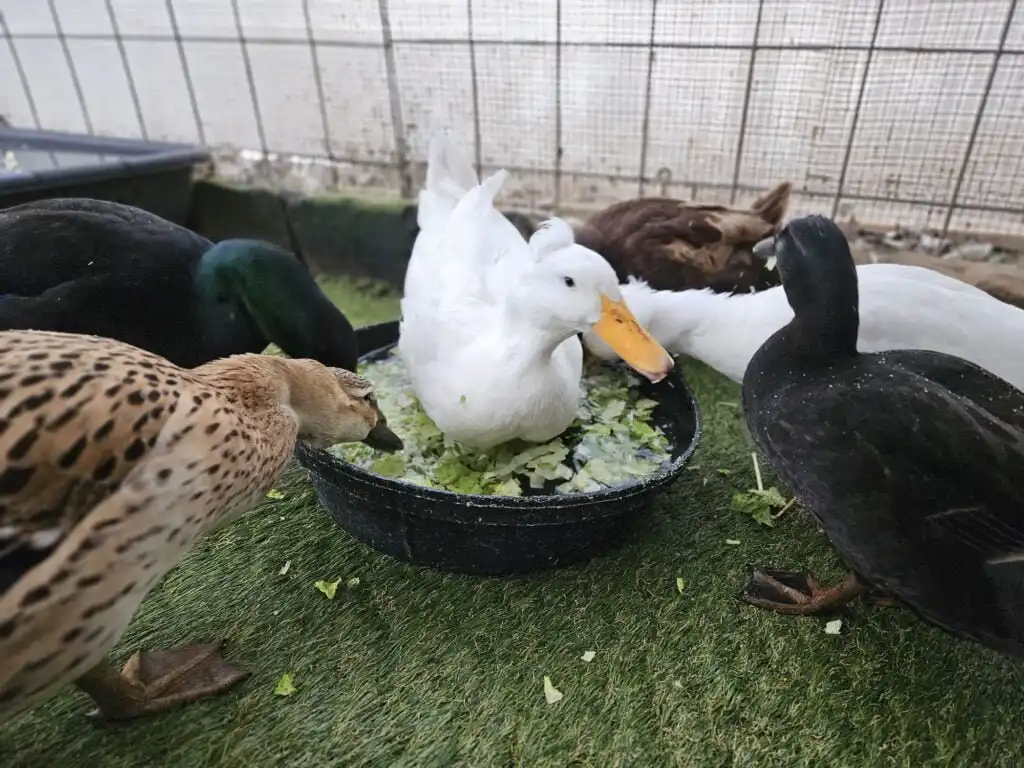
I build my flock’s diet around a complete ration suited to their life stage. Pellets or crumbles contain ground ingredients formulated to supply the nutrients ducks need. Whole grains and seeds give the gizzard more physical work to do. Chopped greens, cucumber, and peas bring different textures and moisture to the bowl. At our house, that’s what duck soup is for. It gives Muffin and the rest of the flock something to dabble for alongside their regular feed.
Fiber is a normal part of the diet, and its form matters. Microbes in the ceca can ferment some of the fiber that escapes digestion in the small intestine. Other fiber passes through largely undigested. A few pieces of chopped leafy greens are easy to offer as enrichment. I keep extras modest because filling up on greens or scratch grains leaves less room for the balanced feed that supplies their everyday nutrients.
Frequently Asked Questions
Do ducks have teeth?
Ducks have no teeth. The ridges along the bill are called lamellae and help some ducks strain food from water or mud. The gizzard does the grinding after the duck swallows.
Do ducks have a crop?
Mallards and the domestic ducks descended from them have a stretchy esophagus that can hold food temporarily. They lack the distinct crop pouch found in chickens. Duck keepers often use crop as shorthand for the area that fills after a meal.
Do ducks have two stomachs?
Ducks have one stomach with two specialized parts. The proventriculus releases acid and enzymes, and the muscular gizzard grinds food.
Do ducks need grit if they only eat pellets?
Supplemental grit is generally unnecessary for ducks eating only a complete pelleted ration. The ingredients in pellets have already been ground. If the ducks also eat whole grains, seeds, or coarse forage, offer appropriately sized insoluble grit when they lack access to suitable stones.
Is the cloaca the same as the vent?
The cloaca is the internal chamber where the digestive, urinary, and reproductive tracts meet. The vent is its external opening.
From the First Bite to the Last Drop
Muffin can make a pea disappear in a second. Behind that quick gulp, her gizzard grinds the food, her small intestine absorbs nutrients, and microbes in her ceca get to work on some of the leftover fiber. By the time I’m reaching for the scoop, her digestive system is already working on the next bite.
For me, the anatomy makes the everyday care choices easier to understand. I keep clean drinking water within reach of the feeder, build meals around a complete feed suited to my ducks’ life stage, and make sure they have access to suitable grit when they eat coarse foods. And yes, there’s still room for a little duck soup.
Next step: Watch your flock at their next meal. How often do they go from a bite of feed to a sip of water and back again? When it’s time to clean up, my guide to what healthy duck droppings look like picks up where that last bite leaves off.
Scientific References
- Avian Medicine, chapter on ducks, geese, and swans
- Anatomical study of the mallard esophagus
- Research on the domestic duck tongue
- Research on intestinal structure in Pekin ducks
- Cornell University’s duck nutrition guide
- Research on dietary fiber and cecal microbes in Pekin ducks
- Veterinary Histology of Domestic Mammals and Birds
Further Reading & Resources
- Is Your Duck Overweight? Duck Obesity, Overfeeding, and What to Do
- The Science of Duck Poop
- Duck Anatomy: A Complete Guide for Pet Owners
- Duck Digestive System: A Science-Backed Guide to Anatomy and Health
- Why Is My Duck Always Hungry? 9 Reasons Ducks Act Starving
Deepen your understanding of avian wellness. Explore the full Duck Health & Anatomy Library for more specialized care guides.