
When Love Means Letting Go: A Compassionate Guide to Euthanasia in Ducks

To keep our research-backed guides free, this site uses ads and affiliate links (earning a small commission at no cost to you). Everything here is created by a duck mom and PhD scientist, combining academic rigor with hands-on experience to provide practical, trustworthy advice for duck keepers everywhere. 🦆 Learn more
There are posts I write with joy.
There are posts I write with urgency.
And then there are posts like this one.
If you share your life with ducks, you already know this truth: they are not “just poultry.” They are family. They have personalities, routines, preferences, and relationships. They greet you in the morning. They complain when dinner is late. They lean into you when they feel safe.
And sometimes, despite everything we do, we are faced with the most painful responsibility of all.
Euthanasia.
This is not an easy conversation. But it is one we must have as responsible duck parents.
Part of the Duck Health & Anatomy Hub, Evidence-based medical resources and anatomical research.
Quick Navigation: Jump to a Section
[hide]
- What Is Euthanasia, Medically Speaking?
- The Ethical Side: When Is Euthanasia the Kindest Choice?
- Conditions That May Warrant Humane Euthanasia
- The Deciding Question
- This is not about giving up too soon.It is about honest, grounded observation.
- How a Veterinarian Performs Euthanasia
- If You Do Not Have Access to a Veterinarian
- The Emotional Reality
- Do Ducks Grieve?
- What Happens After?
- Creating Ritual and Meaning
- Practical Considerations
- The Guilt
- FAQ About Euthanasia in Ducks
- Further Reading & Resources
- References
What Is Euthanasia, Medically Speaking?
From a veterinary standpoint, euthanasia is the intentional induction of a rapid, painless, and irreversible loss of consciousness followed by death, performed to relieve suffering.
The word itself comes from Greek and means “good death.” In medicine, that is not poetic language. It is a clinical standard.
For a procedure to qualify as humane euthanasia, it must:
- Induce unconsciousness quickly
- Prevent perception of pain or distress
- Be reliable and irreversible
- Minimize fear before loss of awareness
When performed by a veterinarian, the most common method in ducks involves:
- Sedation, if needed, to reduce stress
- Administration of an injectable anesthetic overdose
- Loss of consciousness
- Cessation of breathing
- Cardiac arrest
Physiologically, what happens is this:
The anesthetic depresses the central nervous system. Brain activity slows. Awareness disappears first. The duck enters a deep, anesthesia-like state. Only after unconsciousness is fully established do respiration and heart function stop.
When done properly, the duck does not experience fear or pain during the final moments. They fall asleep.
I find comfort in understanding the sequence. It is controlled. It is predictable. It is designed to prevent suffering.
That is the medical foundation.
The Ethical Side: When Is Euthanasia the Kindest Choice?
This is the part that keeps us awake at night.
Euthanasia is not about whether we can prolong life. It is about whether we should.
We do not choose euthanasia because treatment is inconvenient.
We do not choose it because care is exhausting.
We do not choose it lightly.
It becomes the kindest choice when:
- A condition is irreversible
- Pain cannot be adequately controlled
- The duck can no longer perform normal behaviors
- Quality of life cannot be restored
Here is the uncomfortable truth: sometimes we want more time because we are not ready to let go.
But ethical care requires us to shift perspective.
Instead of asking:
“Can I keep her alive?”
We must ask:
“Is she still living well?”
Ducks express joy through behavior. They forage. They preen. They bathe. They socialize. They argue over snacks. They nap in the sun.
When those behaviors disappear permanently, and suffering replaces engagement, we have to consider whether continued life equals continued welfare.
In the wild, a duck with severe injury or organ failure would not receive prolonged supportive care. Nature is rarely gentle. Our role as caretakers is not to replicate nature. It is to improve upon it.
Sometimes that means we intervene to heal.
And sometimes, when healing is no longer possible, it means we intervene to relieve suffering.
Choosing euthanasia in those moments is not abandonment.
It is an act of protection.
It is one of the hardest expressions of love we will ever practice.
Let’s talk about real examples.
Conditions That May Warrant Humane Euthanasia
This is the section none of us wants to read. But if we are going to be responsible duck parents, we need to be honest about the medical realities.
Euthanasia is never the first option. It is considered when diagnosis, prognosis, and quality of life intersect in a way that leaves no reasonable path to recovery.
A diagnosis alone is not a reason for euthanasia. Ducks can recover from remarkable things with proper care. I have seen girls bounce back from infections, injuries, and even reproductive crises that initially looked catastrophic.
What matters is not just what the disease is. It is:
- Whether it is treatable
- Whether pain can be controlled
- Whether function can be restored
- Whether quality of life can return
When those answers shift toward “no,” we have to look honestly at what we are asking them to endure.
Below are conditions where humane euthanasia may become the kindest choice.
1. Advanced, Untreatable Cancer
Ducks can develop ovarian carcinoma, oviduct tumors, liver masses, and aggressive internal growths. Unfortunately, these are often discovered late because ducks hide weakness so well.
You might notice:
- Progressive weight loss
- Abdominal swelling
- Difficulty walking
- Labored breathing
- Reduced appetite
- Withdrawal from the flock
Surgical options in ducks are limited. Chemotherapy protocols are rarely practical in backyard settings. If a tumor is compressing organs, causing internal bleeding, or producing chronic pain, we have to ask whether extending life will meaningfully improve comfort.
If there is no path to recovery and suffering is escalating, euthanasia may prevent a prolonged and distressing decline.
2. Severe Neurological Disease
Neurological disorders are among the most heartbreaking to witness.
Causes may include:
- Severe head trauma
- Advanced heavy metal toxicity
- Central nervous system infections
- Brain tumors
- Viral encephalitis
Signs can look dramatic:
- Inability to stand
- Continuous rolling or uncontrolled head movements
- Recurrent seizures
- Complete loss of coordination
- Inability to eat or drink independently
A duck that cannot right herself or access water is at constant risk of dehydration, aspiration, and stress. If neurological damage is permanent and rehabilitation attempts fail, continuing life may mean ongoing confusion and distress.
In those cases, euthanasia can be the most humane choice.
3. End-Stage Reproductive Disease
Many of us who keep laying ducks are familiar with reproductive disorders. Some are manageable. Some are not.
Chronic egg yolk peritonitis, internal laying, ovarian tumors, repeated egg binding, or persistent oviduct infections can become a cycle of inflammation and pain.
Early intervention with:
- Antibiotics
- Anti inflammatories
- Hormone implants
- Supportive care
can sometimes stabilize a duck.
But if:
- Infections recur repeatedly
- Fluid accumulation becomes chronic
- Hormone therapy no longer works
- Pain persists despite medication
then we have to reassess whether we are treating or simply prolonging.
4. Irreparable Traumatic Injury
Predator attacks, spinal fractures, and catastrophic limb injuries sometimes leave no surgical option.
Euthanasia may be considered when:
- There is spinal paralysis
- Internal organs are ruptured
- Severe tissue necrosis cannot be repaired
- A duck cannot stand or move independently
Ducks need mobility for basic welfare. They need to reach water. They need to reposition themselves. They need to escape social stress within the flock.
A life confined to immobility with chronic pain is not a natural duck life.
5. Chronic, Uncontrolled Pain
Pain in ducks is subtle. They are prey animals and mask vulnerability instinctively.
But long term pain often shows itself through:
- Persistent fluffed posture
- Decreased preening
- Reduced appetite
- Isolation
- Reluctance to move
- Quiet, withdrawn behavior
If multiple pain management strategies fail and a duck no longer engages in normal behaviors, quality of life may be permanently compromised.
A duck that no longer seeks water, no longer forages, no longer reacts to favorite treats is telling us something.
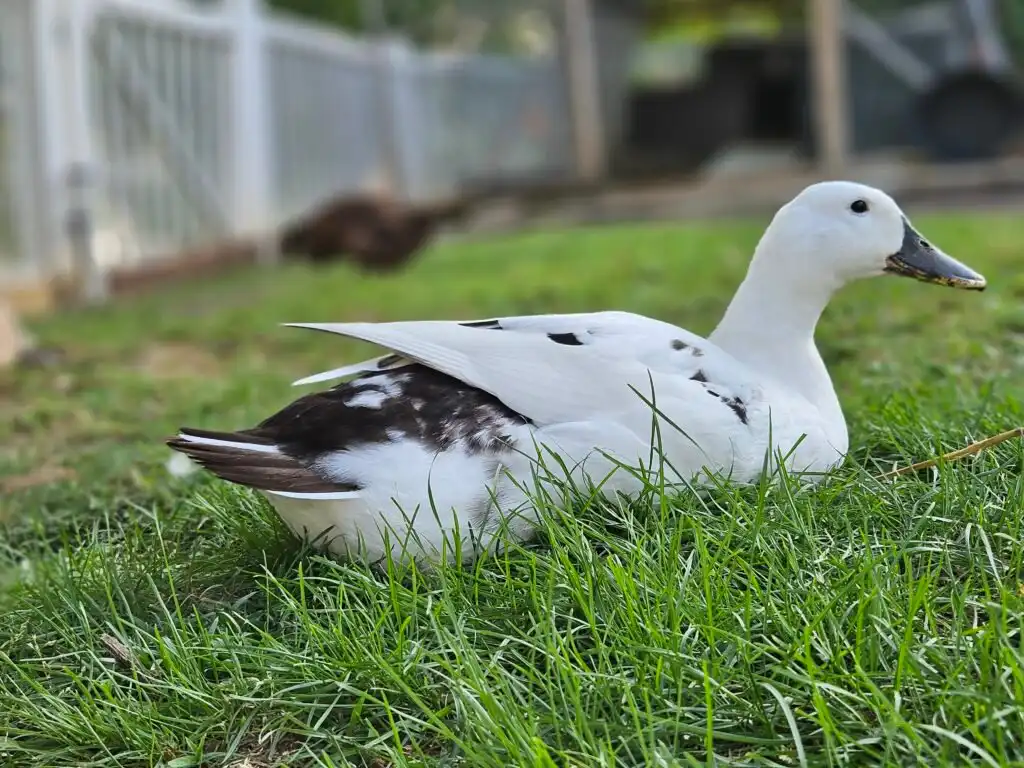
There were good days, and there were harder ones. On the hard days, you could see it in her posture. Slower steps. Longer pauses before standing. Choosing to lie down instead of joining the others at the water.
We managed her pain carefully and intentionally. Anti inflammatories, supportive footing, close monitoring. But arthritis is progressive. And eventually, comfort became harder to maintain.
6. End Stage Organ Failure
Advanced liver, kidney, or heart disease can result in:
- Severe weight loss
- Ascites
- Weakness
- Labored breathing
- Inability to regulate temperature
When organ systems are shutting down and supportive care cannot reverse the decline, euthanasia may prevent a slow and uncomfortable dying process.
7. Progressive Degenerative Disease
Some conditions erode quality of life slowly.
Advanced arthritis, severe skeletal deformities, or chronic debilitating infections can gradually remove mobility and independence.
If a duck can no longer:
- Walk comfortably
- Bathe safely
- Interact with the flock
- Access food and water without assistance
and there is no realistic path to improvement, we must weigh whether life remains comfortable.
The Deciding Question
The presence of disease is not the deciding factor.
The real question is:
Can this condition be treated in a way that restores meaningful quality of life?
If the answer is no, and suffering is increasing rather than decreasing, euthanasia may become the final act of care.
It is not about giving up.
It is about protecting them from a life defined by discomfort.
And sometimes, that is the bravest thing we can do.
This is not about giving up too soon.
It is about honest, grounded observation.
It is about separating our fear of loss from their lived experience.
When I am facing this question, I slow everything down. I stop reacting emotionally and start assessing deliberately. I look at behavior. I look at patterns. I look at trends over days, not just moments.
Because one bad afternoon is not the same as a sustained decline.
I ask myself:
- Is she still enjoying food?
- Is she interacting with her flock?
- Does she show curiosity?
- Can she rest comfortably?
- Are we managing pain effectively?
- Would I want to live in this state?
But let’s unpack those questions more deeply.
Appetite and Engagement
Food is one of the clearest indicators of well-being in ducks. Even mildly ill ducks often perk up for a favorite treat.
If a duck consistently refuses food, even high-value snacks, and this persists despite supportive care, that signals more than just a bad day.
It tells you that the internal drive is fading.
Engagement matters too. Does she still waddle toward the group when they move? Does she react when you enter the run? Does she complain when someone takes her spot?
Or is she detached, sitting alone, eyes half closed?
Withdrawal is not always dramatic. Sometimes it is quiet. Subtle. A gradual fading from the social rhythm of the flock.
Curiosity and Personality
Every duck has a personality baseline.
Penny was vocal. Curious. Always first to investigate something new.
When personality traits disappear entirely and do not return, that is significant.
A duck that no longer:
- Preens
- Explores
- Vocalizes
- Bathes
- Responds to routine
is telling you that the spark is dimming.
Comfort and Rest
Can she lie down and rest without visible distress?
Is breathing calm, or labored?
Does she constantly shift position trying to get comfortable?
Chronic discomfort often shows up in posture:
- Persistent fluffing
- Tucked head without true sleep
- Reluctance to move even when prompted
If rest no longer looks restorative, quality of life is compromised.
Pain Control
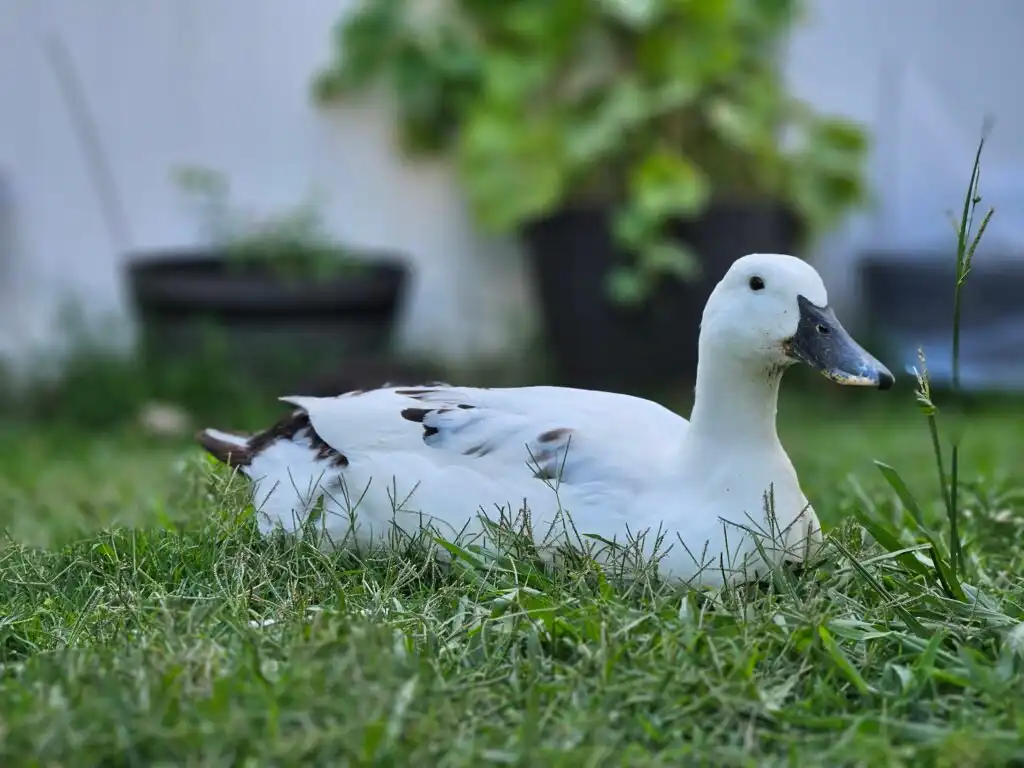
When a duck who once loved water, sunshine, and flock drama chooses to lie quietly instead, that tells you something. This was the moment I had to shift from asking, “Can we keep treating?” to asking, “Is she still enjoying her life?”
This is where medical honesty matters.
Are medications helping?
Or are we escalating doses with diminishing returns?
If anti-inflammatories, antibiotics, supportive care, and environmental adjustments no longer restore comfort, we must consider that pain may be beyond management.
There is a difference between treatable illness and unrelenting suffering.
When the Flock Changes
This is something we do not talk about enough.
Ducks are highly social, but they are also wired for survival. In a flock dynamic, weakness can shift the hierarchy quickly.
When a duck becomes visibly ill or debilitated, you may notice:
- Increased pecking
- Chasing
- Blocking access to food or water
- Isolation from group resting areas
Other ducks may begin to bully her because she is perceived as weak. In evolutionary terms, a compromised member can attract predators and destabilize the group.
Sometimes the flock will almost expel her socially.
This is not cruelty in a human sense. It is instinct.
But for the sick duck, it adds another layer of stress. She is no longer just battling disease. She is also navigating social rejection.
If you find yourself constantly separating her for protection, supervising interactions, or preventing aggression, that is important information.
A duck that cannot safely exist within her own flock without intervention may no longer have a sustainable quality of life.
The Prey Animal Factor
Ducks are prey animals. Their survival depends on masking weakness. By the time a duck stops resisting, stops reacting, stops trying, she may already be deeply compromised.
When they stop fighting, it often means they are exhausted.
And we must be brave enough to see that.
The Hardest Question
Sometimes the barrier is not medical. It is emotional.
We may keep adjusting treatment because we are not ready. We may search for one more intervention, one more supplement, one more possibility.
Hope is powerful. But hope must be grounded in reality.
I ask myself one final question:
If this were me, would I want this life?
If the honest answer is no, then I have to consider whether I am prolonging life for her… or for myself.
This decision is never made lightly. It should feel heavy.
But the real question remains:
Are they still living, or are they only surviving?
And our responsibility is to answer that truthfully, even when it breaks our hearts.
How a Veterinarian Performs Euthanasia
Whenever possible, I strongly recommend having euthanasia performed by an experienced avian or poultry veterinarian.
The standard method typically involves:
- Sedation to reduce stress
- An injectable anesthetic overdose
- Confirmation of cardiac arrest
The duck falls asleep peacefully. There is no fear. No struggle.
When we made this decision for Penny, our veterinarian allowed us to stay with her. We held her. We talked to her. She drifted away in our hands.
It was devastating.
It was also gentle.
That matters.
If You Do Not Have Access to a Veterinarian
I need to be clear here.
Professional euthanasia is always the preferred option.
However, I also know that not everyone has access to avian veterinary care. In rural areas, in emergencies, or during severe suffering, a humane at-home method may be necessary.
If this is your situation:
- Only use methods recognized as humane for poultry by veterinary guidelines.
- The goal must be immediate unconsciousness followed by death.
- The person performing it must be trained and confident.
- Hesitation causes suffering.
Acceptable methods in emergency settings may include:
- Cervical dislocation performed correctly and decisively
- Use of an approved poultry dispatch tool designed for humane euthanasia
In some older poultry resources, you may find references to chemical methods such as ether inhalation. It is important to understand that these methods carry significant risks to both the bird and the person administering them, including improper dosing, prolonged distress, and human health hazards.
Because of these concerns, chemical euthanasia outside of a veterinary setting is generally not recommended. If you come across such methods, read critically and prioritize guidance from current veterinary and animal welfare standards.
We will link to that article here for transparency and discussion purposes, but professional veterinary euthanasia remains the safest and most humane option whenever possible.
Methods that are not humane:
- Drowning
- Suffocation
- Blunt trauma done improperly
- Freezing
- Poison
If you are not trained, please seek guidance from a veterinarian, agricultural extension office, or experienced poultry professional before attempting anything.
This is not a moment for improvisation.
The Emotional Reality
Euthanasia is not failure.
It is not weakness.
It is an act of protection.
We carry the emotional burden so they do not have to carry physical pain.
That is what love sometimes looks like.
When we made the decision for Penny, I questioned myself a hundred times. Was it too soon? Could we try one more thing?
But when I looked at her, really looked at her, I knew she was tired.
And I realized something that changed me:
Keeping her alive was for me. Letting her go was for her.
Do Ducks Grieve?
Yes. They notice.
And if you live closely with your flock, you will see it.
After Penny passed, the entire run felt different. It was quieter. The usual morning chatter was subdued. A few of the girls walked the perimeter of the yard as if searching. Their vocalizations changed. The tone was softer, questioning.
Ducks form real social bonds. They have preferred companions. They sleep near certain individuals. They forage side by side. They defend one another in subtle ways.
When that bond is suddenly disrupted, the absence is not invisible to them.
Grief exists in flocks, just as it does in us.
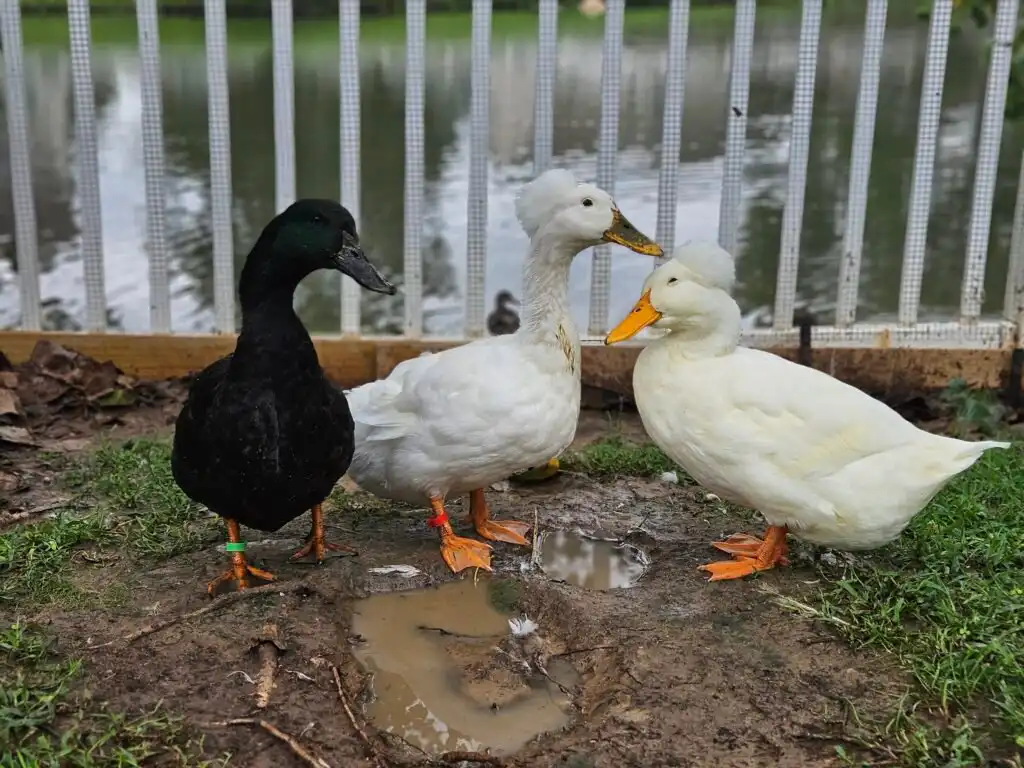
They were inseparable. After Hertha was gone, Schnatterinchen searched, stood in their usual spots, and grew noticeably quieter.
Ducks feel the absence of their companions.
The Strength of the Bond Matters
Grief is not identical in every flock. It depends heavily on the relationship between the ducks.
When Hertha passed, Schnatterinchen was shattered. Those two were inseparable. They bathed together. Rested together. Wandered the yard like a little team.
After Hertha was gone, Schnatterinchen searched. She vocalized differently. She seemed unsettled and restless. You could see her confusion and distress. It was not projection. It was observable behavior change.
Some ducks adjust within days.
Others take weeks.
The closer the bond, the more profound the disruption.
Why I Let Them See the Body
Whenever possible, I allow the flock brief, supervised access to the body.
It sounds difficult, and emotionally it is. But behaviorally, it helps.
They approach. They look. Sometimes they gently peck. Sometimes they simply stand nearby.
After that moment, the frantic searching often decreases. It is as if they register the finality. The absence becomes understood rather than mysterious.
Without that closure, some ducks will continue calling or pacing, expecting the missing flock member to reappear.
Social Reorganization After Loss
There is another layer that we often overlook.
When a duck leaves the flock, the social structure shifts.
Ducks maintain a pecking order. It is dynamic, but it is stable once established. The loss of a member, especially a dominant or central duck, creates a temporary imbalance.
You may observe:
- Increased minor squabbles
- More chasing
- Repositioning at feeding time
- Changes in sleeping arrangements
If the duck who passed was high ranking, the adjustment can be more pronounced. Others will test boundaries and re-establish hierarchy.
If the duck was lower ranking but closely bonded to a dominant bird, that partner may temporarily drop in confidence.
This reorganization is normal. It is not a sign of cruelty. It is a natural recalibration of the flock.
How to Support the Flock Through Grief
After a loss, I focus on stability.
- Maintain routine
- Keep feeding schedules consistent
- Monitor closely for bullying during social reshuffling
- Provide calm supervision
- Offer gentle attention without disrupting structure
Some ducks seek extra closeness. Others withdraw briefly.
Both responses are normal.
Grief exists in flocks just as it does in us.
It may not look like human grief. There are no tears. But there is behavioral change. There is searching. There is adjustment.
And as their caretaker, you become the stabilizing force while they reorganize their little society.
Loss ripples through the flock.
Our job is to help them find balance again.
What Happens After?
The moments after euthanasia can feel strangely quiet. There is relief that suffering has ended. There is heartbreak. There is often a sense of disbelief.
And then, very practically, there is the question: what now?
There is no single correct answer. What matters is choosing what aligns with your values, your circumstances, and local regulations.
You have two primary options: burial or cremation.
Burial
For many backyard duck keepers, burial feels natural and personal. It allows your duck to remain on your property, close to the place she knew.
Before choosing burial:
- Check local regulations. Some municipalities restrict backyard burial.
- Ensure you are not near wells, ponds, or drainage areas.
- Choose a location away from water sources to prevent contamination.
- Bury deep enough to prevent scavengers. In most areas, this means at least three to four feet deep depending on soil conditions.
If your duck was euthanized using injectable anesthetics, be especially mindful of depth. Predators consuming remains containing euthanasia drugs can be harmed. Depth matters.
For some families, that physical space becomes part of the healing process.

A simple wooden box holding her ashes. A clay imprint of her tiny webbed foot. A few soft feathers saved from the girl who once splashed through our yard.
Small things. But they hold a lifetime.
Cremation
Cremation is another meaningful option, particularly if:
- You do not own property
- You plan to move
- Local burial is restricted
- You prefer not to manage a gravesite
There are typically two types:
Individual cremation
Your duck is cremated separately, and the ashes are returned to you. You may receive them in an urn or container of your choice.
Communal cremation
Multiple animals are cremated together. Ashes are not returned. This option is often more affordable.
Many veterinary clinics coordinate cremation services and can guide you through the process. Some offer memorial packages that include paw prints or feathers.
Ashes can be:
- Kept in an urn
- Incorporated into jewelry
- Scattered in a meaningful location where permitted
- Placed beneath a planted tree
We decided to cremate Hertha and Penny. That way, they are always close to us.
We have a small memorial area on our property. It is quiet. There are plants and stones marking the girls who have passed. It gives me a place to sit, to remember, to feel connected.
Creating Ritual and Meaning
Grief benefits from ritual. Even small gestures matter.
Some duck parents:
- Create memory boxes with photos and favorite feathers
- Frame footprints or shadow boxes
- Write letters
- Plant trees or flowers
- Create garden stones with names
These acts are not dramatic. They are grounding.
They acknowledge that this life mattered.
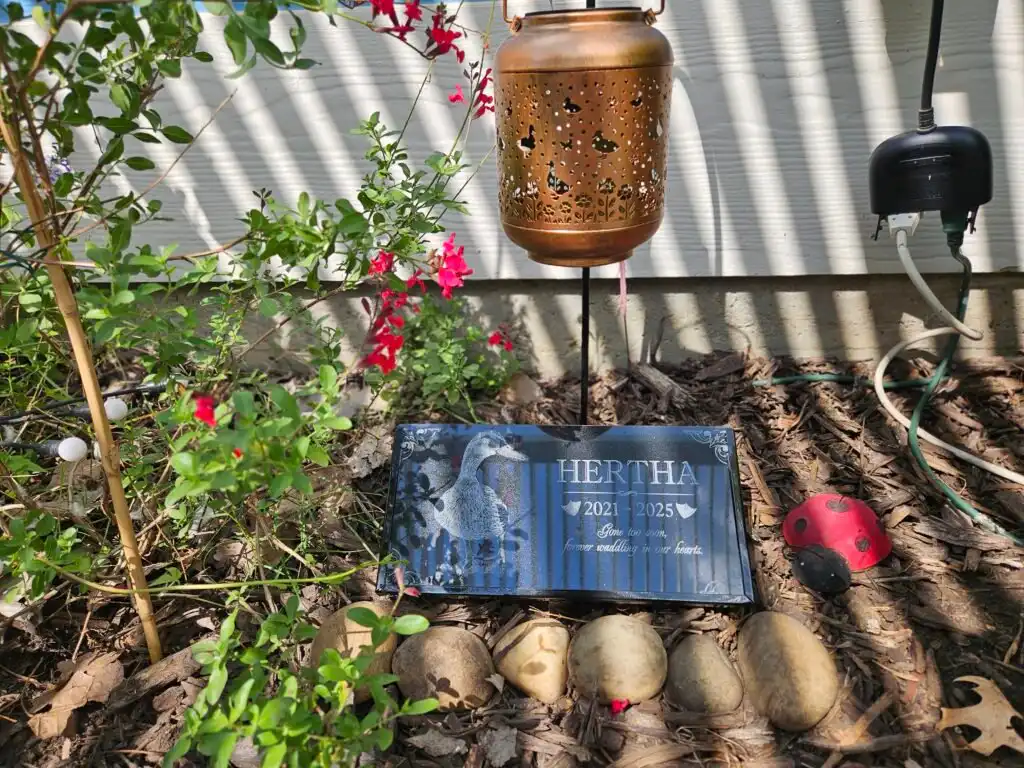
Hertha’s memorial, right beside her favorite spot in the yard.
A stone with her name, her photo, her dates, and a few words that still make my throat tighten. Surrounded by flowers, just where she loved to sit.
She is part of this place forever.
Practical Considerations
After loss, remember:
- Allow the flock brief closure time if possible
- Disinfect any shared medical equipment used during illness
- Monitor the flock for behavioral shifts
- Take time for yourself before making any major flock changes
Do not rush into adding a new duck. Social structures need time to stabilize. And you need time to grieve.
There is no right or wrong choice.
Burial is not more loving than cremation.
Cremation is not less personal than burial.
What matters is that you handled the final chapter with dignity.
That is what they deserved.
The Guilt
No one talks about this part enough.
After the decision is made, after the quiet settles, after the practical steps are handled, guilt often creeps in.
You may replay the conversation with your vet.
You may replay the last morning.
You may replay the exact moment you said yes.
You may ask yourself:
Was it too soon?
Did I miss something?
Should I have tried one more treatment?
This is normal.
When we are given the power to decide the end of a life, even for compassionate reasons, it carries emotional weight. It should. That heaviness reflects love.
When we let Penny go, I questioned myself repeatedly. Even though we had medical confirmation. Even though we had tried treatment. Even though I knew she was declining.
There was a small voice that kept whispering, “What if she would have rallied?”
I had to sit with that voice.
The guilt was not because we made the wrong decision. It was because I loved her deeply. And loving someone makes you want to fight forever.
But here is what I had to remind myself:
I did not choose death.
I chose relief from suffering.
There is a difference.
Ask yourself:
- Did you seek professional input?
- Did you evaluate her condition honestly?
- Did you try reasonable treatment options?
- Did you prioritize her comfort over your fear of loss?
If the answer is yes, then you acted with integrity.
Integrity does not mean the decision was easy. It means it was made thoughtfully and compassionately.
Guilt often comes from the illusion of control. We tell ourselves that if we had just done one more thing, we could have changed the outcome.
But sometimes there was nothing left to fix.
Sometimes the most loving act is stepping aside so they can rest.
And that is what I had to learn with Penny.
The ache does not disappear overnight. But over time, the guilt softens and is replaced by something steadier.
Peace.
Because when I look back now, I do not see the moment we said goodbye.
I see that we protected her from prolonged suffering.
And that is what matters.
FAQ About Euthanasia in Ducks
How do I know I am not acting too soon?
If the condition is treatable and quality of life can realistically be restored, it is not time. If suffering is persistent, progressive, and unresponsive to treatment, delaying may only prolong discomfort. When in doubt, seek a second veterinary opinion. Making a decision based on medical input is not acting too soon. It is acting responsibly.
Is it wrong to wait and see?
Not necessarily.
If treatment has just started or the diagnosis is still evolving, a short, intentional period of observation can be appropriate. Ducks can surprise us, and small improvements in appetite, alertness, or mobility matter.
However, waiting should never mean ignoring ongoing suffering.
Can ducks feel fear during euthanasia?
When done properly with sedation, stress is minimized and unconsciousness is rapid.
Should I let the flock see the body?
In my experience, yes. It helps reduce prolonged searching behavior.
How long does grief last in ducks?
It varies. Most flocks stabilize within days to a few weeks.
Can ducks recover from severe illness even when it looks hopeless?
Sometimes, yes. Ducks are remarkably resilient. That is why trends matter more than single bad days. Improvement over several days with treatment is encouraging. Continued decline despite intervention is different. Hope should be grounded in medical reality.
Should I stay during euthanasia?
If you feel emotionally able, staying can be meaningful for both you and your duck. Your presence is familiar. Your voice is familiar. But if you cannot stay, that does not make you less loving. Do what you can handle. Veterinary staff are trained to provide calm, gentle handling.
How quickly does death occur during veterinary euthanasia?
With proper anesthetic overdose, unconsciousness typically occurs within seconds to a minute. Breathing and cardiac function stop shortly after. The process is controlled and medically designed to prevent awareness and pain.
Can I change my mind once I schedule euthanasia?
Yes. Until the medication is administered, you can pause. A good veterinarian will never rush you. If something changes medically or emotionally, speak up.
Is it cruel to let nature take its course instead?
It depends on the situation. Some conditions allow for a peaceful natural passing. Others involve prolonged distress, organ failure, or unmanaged pain. Our responsibility is not to prolong biological life at all costs, but to prevent avoidable suffering.
Will the flock reject a sick duck before she passes?
It can happen. Ducks instinctively react to weakness. Increased pecking or social isolation is common in debilitated birds. If flock aggression becomes persistent and the sick duck cannot safely coexist without constant separation, that is important information when assessing quality of life.
Is it normal to feel relief after euthanasia?
Yes. Relief that suffering has ended often accompanies grief. That does not mean you did not love them deeply. It means you cared about their comfort.
Will I ever stop questioning the decision?
In the beginning, you may revisit it often. Over time, especially if the decision was made thoughtfully and with veterinary guidance, doubt usually softens. Clarity replaces panic. And memory shifts from the final day back to the life that was lived.
Final Thoughts
We sign up for joy when we bring ducks into our lives.
We also sign up for responsibility.
We cannot promise them forever.
But we can promise them dignity.
And sometimes, dignity means allowing them to cross the rainbow bridge peacefully.
If you are facing this decision right now, I am holding space for you. You are not alone in this.
Love them fiercely.
Protect them bravely.
And when the time comes, let them rest gently.
If this post helped you, consider sharing it with another duck parent who may need it someday.
Further Reading & Resources
- Handling Your Duck’s Passing: Coping with Loss
- In Loving Memory of Penny
- 16 Common Duck Health Conditions You Should Know About
- How to Conduct a Duck Health Check: A Comprehensive Guide
Deepen your understanding of avian wellness. Explore the full Duck Health & Anatomy Library for more specialized care guides.
References