Duck Keeping Survey 2026: Community Trends & Insights

Last updated: April 3rd, 2026
To keep our research-backed guides free, this site uses ads and affiliate links (earning a small commission at no cost to you). Everything here is created by a duck mom and PhD scientist, combining academic rigor with hands-on experience to provide practical, trustworthy advice for duck keepers everywhere. 🦆 Learn more
If you’ve ever spent an afternoon watching a flock of ducks waddle across a yard or heard the excited quack of a runner duck spotting a bag of peas, you know that there is something incredibly special about these birds. But for a long time, ducks were tucked away in the livestock category, kept purely for eggs or pest control.
Is the tide finally turning? We wanted to find out.
In our 2026 Duck Keeping Survey, we reached out to duck keepers around the globe, from the rolling hills of Great Britain to suburban backyards in the USA and Australia, to understand the modern reality of keeping ducks. We analyzed data from nearly 100 dedicated duck parents to see how they manage their flocks, what they feed them, and most importantly, why they keep them.
The results were clear: while a fresh basket of eggs is a lovely bonus, the era of the pet duck has officially arrived. In fact, over 58% of respondents told us that their primary reason for having ducks is simply for companionship and the joy they bring to the home.
In this post, we’re diving deep into the data to reveal the most popular duck breeds, the surprising truth about property sizes (hint: you don’t need a farm!), and why these feathered friends are quickly becoming the world’s favorite unconventional pet.
Part of the Community & Behavior Hub, Exploring the social complexity and psychological needs of domestic ducks.
Quick Navigation: Jump to a Section
[hide]
- A Global Community of Duck Lovers
- The Heart of the Flock: Why We Keep Ducks
- Flock Composition: The Art of the Balance
- Flock Size: Finding the Sweet Spot
- The Breed Census: What’s in Your Flock?
- How People Actually Keep Their Ducks
- Runs and Coops: Security Is the Standard
- Protective Measures: Layered Defense Is Common Practice
- What Does a “Duck Pond” Really Look Like?
- The Duck Diner: Nutrition & Feeding Trends
- The Roll Call: From Quackers to Andre 3000
- Beyond the Pond: The Heart & Soul of Our Flocks
- A Heartfelt Thank You to Our Incredible Community!
- Further Reading & Resources
A Global Community of Duck Lovers
While the heart of our community remains firmly rooted in the USA (representing 77% of our respondents), the 2026 survey highlights a truly vibrant international reach. We discovered that duck love is a universal language, spoken fluently across vastly different climates, cultures, and landscapes.
We heard from dedicated keepers navigating the rainy countryside of Great Britain, the sprawling outback of Australia, and the diverse provinces of Canada. Our community stretches across the European continent, from the sun-drenched gardens of Spain and the historic wetlands of Hungary to the frost-resistant flocks in Sweden and the iconic canals of the Netherlands.
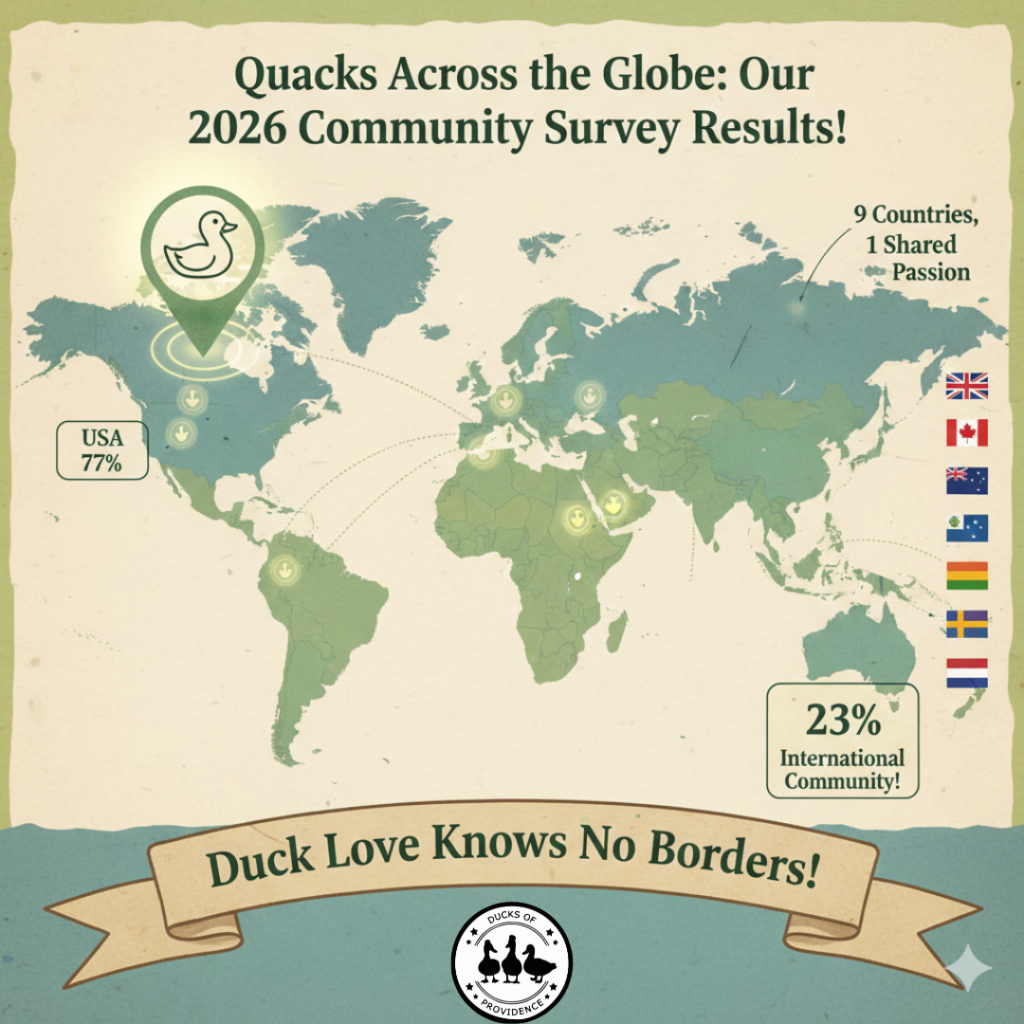
Perhaps most exciting was hearing from our more distant neighbors in Belize and India, proving that whether your ducks are splashing in a tropical pond or a backyard pool in North Texas, the passion for their care remains the same. This survey reminds us that while our methods might vary based on our local environment, the joy of the “quack” knows no borders.
The Heart of the Flock: Why We Keep Ducks
It’s one thing to know where our community is located, but it’s even more fascinating to understand why we bring these charming, chaotic birds into our lives. While every backyard is different, from the suburbs of North Texas to the countryside of Great Britain, our 2026 survey of nearly 100 keepers revealed that our motivations are rooted in three major pillars.
1. Companionship & Mental Well-being
Perhaps the most touching takeaway was the profound emotional connection we share with our birds. The survey proved that ducks are far more than livestock. They are healers and friends with distinct, hilarious personalities.
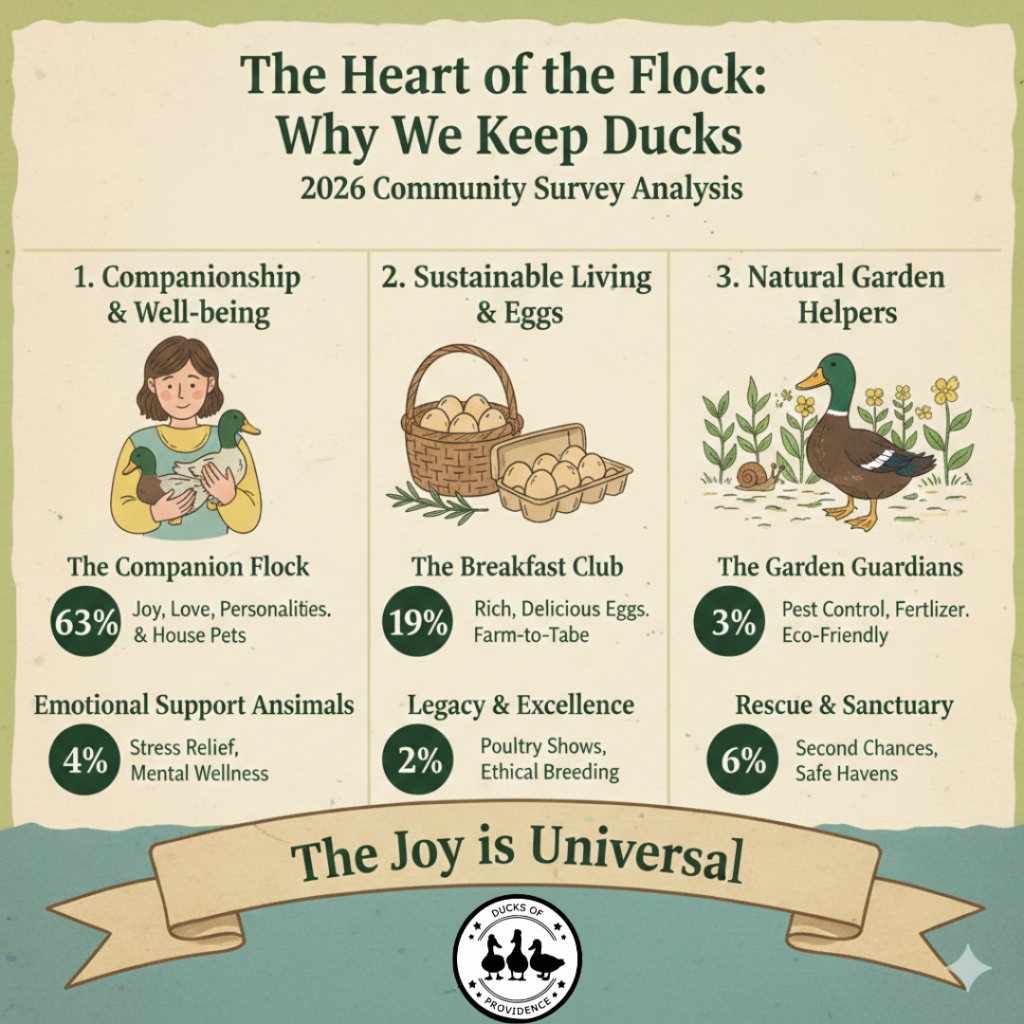
- The Companion Flock (63%): By far our largest group! Most of you keep ducks purely for the joy and love they provide. Whether they are indoor pets, backyard buddies, or even swimming pool surprises, the therapeutic sound of happy splashing offers a unique stress relief that resonates from Australia to Canada.
- Emotional Support & Wellness (4%): A dedicated segment of our community specifically identifies their ducks as Emotional Support Animals (ESAs), highlighting the vital role these birds play in our mental health.
2. Sustainable Living & Fresh Eggs
For many, the journey into duck keeping started with a quest for self-sufficiency and a farm-to-table lifestyle. Our community takes immense pride in knowing exactly where their food comes from and how the animals providing it are treated.
- The Breakfast Club (19%): You know that duck eggs are a baker’s secret weapon! With higher fat content and larger yolks, they are the gold standard for fresh eating.
- Legacy & Excellence (2%): A specialized group focuses on the heritage of these birds through poultry shows and breeding, preserving excellence for the next generation of keepers.
3. Natural Garden Helpers (The Pest Patrol)
Ducks don’t just live in the garden; they help it thrive. Our keepers, especially those in wetter climates like the Netherlands or Sweden, unanimously agree that ducks are a vital part of a working household.
- The Garden Guardians (3%): From clearing out slugs and snails to providing high-nitrogen fertilizer, these Pest Patrol units are eco-friendly alternatives to chemicals.
- Rescue & Sanctuary (6%): A beautiful part of our mission involves providing a Haven for the Homeless. Many of our garden helpers are rescues, given a second chance to live a productive, happy life in a safe environment.
The Takeaway
Whether you are raising them for the eggs, the garden, or simply the morning waddle-out, one thing is clear: The Joy is Universal. We may be spread across the globe, but we are united by the same bill and a shared passion for avian excellence.
Flock Composition: The Art of the Balance
Maintaining a healthy flock isn’t just about how many birds you have. It’s about the social dynamics between them. As our 2026 survey shows, the Drake-to-Hen ratio is the most discussed topic among keepers, as an imbalance can lead to stress, feather loss, or injury during the enthusiastic mating season.
1. The Community Breakdown
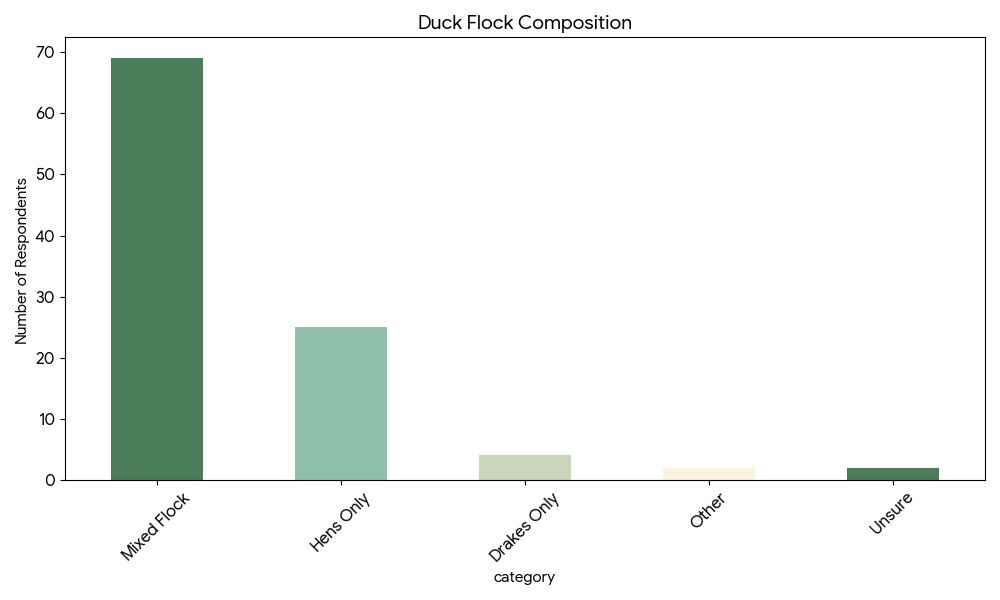
According to nearly 100 responses, the Mixed Flock (68%) is the standard, but it’s not the only way to find success:
- Hens Only (25%): The Quiet & Productive choice. These keepers enjoy a peaceful backyard and consistent egg production without the drama of mating season.
- Drakes Only (4%): The Bachelor Pad approach. Interestingly, drakes often get along famously when there are no hens to compete over.
- Mixed Flocks (68%): The majority, where the ratio becomes the primary focus of management.
2. The Critical Drake-to-Hen Ratio
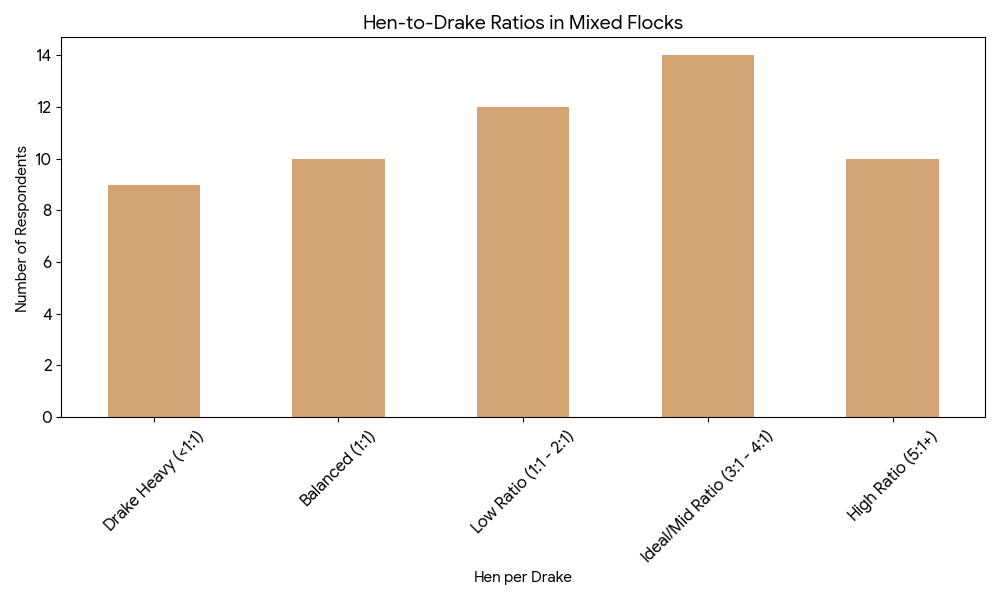
Our survey data reveals that while experts recommend a specific Safe Zone, reality is often more complex. Here is how our community compares to the standard guidelines:
| Ratio | Community Data | Status | The “Why” |
| 1 Drake : 4-6 Hens | 47% | Ideal | The Sweet Spot. This ensures no single hen is over-mated, keeping the flock calm and healthy. |
| 1 Drake : 3 Hens | Community Avg. | Minimum | Manageable, but requires close monitoring during the spring hormone surge. |
| 1 Drake : 1-2 Hens | 43% | High Risk | Often leads to over-mating. Many in our community manage this by using separate enclosures or bachelor pads. |
| Drake Heavy | 10% | Expert Level | When drakes outnumber hens, strict separation is usually required to ensure hen safety. |
Flock Size: Finding the Sweet Spot
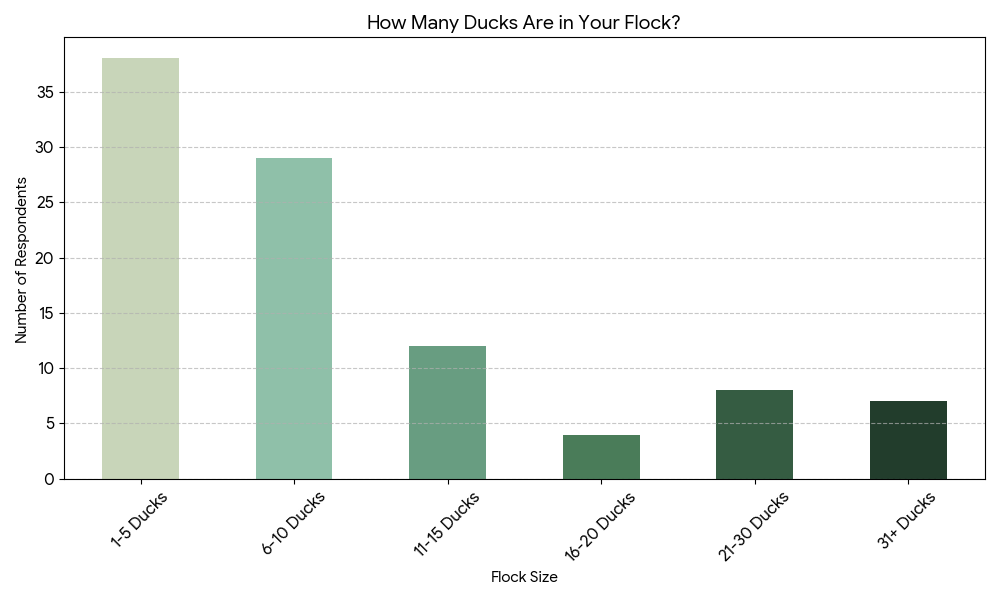
While some of our members manage sprawling sanctuaries, the vast majority of our duck community prefers a more intimate flock size. Based on nearly 100 survey responses, we’ve identified a clear sweet spot for backyard duck keeping.
The Numbers at a Glance
- The Backyard Majority (68%): Most of our community keeps between 1 and 10 ducks. Specifically, 39% have a small flock of 1–5 birds, and 29% have a medium flock of 6–10. These sizes are ideal for maintaining a personal connection with each bird while keeping garden maintenance manageable.
- The Growing Flock (16%): About 16% of you have stepped up to 11–20 ducks. This often marks the transition from hobbyist to a more serious breeding or high-production egg setup.
- The Serious Keepers & Sanctuaries (15%): Roughly 15% of our community manages 21 or more ducks, with several members caring for 30+ birds! These are our most experienced keepers, often running rescues or large-scale homesteads.
Why the Sweet Spot Matters
Keeping 4–7 ducks (the center of our 1–10 range) is often recommended because:
- Social Stability: Ducks are incredibly social; this size provides enough friends for everyone without causing clique drama.
- Husbandry: It’s easier to spot health issues or changes in personality when you are monitoring a smaller group.
- Water Management: As every duck owner knows, water management is the biggest chore. A flock of 6 is much easier to keep clean than a flock of 16!
Community Insight: Growing Your Flock
Interestingly, several respondents mentioned that they started in the 1–5 category but quickly moved into the 6–10 range, a phenomenon we like to call Duck Math. It’s hard to stop at just a few when each breed has such a unique personality!
4. The Accidental Drake Phenomenon
A common thread in our survey was the surprise drake. Many keepers started with straight run (unsexed) ducklings, ending up with a 50/50 split. This accidental ratio is exactly why so many of our community members have become experts in building separate drakes-only quarters!
The Breed Census: What’s in Your Flock?
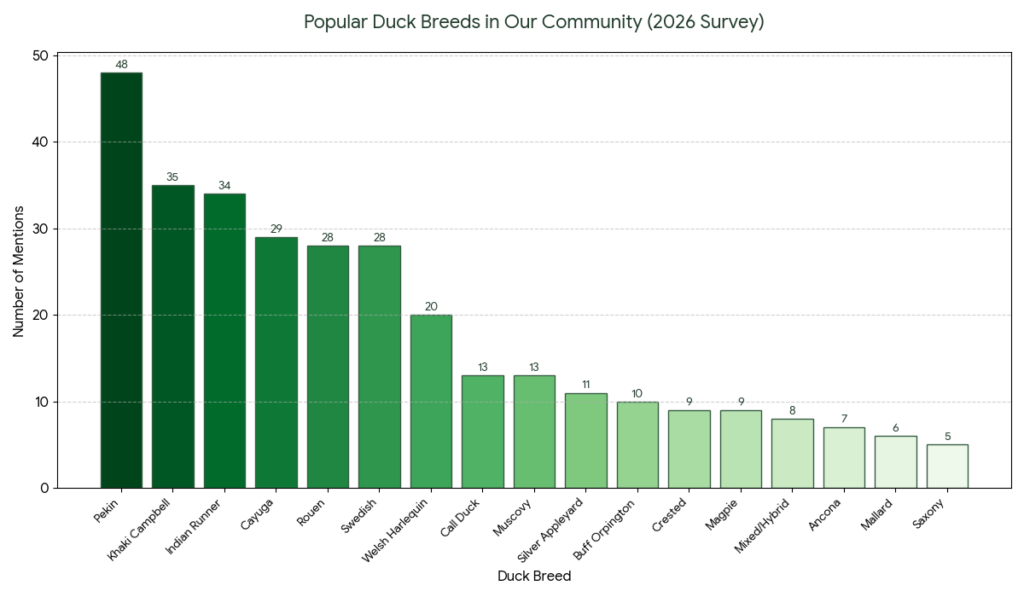
One of the most exciting parts of our 2026 survey was seeing the incredible diversity of breeds represented in your backyards. From the iconic white Pekin to the iridescent shimmer of the Cayuga, the duck community is a beautiful patchwork of heritage and utility breeds.
We analyzed nearly 100 responses to see which ducks are leading the pack. Here is the official 2026 Breed Census:
1. The Big Three Staples
Nearly every other respondent has at least one of these in their flock. They are the backbone of the backyard duck world:
- The Pekin (49% of flocks): The undisputed favorite. Their friendly (and vocal!) nature makes them the perfect starter duck.
- The Khaki Campbell (35% of flocks): The efficiency experts. For those in our Breakfast Club, the Campbell is the gold standard for consistent egg production.
- The Indian Runner (34% of flocks): Our bowling pins on legs. They are the community’s top choice for active garden pest control and endless entertainment.
2. The Heritage & Beauty Tier
Our community clearly has an eye for aesthetics and history. These breeds are prized for their stunning plumage and calm temperaments:
- Cayuga & Rouen: Practically tied in popularity, these breeds offer classic beauty, whether it’s the beetle-green iridescence of the Cayuga or the majestic, wild-mallard look of the Rouen.
- Swedish & Welsh Harlequin: These calico beauties are favorites for keepers who want a calm, docile bird that doubles as a stunning garden companion.
3. The Personality Specialists
Finally, we saw a strong showing for ducks with very specific jobs or traits:
- The Silent Muscovy: A favorite for those with close neighbors, as they hiss instead of quack.
- The Socialite Call Duck: Miniature ducks with massive personalities that prove good things come in small packages.
- The Rare Gems: We even saw entries for Silver Appleyards, Saxony, and Magpies, heritage breeds that our community is helping to keep thriving.
Community Insight: The Confetti Flock The most surprising takeaway? Only 12% of respondents keep a single breed. The vast majority of you have Confetti Flocks, a mix of three or more breeds living together. It seems that once you start learning about different duck personalities, it’s impossible to stop at just one!
How People Actually Keep Their Ducks
As part of this survey, I asked duck keepers one specific question:
How do you keep your ducks?
The responses were incredibly insightful. Even though this was just one data point among many we are analyzing, it revealed a clear and encouraging pattern.
Across different property sizes, climates, and regions, responsible duck keeping follows remarkably similar principles. Housing is secure. Predators are considered. Water access is prioritized. Biosecurity is not an afterthought.
In other words, geography may differ, but good husbandry does not.
Ducks Are Not Just for Large Farms
One of the biggest surprises from this survey was how many people are successfully keeping ducks on smaller properties.
While there is a strong representation of duck keepers on 1–5 acres, a significant portion of respondents reported living on:
• Less than 1/4 acre
• 1/4 to 1 acre
In other words, many ducks are thriving in suburban backyards, not just on sprawling rural homesteads.
Yes, there are duck owners with 5+ acres, ponds, and pasture. But acreage alone does not determine success. In fact, several large-property owners still rely heavily on fenced runs, electric netting, and supervised free ranging.
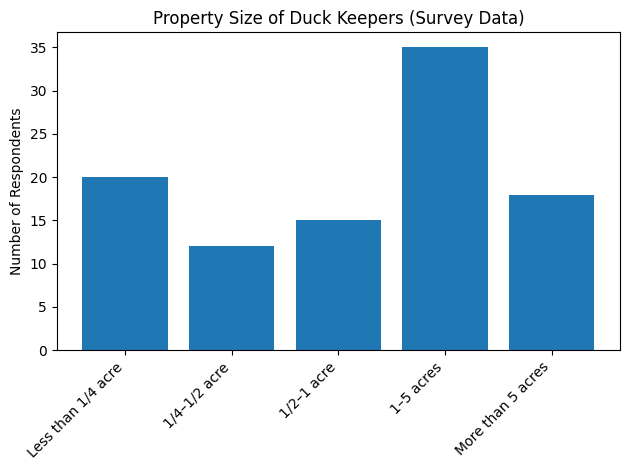
The key is not land size. It is structure.
Successful backyard duck keepers focus on:
• Predator-proof housing
• Thoughtfully designed runs
• Reliable water systems
• Consistent daily management
Ducks do not require vast open fields. They require safe, well-planned environments.
If you live on a smaller property and have wondered whether ducks are possible, this data should be reassuring. With proper planning and responsible setup, backyard duck keeping is absolutely achievable, even in compact spaces.
Free Ranging: Freedom With Boundaries
When it comes to free ranging, the data reveals something important.
The majority of duck keepers do allow their ducks to roam outside of a confined run, but most do so with supervision.
Unrestricted, full-property free ranging certainly exists, particularly on larger acreages. However, it is not the dominant practice. A substantial portion of respondents either supervise free time carefully or rely on aviaries and enclosed systems instead.
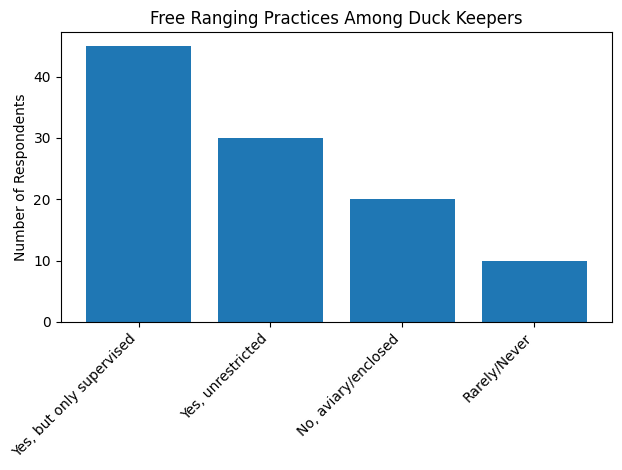
This tells us something significant.
Backyard duck keeping is rarely casual.
Even those with multiple acres often limit unsupervised roaming. Predator pressure, traffic, neighbor proximity, and aerial threats do not disappear simply because property size increases.
Pet Ducks vs Homestead Ducks
Free ranging also depends heavily on your focus as a duck keeper.
If your ducks are primarily:
Companion animals: You are more likely to supervise closely, limit exposure to risk, and prioritize controlled environments. Injury prevention and long-term health are central concerns.
Part of a homestead system: You may allow more extensive ranging for pest control, pasture management, or rotational grazing. Infrastructure often includes electric net fencing, livestock guardian animals, or structured pasture rotation.
Neither approach is inherently right or wrong. They simply reflect different priorities.
Pet-focused duck keepers often emphasize safety and monitoring. Homestead-focused keepers may emphasize land integration and functional roles within the property.
What remains consistent across both groups is intentionality.
Very few respondents described a completely hands-off approach. Most layered their management with fencing, timing, supervision, or enclosure systems.
Free ranging, when done responsibly, is rarely about unlimited freedom. It is about managed access.
And that distinction matters.
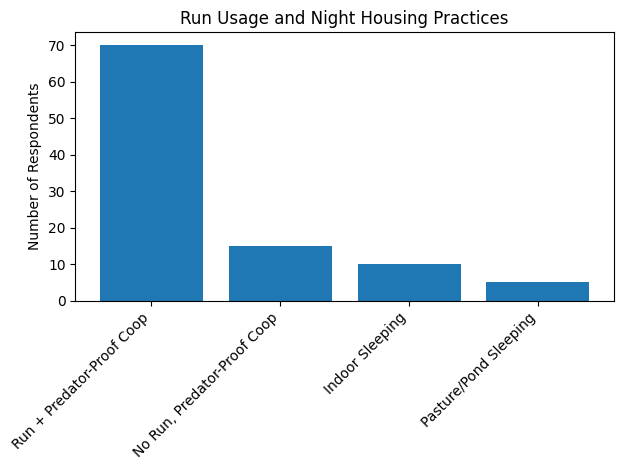
Runs and Coops: Security Is the Standard
If there is one pattern that stands out clearly in this survey, it is this:
Most duck keepers prioritize secure housing.
The overwhelming majority of respondents reported using a predator-secure coop for nighttime housing, and most also use a dedicated run during the day. Even among those who do not have a formal run structure, secure sleeping arrangements were still the norm.
Very few ducks are left to sleep on open pasture or ponds without protection.
This is important.
Predator attacks most commonly occur at night. Raccoons, foxes, coyotes, owls, and neighborhood dogs are active when ducks are resting and most vulnerable. Even large acreage does not eliminate this risk.
In fact, many respondents with multiple acres still rely on:
• Covered runs
• Hardware cloth
• Electric fencing
• Double-gated entries
• Layered perimeter systems
Acreage alone does not equal safety.
What protects ducks is structure.
Protective Measures: Layered Defense Is Common Practice
Beyond coops and runs, the survey revealed something equally important:
Most duck keepers do not rely on a single line of defense.
They layer protection.
Even those with secure housing often add additional safeguards, especially during free ranging or peak predator seasons.
Structural Reinforcements
Many respondents mentioned reinforcing their setups with:
• Hardware cloth lining
• Buried fencing or no-dig barriers
• Covered runs or aviaries
• Double-gate entry systems
• Padlocks and reinforced doors
Several described highly engineered systems with layered mesh, underground barriers, and roofed enclosures. This reflects a proactive mindset rather than a reactive one.
Electric Fencing
Electric poultry netting and perimeter fencing were frequently mentioned, particularly on larger properties or in rotational grazing systems.
Electric fencing offers flexibility:
• Temporary pasture rotation
• Seasonal adjustments
• Expanded daytime grazing areas
Even those using electric fencing typically still secure ducks inside predator-proof housing at night.
Guardian Animals
Some duck keepers use:
• Geese
• Livestock guardian dogs
• Farm dogs
• Donkeys
Guardian animals can act as deterrents, particularly for ground predators. However, they are rarely used as the sole form of protection. Most respondents still rely on secure housing and fencing.
A guardian is a supplement, not a substitute for structure.
Technology and Deterrents
Modern backyard setups often include:
• Motion sensor lights
• Cameras
• Audible alarms
• Reflective deterrents
• Radios or white noise
These tools are especially common in suburban settings where predator pressure may be unpredictable.
Firearms
Firearms were mentioned repeatedly in the survey, particularly by respondents living on larger acreage.
In rural settings, some duck keepers view firearms as a last-resort response to active predator threats, especially where livestock loss can occur.
However, even among those who mentioned firearms, they were typically described as one component of a broader protection strategy, not a primary or preventative measure.
Preventive infrastructure, secure housing, and fencing remain the first line of defense.
What This Tells Us
Across property sizes and regions, one principle stands out: Responsible duck keepers think in layers.
They do not assume their area is predator-free. Even respondents in low-risk regions still use fencing and secure housing.
Protection is not based on optimism. It is based on preparation.
For beginners, this is one of the most valuable lessons from the survey: Safety comes from thoughtful design, not property size.
When secure coops, well-built runs, fencing, supervision, and additional deterrents work together, the result is a flock that can thrive with significantly reduced risk. And that consistency across so many different setups is both reassuring and instructive.
What Does a “Duck Pond” Really Look Like?
If you spend any time online, you might get the impression that ducks require a large natural pond to live happy, healthy lives.
The most common water setups reported were:
The survey data tells a different story.
• Small kiddie pools
• Large pet pools
• Water bowls and troughs
Yes, some respondents have real ponds, streams, or large natural water features. But even among those with access to ponds, many still rely on supplemental pools.
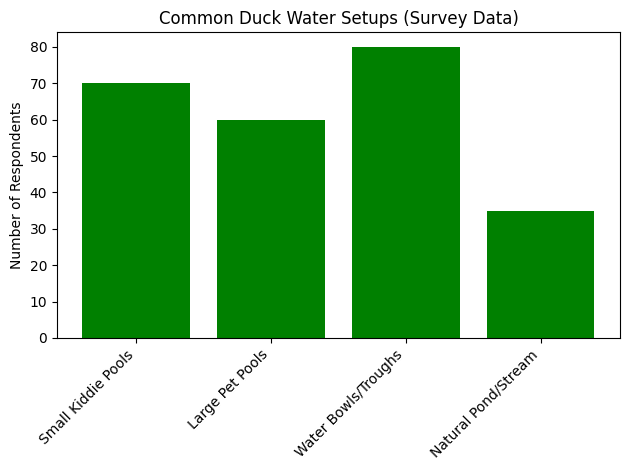
Why? Because controlled water is easier to manage. Natural ponds are beautiful, but they can:
• Accumulate parasites
• Attract wild waterfowl
• Be difficult to clean
• Become stagnant in hot weather
Kiddie pools and pet pools, on the other hand, allow duck keepers to:
• Dump and refresh water regularly
• Monitor cleanliness
• Control depth
• Maintain better hygiene
For small backyard setups, pools are often the most practical solution. And here is the most important takeaway: Ducks do not require a large pond to be healthy. They require:
• Water deep enough to submerge their bills
• The ability to clean their nostrils and eyes
• Access for occasional bathing
• Clean drinking water at all times
That can be achieved with a simple, well-maintained pool.
Even many duck keepers with multiple acres and natural water features supplement with troughs or pools to ensure consistent access to clean water. The idea that you need a lake to keep ducks responsibly is simply not supported by how most people are actually doing it. What matters most is not the size of the water source. It is cleanliness, accessibility, and regular maintenance.
What This Tells Us
Across property sizes and regions, the patterns are consistent:
• Most duck keepers use secure runs
• Most supervise free ranging
• Most lock ducks in at night
• Most rely on pools rather than natural ponds
• Most use layered predator protection
Backyard duck keeping is not about unlimited space. It is about thoughtful design. And that is encouraging. It means you can keep ducks responsibly on a small property if you plan well.
The Duck Diner: Nutrition & Feeding Trends
What goes into a duck determines what comes out: whether that’s healthy feathers, high-quality eggs, or just a happy quack. Our 2026 survey highlights the brands and habits that keep our community’s flocks thriving.
1. Top Commercial Food Brands
The North American Frontrunners
For our members in the USA and Canada, the feed choice is often a balance between high-end specialized nutrition and local convenience:
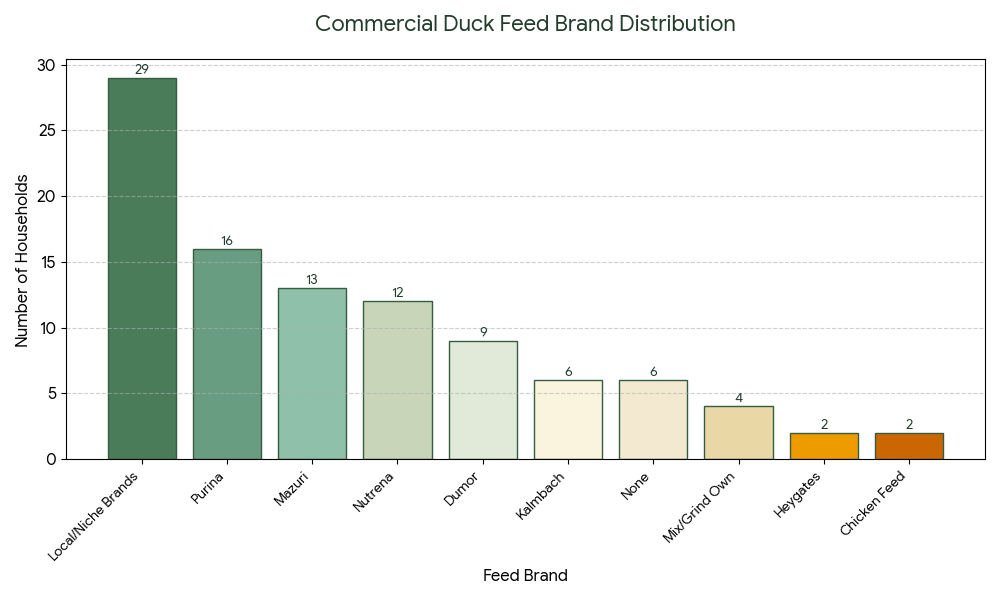
- Purina (16%) & Mazuri (13%): These two are often seen as the “gold standard” for domestic waterfowl. Mazuri is particularly beloved by those focused on long-term wellness and exotic-level nutrition; many who switched to this brand did so specifically for its high-quality ingredients and lower fines (the dusty powder at the bottom of the bag). Purina remains a staple for its accessibility and consistent results in bird health and feather quality.
- Nutrena (12%) & Dumor (9%): These are the workhorses of the community. Largely available at major retailers like Tractor Supply, they are the go-to for many keepers who need reliable feed that is always in stock. Nutrena is often praised for its “All Flock” versatility, while Dumor is a frequent choice for those looking for a solid value without sacrificing basic nutritional requirements.
The Global Menu: Duck Love Without Borders
Our survey truly highlighted the international reach of our flock! Since many of our members reside in Great Britain, Australia, Sweden, and the Netherlands, the Big Four above aren’t always on the menu.
- In the UK, keepers rely on specialized heritage brands like Allen & Page (Smallholder Range) or Heygates, which offer non-GMO and soy-free options that are highly regarded for producing flavorful eggs.
- In Australia, brands like Feed n Fire or Red Hen are the regional favorites, tailored to the specific climatic needs of the Southern Hemisphere.
- Across Europe, from Versele-Laga to local Swedish mill mixes, our international friends prove that while the brand names change, the commitment to “duck-first” ingredients is a global constant.
The Switchers: Why the Change?
About 40% of you have changed your ducks’ primary diet at least once. This isn’t just about being picky; it’s about attentive husbandry. The most common reasons for the swap included:
- Dust & Fines: No one likes paying for a bag of powder. Excessive dust can cause respiratory issues in ducks and lead to significant waste.
- Egg Performance: Several keepers noted they switched to a higher-calcium Layer pellet or a more nutrient-dense brand after seeing a dip in egg production or shell strength.
- The Expert Influence: Many of you moved to organic or soy-free brands (like Grubbly Farms or New Country Organics) after meeting a local duck guru or researching the impact of diet on the taste of the eggs.
Finding the right food is a journey, 40% of you have already switched brands at least once! To help you navigate the feed aisle, I’ve put together a head-to-head breakdown of the market’s top players.
Check out our Commercial Duck Feed Comparison Guide.
In this post, we put the top brands head-to-head to help you find the best fit for your Confetti Flock. Whether you are looking for the high-end nutritional density of Mazuri, the reliable accessibility of Purina and Nutrena, or organic alternatives like Grubbly Farms, my guide compares the protein levels, calcium content, and niacin for each.
2. Maintenance vs. Layer: The Great Debate
With a nearly perfect 44% to 44% split, our community is divided between those prioritizing long-term physical maintenance and those focused on peak egg production. This isn’t just a matter of brand preference; it’s a reflection of the different roles ducks play in our lives.
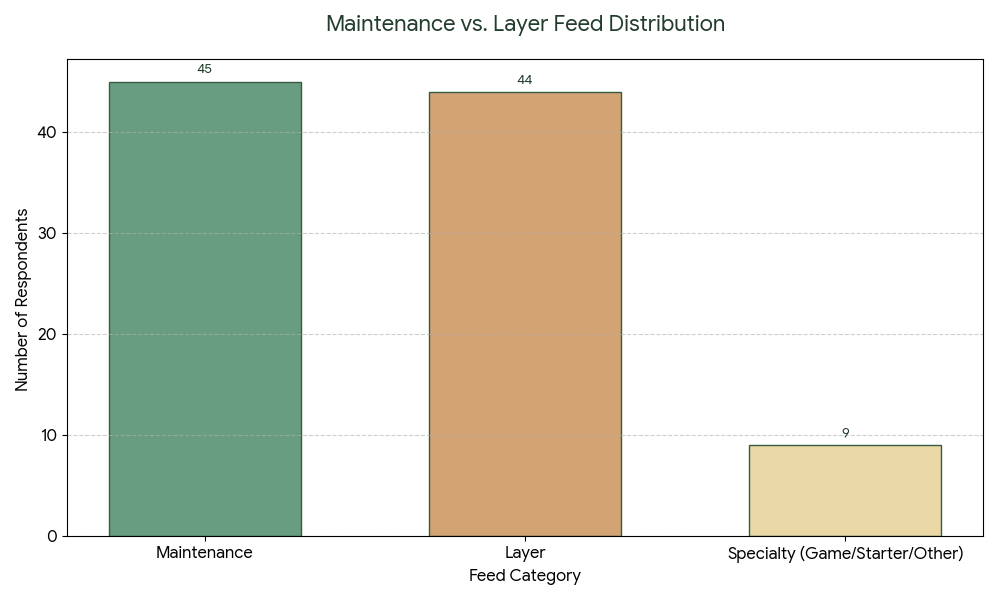
The Maintenance Philosophy (45%)
For the nearly half of our community choosing Maintenance feed, the goal is often longevity and weight management. Maintenance pellets typically contain lower protein and calcium levels (usually around 14% protein), which is ideal for:
- Drakes: Males do not need the extra calcium found in layer feed, which can actually cause kidney issues over time.
- Pet Ducks: Keeping weight in check to prevent leg and joint issues like bumblefoot.
- The Off-Season: Providing a nutritional break for hens during the winter months when they naturally stop laying.
The Layer Priority (44%)
The other half of the community treats their ducks as the engines of the backyard. Layer feed is specifically formulated with higher calcium (usually 3% or more) and protein (16–17%) to support the massive physical toll of producing an egg nearly every day.
- Egg Shell Integrity: Preventing soft-shelled eggs, which can lead to life-threatening egg binding.
- High-Producers: Essential for breeds like Khaki Campbells or Runners that are bred specifically for high output.
The Mixed Approach & The Savvy Middle Ground
The most interesting takeaway came from the savvy keepers who refuse to choose just one. Many respondents utilize a Phase Feeding strategy:
- The Spring Switch: Many keepers use Maintenance all winter and switch to Layer feed only when the first spring eggs appear.
- The All-Flock Compromise: A popular community hack is to feed an All-Flock/Maintenance base to the whole group to keep the drakes safe, while providing a separate, free-choice bowl of Oyster Shells. This allows the laying hens to self-regulate their calcium intake without over-supplementing the boys.
3. Feeding Schedules: Grazers vs. Timed Diners
Ducks follow a specific digestive plan that is often misunderstood. Unlike chickens, which possess a true crop, a distinct, pouch-like sac for long-term food storage, waterfowl rely on a highly expandable section of the esophagus. This flexible structure serves as a functional equivalent to a crop, allowing ducks to store food temporarily before it moves toward the gizzard.
Because this setup functions more like a steady conveyor belt than a large-capacity storage tank, ducks are natural grazers that prefer smaller, frequent meals throughout the day. In our community, managing this grazing instinct generally falls into two distinct philosophies.
The Free Choice Advocates (63%)
The majority of our keepers provide either 24/7 access or Day-Only availability.
- Preventing Food Anxiety: Many of you noted that keeping food available at all times prevents the stampede effect. When ducks know food is always there, they are calmer and less likely to gorge themselves, which leads to better digestion.
- Consistent Growth & Laying: For those with high-production hens, constant access to nutrients ensures they have the energy required for daily egg-laying.
- The Day-Only Compromise: A large subset of this group pulls the food at night. This is a brilliant management tactic to prevent attracting nocturnal rodents and predators to the coop, while still allowing the ducks to graze freely during their active hours.
The Scheduled Meal Philosophy (30%)
About a third of the community sticks to a strict 1–2 times per day feeding routine. This isn’t just about discipline; it’s a strategic choice for specific backyard environments:
- Pest & Rodent Control: By feeding only what the ducks can finish in 15–20 minutes, you leave zero “leftovers” for rats, mice, or wild birds.
- Encouraging Foraging: Many of you use scheduled meals to ensure your ducks spend their day working for you: hunting for slugs, snails, and grass in the yard, rather than just sitting by the feeder.
- Training & Bonding: Scheduled feeding creates a recall. Your ducks learn that a specific time (or a specific whistle/bucket rattle) means food, making it much easier to herd them back into the security of their coop at sunset.
The Water Connection Rule
Regardless of the schedule, a common piece of advice shared by our veteran keepers is the No Food Without Water rule. Because ducks need to flush their bills and dry pellets can be a choking hazard, 100% of our successful keepers ensure that whenever food is present, deep water is right next to it.
4. The Treat Hierarchy
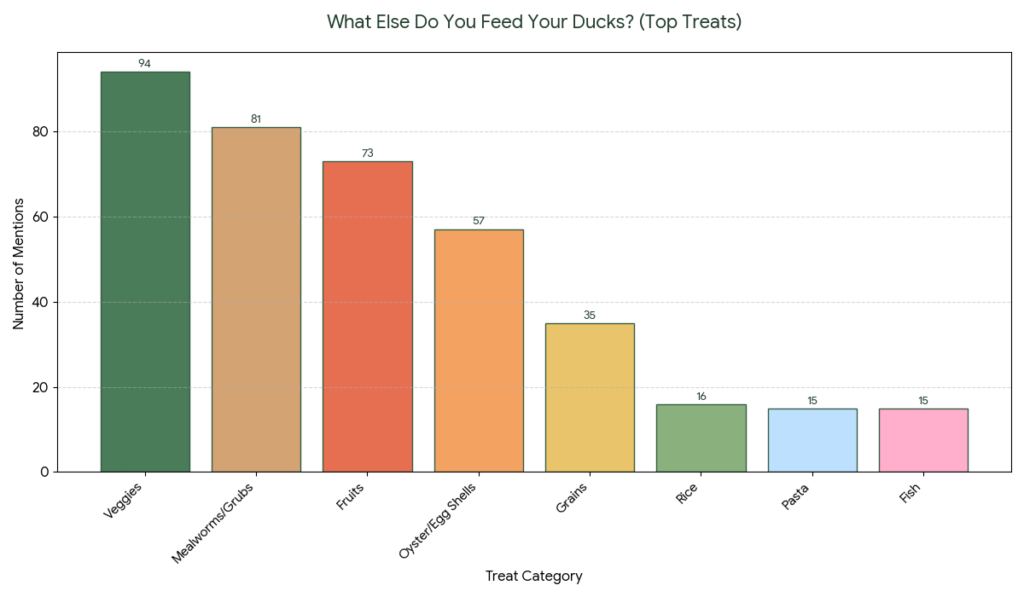
While ducks can be notoriously picky, turning their bills up at one brand of lettuce while devouring another, our community has identified a clear hierarchy of snacks. These aren’t just empty calories; they are functional tools for training, health, and seasonal hydration.
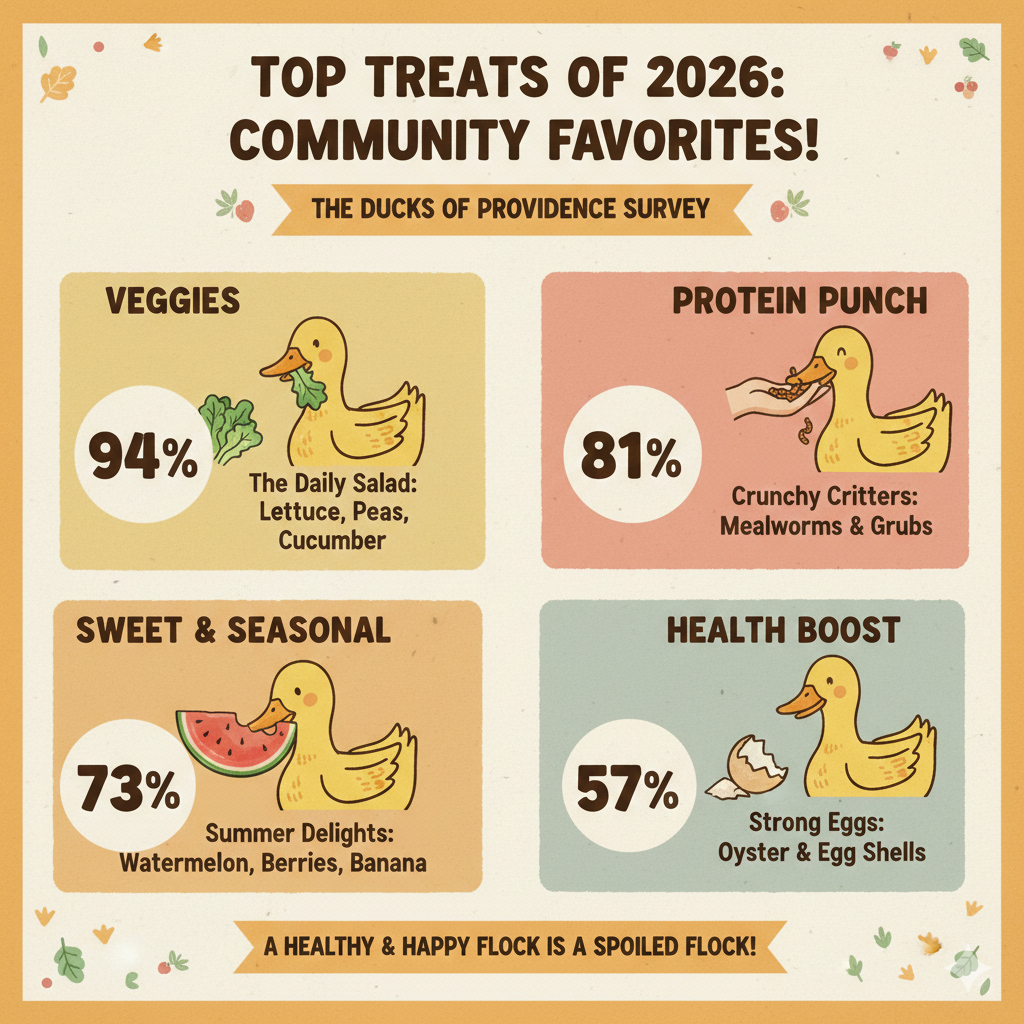
With nearly 94% of respondents supplementing their ducks’ diet with fresh treats, it’s clear that spoiling the flock is a universal hobby. Here is how those favorites break down into functional categories.
The Gold Standard: The Daily Salad (94%)
Veggies are the cornerstone of a healthy duck’s supplemental diet.
- The Green Favorites: Lettuce (avoid iceberg), cucumber, and the legendary frozen peas are the universal winners.
- The Foraging Factor: Many keepers use these greens in a treat bowl filled with water, which mimics the natural dabbling behavior ducks use in the wild. This keeps them hydrated while they snack.
The Protein Punch: Training & Rewards (81%)
Mealworms and grubs aren’t just snacks; they are the ultimate currency for duck keepers.
- Recall Training: Over 80% of you use dried mealworms or Black Soldier Fly Larvae (like Grubbly Farms grubs) to build a strong recall. When your ducks hear that bag crinkle, they know it’s time to head into the safety of the coop for the night.
- The Bedtime Routine: It’s the perfect tuck-in snack that provides a quick protein boost, which is especially helpful for growing ducklings or molting adults.
The Seasonal Highlight: Hydration & Happiness (73%)
Fruit is the highlight of the summer months, providing much-needed hydration during the Texas heat and beyond.
- The Watermelon Legend: Watermelon is the undisputed king of summer. It’s high in moisture and provides a cooling effect.
- Berries & Bananas: Blueberries and strawberries are frequently used as high-value treats for bonding.
Health Essentials: The Invisible Treat (57%)
Over half of our community correctly identifies calcium as a non-negotiable health essential rather than just a snack.
- The Shell Solution: Providing free-choice Oyster Shells or crushed, dried eggshells ensures that laying hens can maintain their calcium reserves without over-supplementing the drakes in the flock.
- Nutritional Insurance: This is especially vital for the high-production breeds in our Confetti Flocks, preventing the thin shells or soft-shelled eggs that can lead to health complications.
Community Insight: Taco Bell & Cheese?
We love the honesty in our survey! From the occasional special occasion cheese to the duck who apparently got into some Taco Bell, it’s clear our ducks are living their best lives. However, the majority of you stick to the healthy basics to ensure long-term health.
The Roll Call: From Quackers to Andre 3000
Analyzing the names of our community’s ducks was perhaps the most entertaining part of the entire survey! It’s clear that when it comes to naming, our keepers are incredibly creative, often drawing inspiration from their favorite snacks, pop culture, and high-fashion aesthetics.
After looking through hundreds of names, a few hilarious and heartwarming naming tribes emerged.
1. The Baristas (Coffee & Sweets)
A huge portion of our community looks to their morning brew for inspiration. We have an entire cafe’s worth of ducks out there:
- The Coffee Crew: Flat White, Cappuccino, Mocha, Espresso, Chai, Matcha, and Dalgona.
- The Bakery: Pumpernickel, Waffles, Pancake, Muffin, and Pumpernickel.
- The Candy Aisle: Jolly Rancher, Blue Razz, Tiramisu, and Skittles.
The food and drink category is by far the largest. Beyond the lattes, we have a full pantry:
- The Spice Rack: Cayenne, Ginger, Saffron, Sage, Nutmeg, Cinnamon, and Pepper.
- The Breakfast Club: Syrup, Benedict, Toast, and even Applesauce.
- Sweet Treats: Oreo, Cheesecake, Butterscotch, Fudge, Marmalade, and Jelly.
2. The Nostalgia Flocks
Pop culture is alive and well in the coop! Many of you named your flocks after iconic groups:
- The Gilmores: Lorelai, Rory, and Emily.
- The Nintendo Gang: Bowser, Yoshi, Peach, and Rosalina.
- The Disney/Donald Family: Webby, Goslin, Magica, and even a “Darkwing.”
- The Buffyverse: Buffy, Willow, Cordelia, and Anya.
- Star Wars Fans: Solo, Solum, and Seven of Duck.
- Middle-earth: Frodo and Legolas (or Legolias as one keeper lovingly spelled it).
- The Classics: Lady Macbeth for the drama fans, and Batman and The Penguin for the comic book lovers.
- Sitcom Squads: The Friends cast made an appearance with Monica, Rachel, and Pheebs.
3. The Duck Puns
Some keepers lean into the classic waterfowl identity with a wink:
- Punny Names: Quackers (the overall most popular name!), Aflac, Rubber Ducky, and the clever Quackery-Daiquiri.
- The Literalists: Many of you keep it simple with names like Duck, Duckie, or White Duck.
4. Nature & Elegance
Reflecting the beauty of our breeds, many names pull from the garden:
- Botanical Beauties: Ivy, Iris, Poppy, Willow, Petunia, and Saffron.
- Celestial & Color: Indigo, Violet, Aurora, and Midnight.
- The Meadow: Daisy, Tulip, Bluebell, Marigold, and Clover.
- The Orchard: Maple, Olive, Cherry, and Clementine.
- The Elements: Stormy, Cloudy, Sunny, and Snowflake.
5. The I Can’t Believe You Named Them That Gems
And of course, there are those names that just make us smile:
- The Professional: Mr. Quackers (presumably the CEO of the backyard).
- The High-End: Ducati and Carrera (for the faster ducks in the bunch).
- The Mystery: Grey Matter and 26.
- The Outliers: Karen, Andre 3000, Lady Macbeth, Taco Bell, and Seven of Duck.
- The Honorary Species: Several ducks are actually named Chicken or Goose.
6. The Rescues & Resilient Boys
Many of the names for the drakes and rescue boys suggest strong, classic personalities:
- The Boys: Bubba, Louie, Steve, and Ralph.
- The Gentlemen: Winston, Franklin, Arthur, George, and Herbert.
- The Cool Guys: Jax, Zeke, Rocky, and The Baron.
Beyond the Pond: The Heart & Soul of Our Flocks
The final question of our survey was an open invitation to share anything else about your flocks, and the responses were nothing short of heartwarming. Beyond the logistics of feed and breeds, it is clear that for this community, ducks aren’t just livestock. They are family, therapists, and a source of profound joy.
Here are a few gems and common themes from the stories you shared:
1. The Therapy Duck Effect
Many of you touched on the emotional impact of owning ducks. One keeper noted that while they originally did research to get ducks for eggs, they didn’t realize how therapeutic it would be to just sit with them. From 9-year-old veterans to those who have only had ducks for four weeks, the sentiment was the same: they bring peace to a busy yard.
2. They Aren’t Just Drakes, They’re Boys
There is a massive rescue heart in this community. We heard from people promoting the joys of Bachelor Flocks to combat the issue of drakes being dumped more often than hens. One respondent put it perfectly: “I don’t like calling them drakes… they are my children, so ‘boys’ is better.” We also saw a beautiful representation of disabled and differently-abled ducks, including Pips with a slipped tendon and emotional support babies who live indoors.
3. The Ghostbusters & Strollers
The level of integration into human life is incredible. We have ducks that:
- Watch Movies: One pair of rescued ducks reportedly loves watching the original Ghostbusters.
- Go to Town: Some of you use duck strollers to take your feathered friends out to schmooze with the public.
- Listen to Music: One runner duck and two Campbells have recently taken to enjoying short spells of listening to music with their carer.
4. Hard-Earned Wisdom
Among the stories were vital pieces of advice for the community:
- The Sunset Rule: A heartbreaking reminder of why lock-up is so important. One keeper lost a duck to a raccoon because they weren’t put to bed before dusk.
- Substrate Matters: A reminder that duck feet are sensitive; minimizing time on concrete and using soft substrates can prevent lifelong handicaps.
- The Texas Heat: For those in our neck of the woods, several people mentioned the necessity of bringing ducks inside for cooling relief during the brutal August peaks.
5. Duck Math and Family Dynamics
We saw several mentions of ducks living alongside chickens (up to 22 in one flock!) and the complex family hierarchies they form. One keeper described a tight hierarchy where a mom lives with her six sons and a dad lives with a son and three daughters, all of whom chose to stay together rather than find new territory.
A Heartfelt Thank You to Our Incredible Community!
We want to extend a massive Thank You to everyone who took the time to participate in our 2026 census. Whether you’ve been keeping ducks for decades or just brought home your first fluff-balls four weeks ago, your insights are truly invaluable.
Because of you, we’ve been able to paint a vivid picture of what modern duck-keeping looks like, from the nuances of esophageal anatomy to the shared joy of a Ghostbusters movie night with a feathered friend. This data doesn’t just sit in a spreadsheet. It helps us all become better, more informed keepers for the birds we love.
The Journey Continues!
If you haven’t had a chance to share your story yet, don’t worry, the survey is still open! We plan to keep this data set growing and will be performing a fresh analysis next year. Our goal is to see how the world of duck-keeping evolves over time. Will we see new favorite treats? A shift in breed popularity? Or will a larger data set reveal even more fascinating trends?
- New Keepers: We want to hear from you! Your fresh perspective is exactly what helps our community grow.
- Veteran Keepers: Your long-term data helps us understand the longevity and health of our senior ducks.
Click Here to Participate in the Ongoing Survey
Let’s keep learning, sharing, and waddling forward together. We can’t wait to see how our Confetti Flocks change by 2027!
Further Reading & Resources
- Key Findings from Our Survey on Duck Care (Results from 2025)
- Ultimate Duck Breed Comparison Guide: Find the Right Duck for Your Flock
- Commercial Duck Feed Comparison
- Duck Nutrition Myths vs. Facts: What Your Flock Really Needs
- Feeding Ducks: A Guide to Keeping Your Flock Happy and Healthy
- Free-Ranging Ducks: The Pros and Cons of Letting Your Flock Roam Freely
- Creating the Perfect Home for Your Pet Ducks: Housing, Space, and Safety Tips
Connect deeper with your flock. Discover more about duck psychology and social dynamics in the Community & Behavior Hub.