
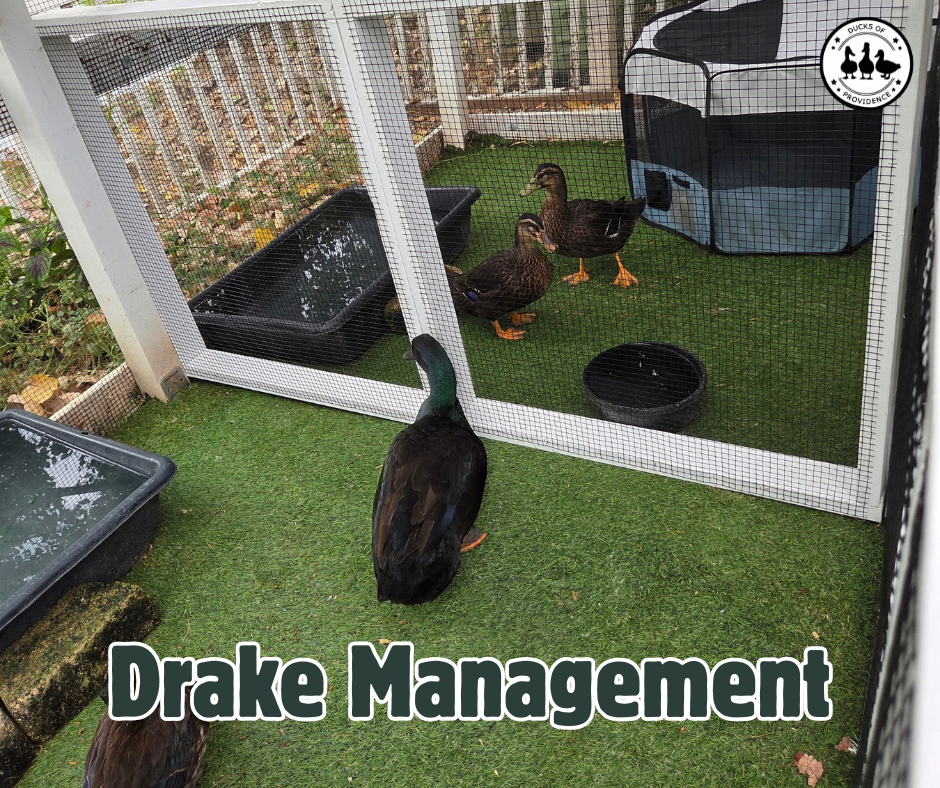
Drake Management: How to Keep Male Ducks Without Flock Drama

To keep our research-backed guides free, this site uses ads and affiliate links (earning a small commission at no cost to you). Everything here is created by a duck mom and PhD scientist, combining academic rigor with hands-on experience to provide practical, trustworthy advice for duck keepers everywhere. 🦆 Learn more
Drakes get a bad reputation. Search any duck-keeping group during breeding season, and you will find worried owners asking why their sweet male duck suddenly became aggressive, why he will not leave the hens alone, or whether they need to rehome him. But your drake is not a bad duck. He is a drake.
Male duck behavior is strongly influenced by hormones, particularly during breeding season. Chasing hens, frequent mating, guarding females, and competing with other drakes can all be part of normal reproductive behavior. The problem is that normal does not always mean safe. A persistent drake can exhaust or injure a hen, and competition between males can escalate into serious fights.
That is where responsible drake management comes in.
As duck keepers, we cannot expect our drakes to simply ignore their biology. What we can do is create a flock structure that allows them to express natural behaviors without putting other ducks at risk. That may mean maintaining a healthy drake-to-hen ratio, keeping an all male bachelor flock, separating ducks during breeding season, rotating different groups through shared spaces, or temporarily placing an overly enthusiastic male in what duck keepers affectionately call drake jail.
And yes, sometimes the flock that works beautifully in November becomes complete chaos by March. I have experienced this with my own ducks. Relationships change, hormones change, and the management strategy that worked yesterday may need to change with them.
In this guide, I will walk you through how to manage drakes responsibly, including flock ratios, bachelor groups, signs of overmating, seasonal separation, drake jail, and what to do when one particular duck becomes a target. My goal is not to teach you how to fix your drake. He probably does not need fixing. Your flock may simply need better management.
Because loving our drakes means accepting them for what they are while making sure every duck in the flock is safe.
Part of the Community & Behavior Hub, exploring the social complexity and psychological needs of domestic ducks.
Quick Navigation: Jump to a Section
[hide]
- What Changes When a Duckling Becomes a Drake?
- The Drake to Hen Ratio: Why Numbers Matter
- How to Tell When Your Hens Are Getting Too Much Attention
- Bachelor Flocks: An Underrated Solution for Drakes
- Seasonal Separation and Flock Rotation
- What Is Drake Jail and When Should You Use It?
- When One Drake Targets One Particular Duck
- Should You Rehome a Drake?
- What NOT to Do With a Hormonal Drake
- From Our Flock: How We Manage Simon During Breeding Season
- Frequently Asked Questions About Drake Management
- Good Drakes Need Responsible Keepers
- Further Reading & Resources
What Changes When a Duckling Becomes a Drake?
That sweet little duckling following you around the yard does not suddenly develop a bad personality when he reaches sexual maturity. His biology changes.
As young drakes mature, reproductive hormones begin influencing their behavior. You may notice more interest in the females, increased mating attempts, chasing, guarding preferred hens, or conflicts with other males. These behaviors can become especially intense during the breeding season, when reproductive activity naturally increases.
For new duck keepers, the change can be startling. A drake who peacefully shared food, water, and sleeping space with his flock all winter may suddenly seem obsessed with mating once breeding season begins.
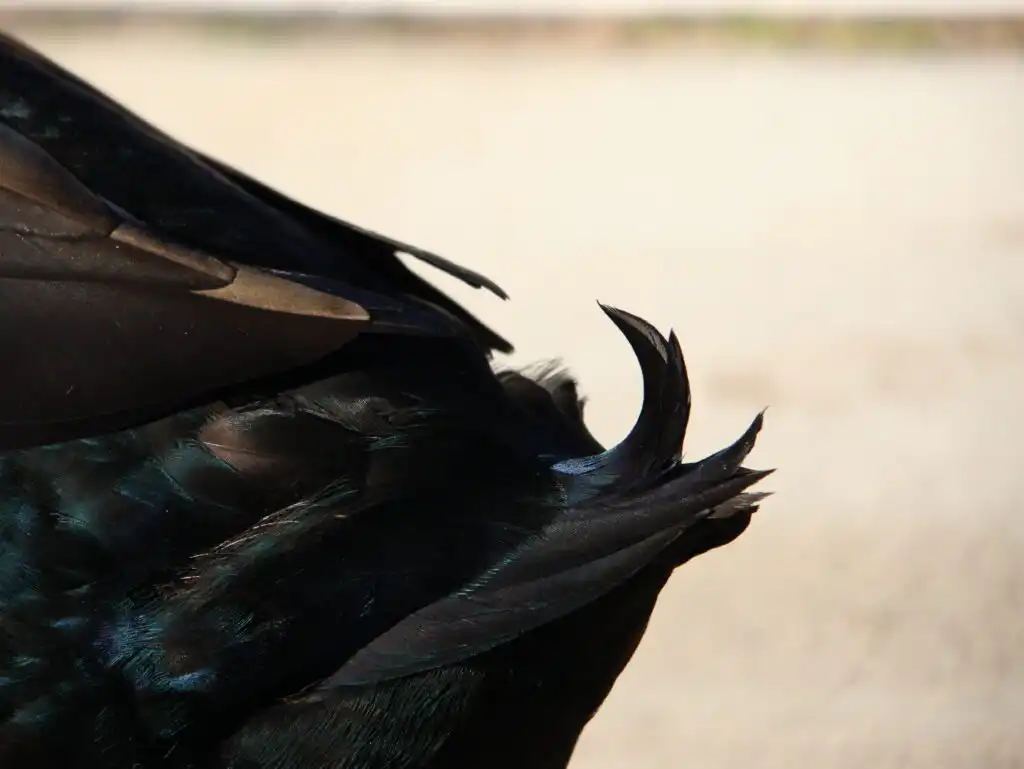
Hormones Can Change the Entire Flock Dynamic
Drake behavior does not happen in isolation. Once reproductive behavior increases, relationships throughout the flock can change.
Two males who previously got along may begin competing over females. One hen may become the favorite and receive far more attention than the others. A drake may start guarding a particular female or preventing another male from approaching her. Ducks lower in the flock hierarchy may also become easier targets when everyone is already a little more hormonally charged.
This is one reason I never assume that a peaceful flock will automatically remain peaceful year-round.
A flock is a dynamic social group, not a fixed arrangement.
Season, age, health, new flock members, available space, and individual personalities can all change how well a particular group of ducks functions together.
Normal Drake Behavior Can Still Become Dangerous
This distinction is incredibly important.
Mating is normal. Chasing a female as part of courtship or mating behavior can be normal. Competition between males can also be normal.
But we should not use “it is natural” as an excuse to ignore a duck who is being injured, exhausted, or relentlessly harassed.
A hen who cannot get away from repeated mating attempts needs our help. A duck being pinned down by several drakes needs our help. Two males whose competition has escalated into repeated fighting may need to be separated.
Our job is not to decide whether the drake means to hurt another duck. He is not making a moral decision about his behavior. Our job is to recognize when natural behavior has created an unsafe situation and change the environment before someone gets seriously hurt.
Breeding Season Can Bring Out a Very Different Drake
For many flocks, the most challenging period is the breeding season. Increasing daylight is an important environmental signal influencing seasonal reproductive activity in ducks, although the exact timing and intensity can vary with breed, age, climate, and the individual bird.
That means a drake who requires almost no special management during part of the year may need considerably more supervision or even temporary separation during another.
And that is okay.
Using gates, separate runs, flock rotations, bachelor groups, or temporary drake jail does not mean you failed to create a harmonious flock. It means you are responding to the flock you actually have rather than the flock you wish you had.
Once we understand that, the next question becomes much easier to answer: How many drakes can safely live with a group of hens?
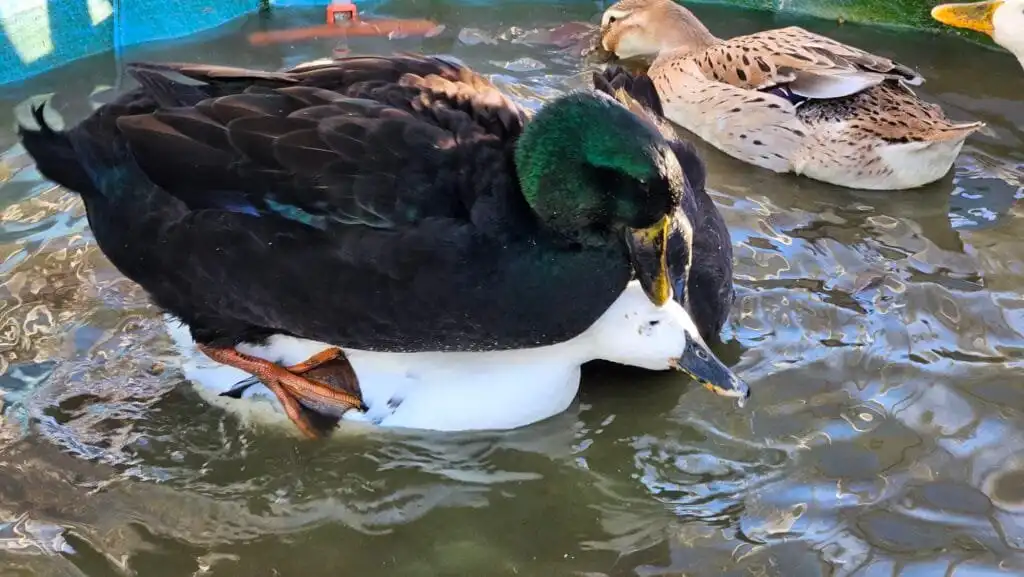
The Drake to Hen Ratio: Why Numbers Matter
One of the first pieces of advice new duck keepers hear is that they need a certain number of female ducks for every drake. You will often see recommendations of about four to six hens per drake.
That is a useful starting point, but I do not like treating the drake-to-hen ratio as a hard rule. There is no magic number that guarantees a peaceful flock.
You could have one drake with five hens and still have problems if he relentlessly favors one particular female. Meanwhile, another flock may function well with a somewhat different ratio because the drake is less persistent, the ducks have plenty of space, and the females can easily move away from him.
The ratio matters, but the ducks in front of you matter more.
Why Too Few Hens Can Become a Problem
When a drake lives with only one or two females, all of his reproductive attention is concentrated on those ducks. During periods of intense hormonal activity, that can become exhausting for the hens.
With more females in the flock, mating attention may be distributed among several ducks. However, adding females does not guarantee that it will be distributed evenly. Drakes can have favorites, and one hen may still receive a disproportionate amount of attention.
This is why I recommend looking beyond the numbers and regularly checking the condition and behavior of every female in a mixed sex flock.
| Flock setup | What to consider |
|---|---|
| 1 drake with 4 to 6 hens | Often a reasonable starting ratio, but still monitor individual hens |
| 1 drake with 1 or 2 hens | Mating pressure may be concentrated on very few females |
| Multiple drakes with many hens | May work, but competition between males can increase during breeding season |
| Multiple drakes with few hens | Greater risk of competition, repeated mating, and females being overwhelmed |
| Drakes only | A bachelor flock can be an excellent option and does not require adding hens |
Multiple Drakes Make the Equation More Complicated
Simply multiplying the recommended number of hens by the number of drakes does not necessarily create a safe flock.
Two drakes with ten hens, for example, may sound perfectly reasonable on paper. But what happens if both males prefer the same two females? What happens if one drake continually challenges the other? What happens when breeding season arrives and a previously peaceful relationship changes?
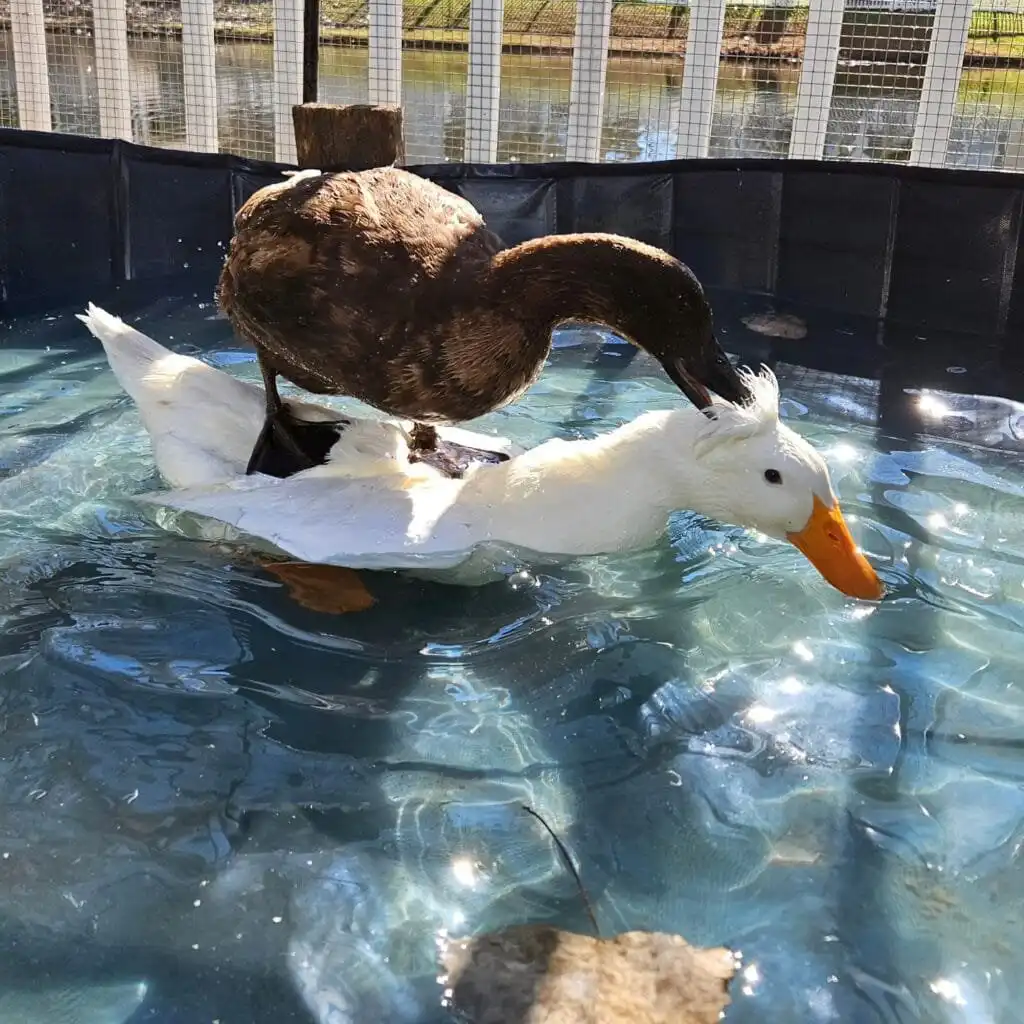
Multiple drakes can also attempt to mate with the same female in quick succession or at the same time. That is a situation I take very seriously, particularly around water, where a female who is being restrained or overwhelmed may have difficulty keeping her head above the surface.
This is why mixed sex flocks with multiple males often require more active management than the ratio alone suggests.
Space Matters Too
A ratio that works in a large enclosure may not work nearly as well in a small one.
Ducks need the ability to move away from one another. Visual barriers, multiple feeding and drinking stations, sufficient resting areas, and enough room to escape an overly persistent flock mate can make a tremendous difference.
But space has limits as a solution. If a hen is being relentlessly pursued, giving her a slightly larger enclosure does not solve the underlying problem.
If she cannot reliably get away, it is time for us to intervene.
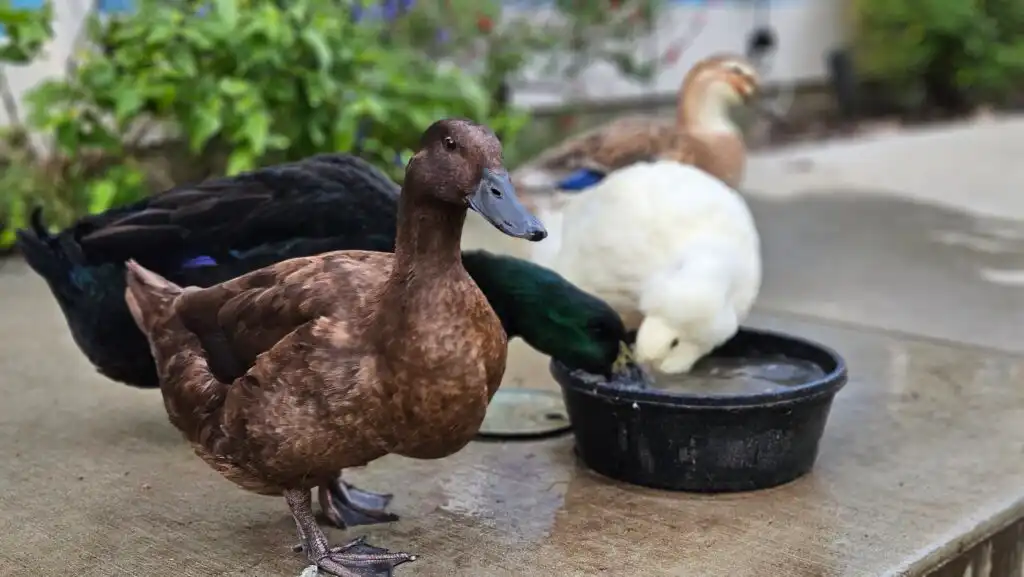
More Hens Are Not Always the Solution
When someone has too many drakes, the standard advice is often, “Just get more females.”
Sometimes that is a perfectly reasonable solution. If you already planned to expand your flock and have the space, housing, finances, and time to care for additional ducks, increasing the number of hens may improve the flock balance.
But please do not bring home six more ducks simply because a ratio calculator says you need them.
Every additional duck needs food, housing, predator protection, clean water, veterinary care, and your time. Adding more hens also does not guarantee that your drakes will suddenly behave exactly as expected.
Sometimes the more responsible solution is separation, flock rotation, a bachelor group, or a permanent change in how the flock is housed.
The Best Ratio Is the One That Keeps Your Ducks Safe
Rather than asking only, “Do I have enough hens per drake?”, I prefer to ask:
Are all of my ducks thriving in the flock arrangement I currently have?
If the hens have intact feathers, can rest and eat without being constantly pursued, willingly interact with the flock, and are not showing injuries or signs of excessive mating pressure, your current arrangement may be working.
If one female is bald, scratched, hiding, exhausted, or constantly trying to escape a drake, it does not matter that your ratio looks perfect on paper.
The condition of your ducks should always outrank the calculator.
How to Tell When Your Hens Are Getting Too Much Attention
A healthy drake-to-hen ratio is helpful, but ultimately, your hens will tell you whether the arrangement is working.
Some mating behavior is expected in a mixed sex flock. You may occasionally notice slightly ruffled feathers or see a hen being chased before mating. That alone does not necessarily mean you have a problem.
What concerns me is when mating becomes so frequent or persistent that a female cannot comfortably go about her normal day.
Watch the Hen, Not Just the Drake
It is easy to focus on how often your drake is mating. I pay just as much attention to how the hen responds.
Is she still eating normally? Is she resting with the flock? Does she voluntarily approach the pool? Can she walk away from the drake and actually get some peace?
Or is she spending much of her day running, hiding, avoiding certain areas, or immediately being pursued whenever she rejoins the group?
Those behavioral changes can appear before a serious physical injury develops.
| What you notice | What it may tell you |
|---|---|
| Mildly ruffled feathers after occasional mating | May be normal in an actively breeding flock |
| Increasing feather loss on the head or neck | Repeated grabbing during mating may be occurring |
| Bald areas or broken feathers on the back | Frequent mounting may be causing excessive wear |
| Scratches, abrasions, or open wounds | Mating pressure has progressed beyond simple feather wear |
| Hen frequently hiding or avoiding the drake | She may not be getting adequate opportunities to rest |
| Constant chasing | The hen may be unable to eat, drink, forage, or rest normally |
| Reluctance to enter the pool | She may be avoiding mating attempts in the water |
| Lethargy, weight loss, or behavioral changes | The situation warrants closer evaluation and potentially veterinary care |
I do not wait for an open wound before deciding that something needs to change. Repeated feather loss and behavioral avoidance are already useful warning signs.
Pay Special Attention to the Head, Neck, and Back
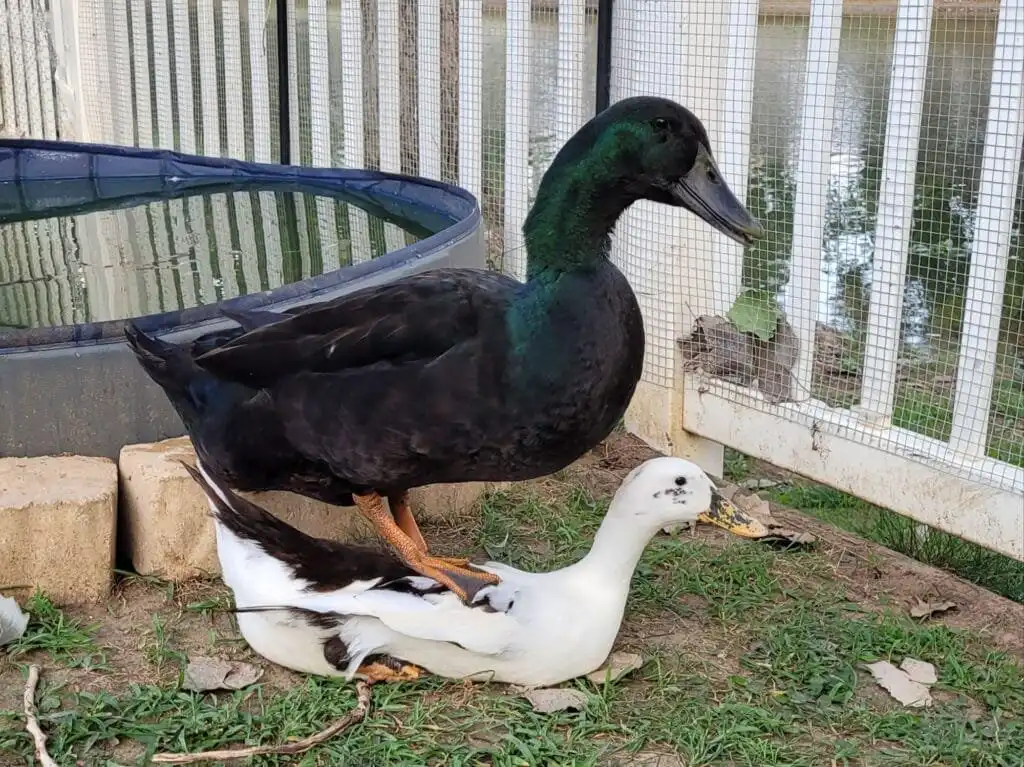
During mating, a drake commonly grabs feathers around the female’s head or neck while mounting her. With repeated mating, those feathers can become damaged or disappear altogether. The feathers across the back may also become worn or broken.
Once the skin is exposed, the risk of injury increases.
This is a good reason to make hands on health checks part of your routine. Thick duck feathers can hide scratches and wounds surprisingly well. If one of my girls is receiving a lot of attention, I want to know what is happening under those feathers, not just what she looks like from across the yard.
Multiple Drakes Can Make Mating More Dangerous
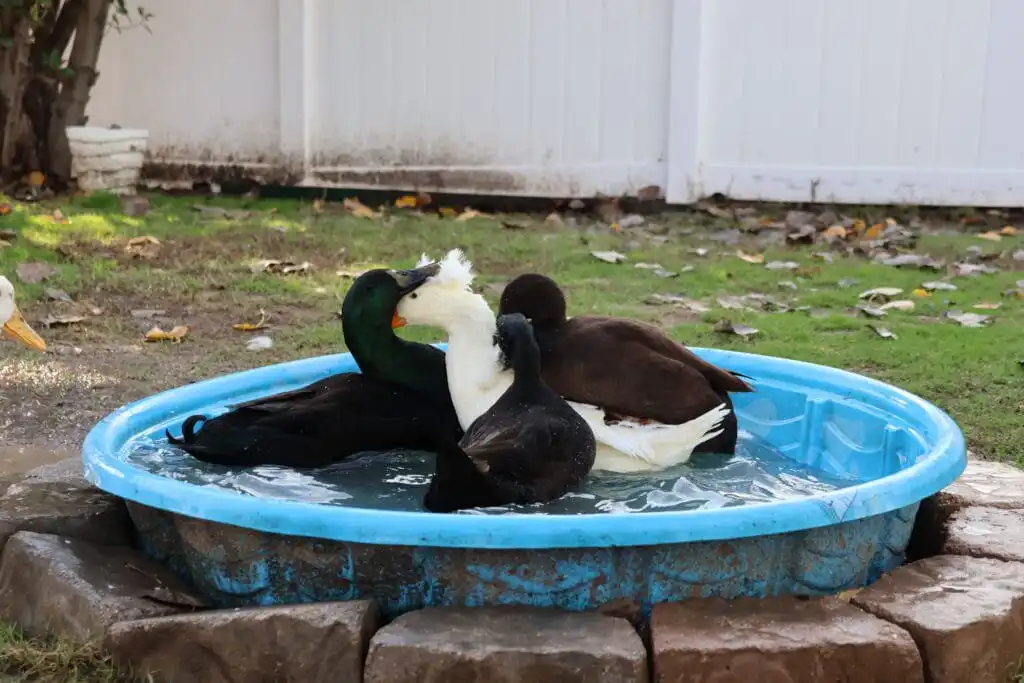
I become particularly cautious when several drakes pursue the same female.
One male may mount her while another attempts to do the same, or she may be chased repeatedly from one drake to another. In these situations, the concern is no longer simply whether she loses a few feathers.
She can become exhausted, injured, or unable to escape.
Water adds another layer of risk. Ducks naturally mate in water, but a female being restrained or overwhelmed by multiple males may have difficulty keeping her head above the surface.
If I see several drakes piling onto one female, I intervene. I do not consider that something the flock simply needs to work out.
Some Hens Become Favorites
Another reason flock ratios are imperfect is that drakes do not necessarily distribute their attention equally.
You might have six hens and one drake and still discover that he has chosen one particular girl as his favorite. Suddenly, your mathematically beautiful 1:6 ratio does very little for the hen receiving most of his attention.
This is where individual management becomes more important than flock math.
The solution might mean temporarily separating the drake, separating the affected female while she heals, changing flock groups, or using rotations so she gets predictable periods without him.
When Feather Loss Becomes an Injury
Minor feather wear should prompt closer monitoring. Broken skin changes the situation.
Any wound needs to be evaluated and protected from further trauma. Ducks can also peck at visible wounds, and returning an injured hen directly to the same mating pressure can repeatedly reopen healing tissue.
Deep wounds, significant bleeding, swelling, signs of infection, difficulty walking, weakness, breathing problems, or a duck who is not eating warrant veterinary attention.
Most importantly, treating the wound without changing the flock arrangement only addresses half of the problem.
If mating caused the injury, we also have to stop the mating pressure that caused it.
That does not mean the drake is being punished. It means we are doing our job as flock keepers.
And sometimes the easiest way to remove that pressure is surprisingly simple: take the hens out of the equation altogether and let the boys live together.
Bachelor Flocks: An Underrated Solution for Drakes
One of the most common misconceptions I hear about drakes is that they need females to be happy.
They do not.
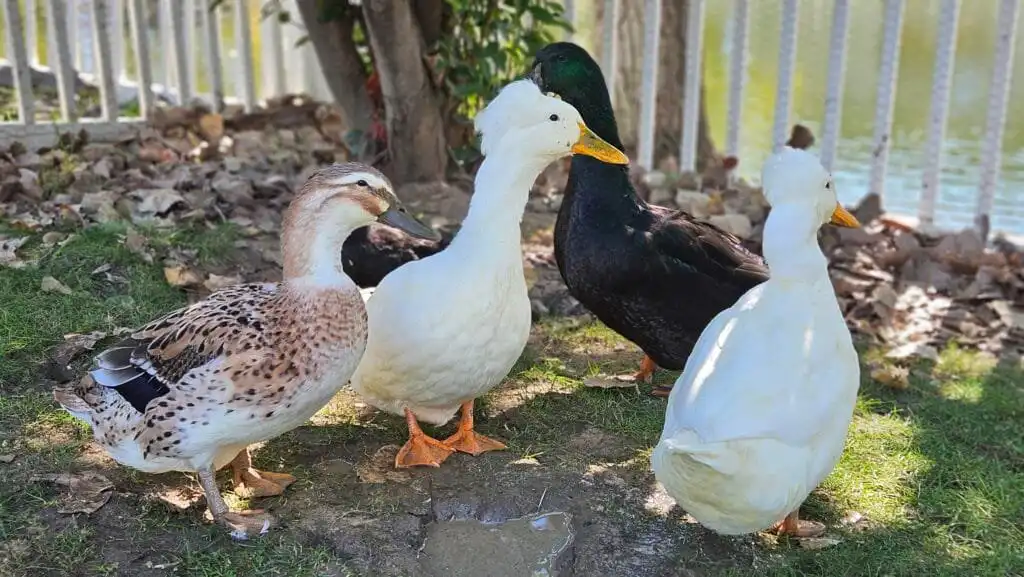
Ducks need companionship because they are highly social animals, but that companion does not have to be a female. In fact, an all male bachelor flock can be one of the best solutions for keeping multiple drakes without putting hens under excessive mating pressure.
And no, your boys are not sitting around wondering why you ruined their dating lives.
Why Bachelor Flocks Can Work So Well
Removing females from the group changes an important part of the social dynamic. There are no hens to repeatedly mate with, and one potential source of competition between the males is removed.
But I want to be very clear about something: a bachelor flock is not guaranteed to be peaceful.
Drakes still have reproductive hormones even when there are no females around. During breeding season, some bachelor groups become noticeably more restless, territorial, or aggressive with one another. Males that were perfectly happy together during fall and winter may suddenly begin chasing, fighting, or repeatedly mounting one another as hormone levels rise.
So while removing females may make management considerably easier, it does not remove the need to monitor your drakes.
| Bachelor flock advantage | What to keep in mind |
|---|---|
| No hens to overmate | Males can still direct hormonal behavior toward each other |
| No need to maintain a drake to hen ratio | Individual compatibility still matters |
| Drakes retain duck companionship | Some males may fight or repeatedly mount flock mates |
| Can work beautifully year round | Behavior may change during breeding season |
| Can simplify flock management | Some bachelor groups may still require temporary separation |
Yes, Male Ducks May Mount Each Other
This sometimes surprises new duck keepers.
Drakes in an all male group may still mount one another. Mounting is not exclusively about reproduction and can occur as part of social and hormonally influenced behavior.
The same rule applies here as it does in a mixed flock: look at the duck receiving the behavior.
Occasional mounting or brief disagreements are very different from one drake being relentlessly chased, pinned, injured, prevented from eating, or unable to rest.
Sometimes Bachelor Drakes Need Separation Too
This is especially important during breeding season.
Even without a single female in sight, hormones can affect how males interact with one another. Some bachelor flocks remain wonderfully peaceful. Others become much more difficult for a few weeks or months.
If two drakes are repeatedly fighting, one male is being relentlessly targeted, or you begin seeing wounds or significant stress, do not wait for them to work it out.
You may need to temporarily divide the bachelor flock into compatible smaller groups or separate particular individuals. Ideally, separated drakes should still have safe social contact with other ducks whenever possible.
This is another reason I love having flexible housing. Gates, dividers, adjacent pens, and multiple secure spaces give you options when flock dynamics suddenly change.
A bachelor flock can be an excellent management strategy, but it is a strategy, not a guarantee.
Can Bachelor Drakes See the Females?
This is where things can get interesting.
Some bachelor groups remain perfectly calm when females are housed nearby. Others become much more agitated when they can see or interact with hens through a fence.
You may see fence pacing, calling, fighting between males, or attempts to get through the barrier.
If that happens, increasing the distance or adding a visual barrier between the groups may help. In other situations, adjoining runs work beautifully because everyone can still see and hear the larger flock without having physical access to one another.
There is no universal setup that works for every group.
Watch your ducks and adjust accordingly.
Bachelor Flocks Can Be Seasonal
Keeping a bachelor flock does not necessarily mean permanently dividing your ducks.
If your mixed flock lives peacefully together for much of the year but becomes difficult during breeding season, you may decide to separate the males temporarily.
This can be a very practical compromise. The boys retain duck companionship while the females get a break from mating pressure.
Later, when reproductive behavior decreases, you can carefully evaluate whether combining the groups again is appropriate.
I would never reunite them simply because the calendar says breeding season should be over. Their behavior should determine when, or whether, they are ready.
Do Not Add Hens Just Because You Feel Sorry for Your Drakes
If you have three male ducks living happily together, you do not need to buy twelve or eighteen females just to create a textbook ratio.
That would dramatically increase the size of your flock and everything that comes with it: feed, housing, cleaning, water use, predator protection, veterinary expenses, and daily care.
A stable group of three happy drakes may be a much more responsible flock than a much larger mixed flock acquired simply to satisfy a ratio.
There is nothing incomplete about a bachelor flock.
The Goal Is Companionship, Not Access to Females
When we talk about duck welfare, it is easy to accidentally humanize their relationships. We imagine that a male duck must be missing something if he does not have a female partner.
But what our drakes need from us is appropriate social companionship, a safe environment, good nutrition, clean water, enrichment, veterinary care when needed, and opportunities to express normal duck behaviors.
They do not need reproductive access to hens.
For many drakes, a bachelor flock can provide an excellent home. For others, especially during breeding season, even the boys may need a little extra management.
And that really is the theme of responsible drake keeping: there is no flock arrangement that allows us to stop paying attention.
Seasonal Separation and Flock Rotation
Sometimes you do not need to permanently change your flock. You simply need to change who has access to whom for a while.
This is especially useful during breeding season. A group of ducks may live together peacefully for much of the year, only for hormones to completely change the dynamic in spring. Drakes may become more persistent with the hens, males may begin fighting, or one particular duck may suddenly become the target of unwanted attention.
In these situations, temporary separation can be one of the most effective drake management tools we have.
Separation Is Management, Not Punishment
I think this distinction is incredibly important.
When I separate a drake because he is relentlessly pursuing a hen, I am not putting him in timeout because he was naughty. He does not understand separation as punishment, nor is he going to spend the afternoon reflecting on his behavior and emerge a changed duck.
I am simply removing his opportunity to continue a behavior that has become unsafe.
The same applies when two drakes begin fighting. Neither duck has to be the villain. Sometimes hormones and flock dynamics simply mean those two individuals cannot safely share the same space right now.
Seasonal Separation May Be All You Need
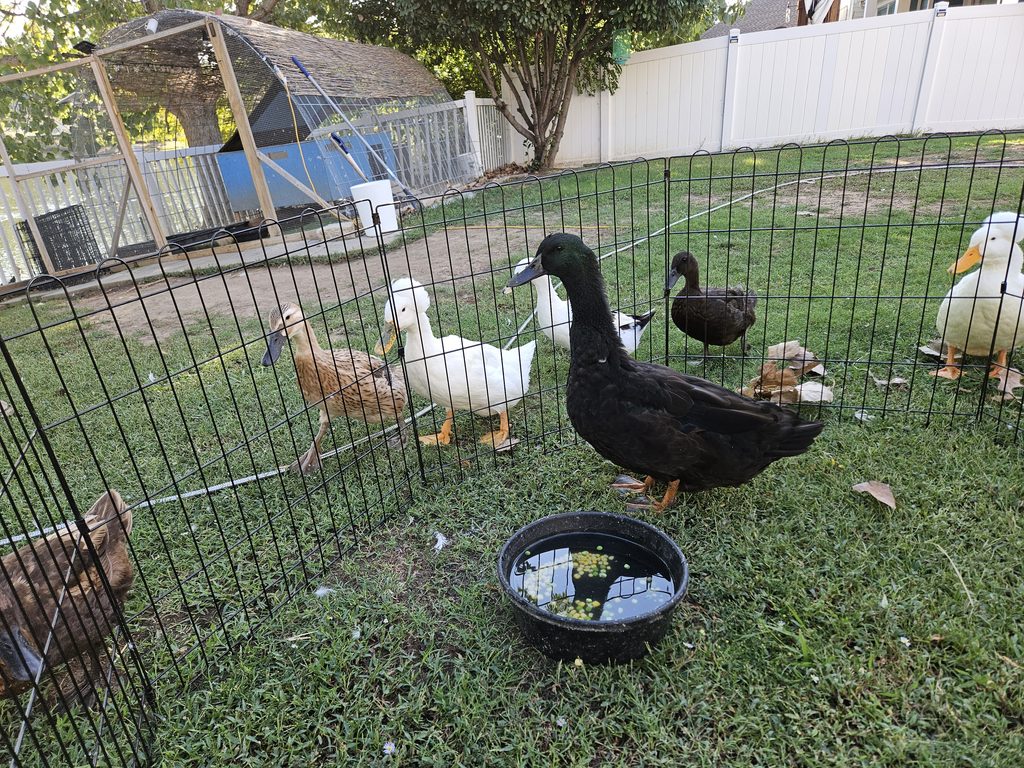
If your flock problems occur primarily during breeding season, you may be able to divide the flock temporarily and reunite them once hormonal behavior decreases.
There are several ways this can look:
| Management strategy | When it may help |
|---|---|
| Separate drake group | Several males are putting too much pressure on the hens |
| Separate one drake | One individual is causing most of the problems |
| Divide the flock into compatible groups | Certain ducks get along better than others |
| Alternate access to the main run or yard | You do not have two equally large enclosures |
| Rotate pool time | Mating in the water has become unsafe |
| Use adjoining enclosures | Ducks need physical separation but can safely remain near the flock |
| Add a visual barrier | Seeing another group causes pacing, fighting, or frustration |
You may only need these arrangements for part of the year. Or you may discover that your ducks are actually happier living in separate groups permanently.
Either outcome is okay.
Flock Rotation Can Be a Game Changer
You also do not necessarily need a completely separate duck setup for every group.
Rotating access to shared spaces can make complicated flock dynamics much easier to manage.
One group might spend the morning in the larger yard while another uses the secure run. Later, you switch them. Pools and favorite foraging areas can be shared at different times without allowing ducks that are currently incompatible to interact directly.
This does require more work from us. There are gates to open, ducks to move, and routines to remember.
But sometimes that little bit of extra management allows you to safely keep ducks who simply cannot all live together at the same time.
Separation Should Still Meet a Duck’s Needs
Temporary separation should never mean putting a drake alone in a tiny cage for hours without appropriate care.
A separated duck still needs clean drinking water, food, shade, protection from weather and predators, enough room to move comfortably, and appropriate opportunities for bathing and normal duck behavior.
Social needs matter too.
Whenever possible, I prefer arrangements where separated ducks still have compatible duck companionship. If one individual must be housed alone for safety, being able to safely see or hear the flock may help maintain social contact, provided that seeing the other ducks does not cause additional stress or aggression.
Build Flexibility Into Your Duck Setup
If there is one thing keeping drakes has taught me, it is this: you can never have too many gates.
Seriously.
A divider, spare pen, temporary fencing, second water station, or small attached run may seem unnecessary when everyone is getting along. Then breeding season arrives, someone gets injured, or two ducks suddenly decide they absolutely cannot stand each other, and that extra space becomes invaluable.
I strongly recommend designing duck housing with the possibility of separation in mind, especially if you keep multiple drakes.
You may never need it.
But when you do, you will be very glad it is there.

Let Behavior Determine When You Reunite the Flock
There is also no predetermined number of days after which separated ducks should automatically go back together.
When you think the situation has settled, supervise reintroductions carefully. Watch for immediate chasing, fighting, persistent mating, guarding, or renewed targeting of the same duck.
If the problematic behavior starts right back up, separate them again.
That does not mean the separation failed. It simply means your ducks are telling you that they are not ready for that particular flock arrangement.
Sometimes separation lasts a few hours. Sometimes it lasts weeks or months. And sometimes what started as a temporary arrangement turns out to be the safest long term solution.
For shorter situations, however, we have another wonderfully named tool in the duck keeper’s toolbox: drake jail.
What Is Drake Jail and When Should You Use It?
Drake jail sounds dramatic, but it is really just a funny name duck keepers use for temporarily separating an overly persistent or aggressive drake from the rest of the flock.
Despite the name, drake jail should never be punishment.
Your drake is not sitting behind the fence contemplating his poor decisions and promising to be a better gentleman tomorrow. His behavior is largely driven by hormones and instinct.
The purpose of drake jail is to protect the other ducks and give everyone a break.
When Drake Jail Can Help
I use temporary separation when a situation needs an immediate reset. Maybe a drake will not stop pursuing one particular hen. Maybe the girls cannot rest without being chased. Or perhaps two males have spent the morning picking fights with each other.
Instead of waiting to see whether things escalate, separating the troublemaker can immediately remove the pressure.
| Situation | How temporary separation may help |
|---|---|
| A drake relentlessly pursues one hen | Gives the hen uninterrupted time to rest, eat, drink, and forage |
| A hen has minor feather damage | Prevents continued mating pressure while you evaluate her |
| Two drakes repeatedly fight | Stops the immediate conflict and reduces the risk of injury |
| Several males target one female | Immediately removes her from a potentially dangerous situation |
| Hormonal behavior suddenly escalates | Gives you time to reassess the flock arrangement |
| A drake becomes difficult at a particular time of day | Scheduled separation may prevent a predictable problem |
Drake jail can be particularly useful when the problem is short-lived or predictable.
For example, perhaps your drake becomes especially persistent for a few hours each morning. Separating him during that period may allow the hens to eat, forage, bathe, and relax before everyone is allowed together again.
What Should Drake Jail Look Like?
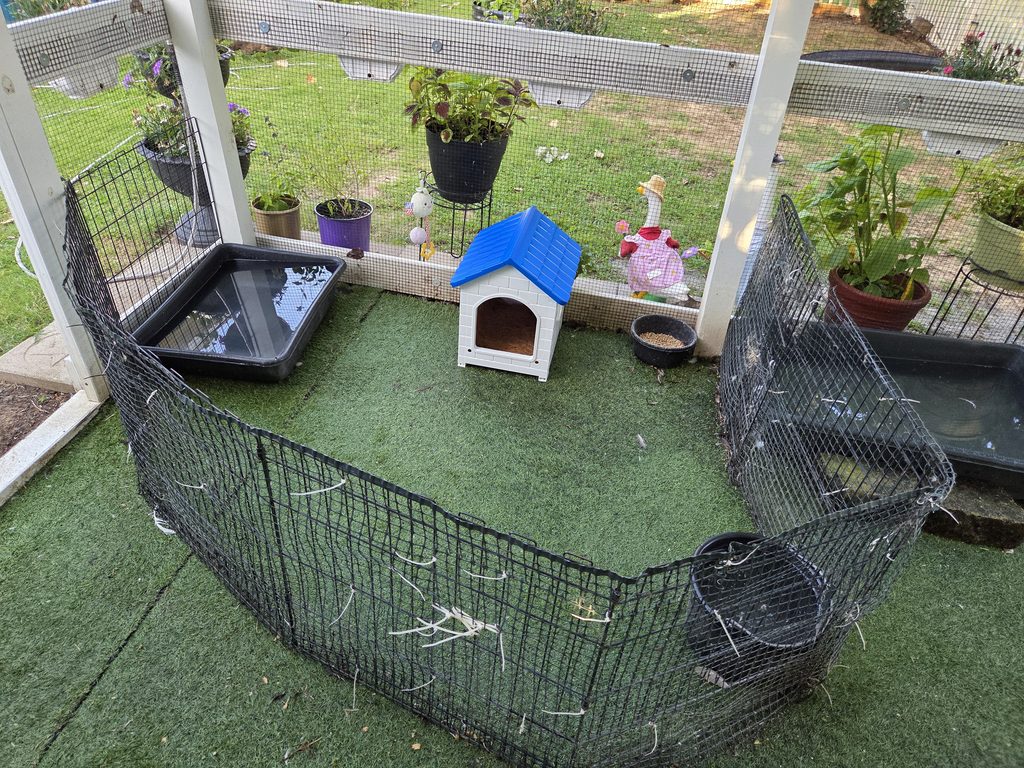
Drake jail does not have to be elaborate, but it does need to be appropriate housing.
Your drake should have enough room to move comfortably, along with shade, shelter from weather, drinking water deep enough to clean his nostrils, food when appropriate, and protection from predators. If he will remain there for an extended period, he also needs opportunities to bathe and perform normal duck behaviors.
Whenever possible, I also like separated ducks to maintain safe social contact with other ducks. An adjacent enclosure can work beautifully because the drake can still see and hear his flock without physically reaching the ducks who need a break from him.
However, watch his behavior. If standing at the fence watching the hens causes frantic pacing, fence fighting, or obvious agitation, more distance or a visual barrier may be better.
How Long Should a Drake Stay in Drake Jail?
There is no universal timer.
Sometimes a few hours is enough to give everyone a much-needed break. Other situations require separation for several days or considerably longer.
What matters is why you separated him in the first place.
If you let him out and he immediately races across the yard and starts relentlessly pursuing the same hen again, he probably did not need another ten minutes in drake jail.
He needs a different management plan.
That might mean scheduled daily separation, moving him into a bachelor group, dividing the flock for breeding season, or creating a longer-term rotation.
Drake Jail Does Not Fix Hormones
This is probably the biggest misconception I want to prevent.
Temporary separation may interrupt the immediate behavior, but it does not train reproductive hormones out of a drake.
If you repeatedly put the same drake in jail every morning, release him, watch him immediately resume the same behavior, and put him back again, you have learned something important.
The problem is no longer that your drake needs a timeout.
Your current flock arrangement is not working.
At that point, I would stop treating each incident individually and look for a more sustainable solution.
🦆 Duck Mom Tip: An Easy Temporary Drake Jail
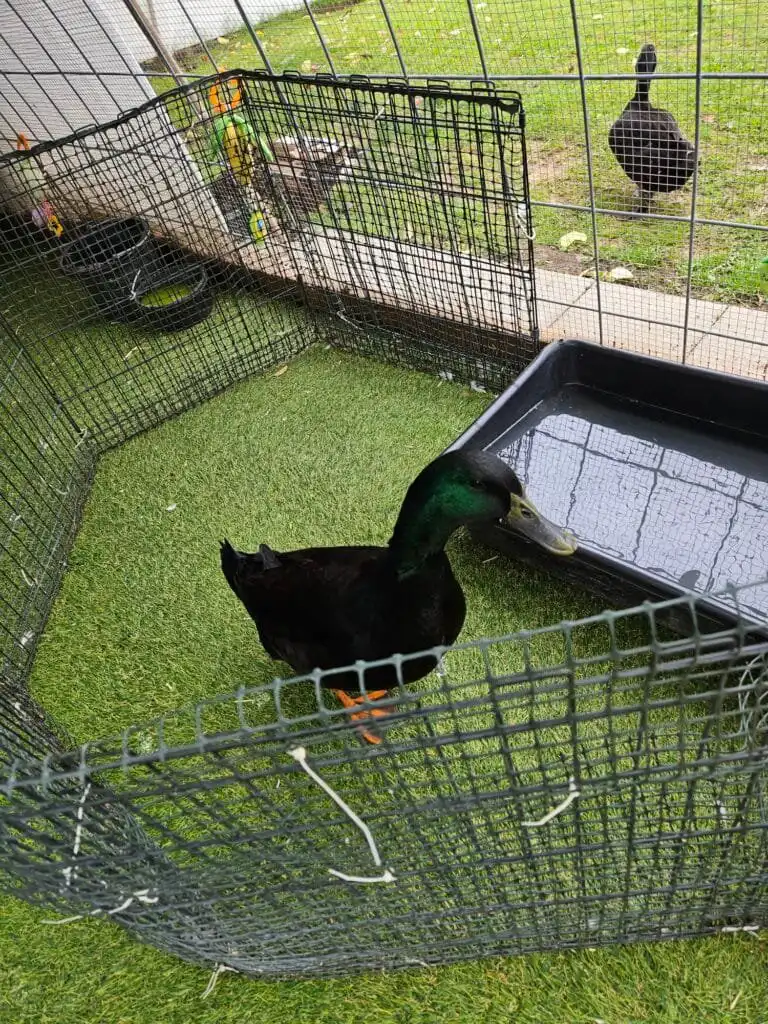
Need a quick way to separate an overly hormonal drake? A foldable metal exercise pen has been one of our most useful duck-keeping tools. We used one for years to create a temporary drake jail inside our run before building a permanent divider.
It is easy to set up, move, fold away when you do not need it, and repurpose for introductions, injuries, or other temporary separations.
👉 See the foldable metal pen we recommend
Affiliate note: This link may earn us a small commission at no additional cost to you. It helps support our flock and the free duck care resources we share.
Sometimes the Hen Needs the Separate Space
We often automatically remove the drake, but there are situations where temporarily separating the hen makes more sense, particularly if she is injured and needs a quiet place to recover.
The important distinction is that the vulnerable duck should not lose access to appropriate care simply because another duck is causing the problem.
If I move an injured hen, I want her recovery area to be comfortable, safe, and socially appropriate. And before she goes back, I also need a plan to prevent the same injury from happening again.
Treating wounds and returning her directly to unchanged mating pressure simply starts the cycle over.
Drake Jail Is a Tool, Not a Failure
I actually think having a designated separation space is one of the smartest things a multi-duck household can do.
You can use it for an overly hormonal drake today, an injured duck tomorrow, introductions later, or temporary separation when flock relationships change.
And most importantly, using it does not mean you have a bad drake.
Sometimes being a responsible drake owner means loving the little hormonal menace from the other side of a fence for a while.
When One Drake Targets One Particular Duck
You can have what looks like the perfect flock on paper and still have one hen getting far too much attention.
Drakes can develop strong preferences for particular females. A male living with five or six hens may largely ignore most of them while relentlessly pursuing one favorite. When that happens, your technically appropriate drake-to-hen ratio does very little to protect her.
This is why I manage individual ducks, not just numbers.
A Favorite Hen Can Still Be Overmated
Having a favorite is not necessarily a problem. You may notice your drake spending more time near one female, following her around, or mating with her more frequently than the others.
The concern begins when she cannot comfortably disengage.
If she is constantly running from him, hiding, losing feathers, avoiding the pool, or struggling to eat and rest without being pursued, I consider that a management problem regardless of how many other hens are available.
This can be especially frustrating because the solution seems obvious: Why doesn’t he just go bother one of the other girls?
Unfortunately, drakes do not consult our flock management spreadsheets.
Sometimes the Target Is Another Drake
Females are not the only ducks that can become targets.
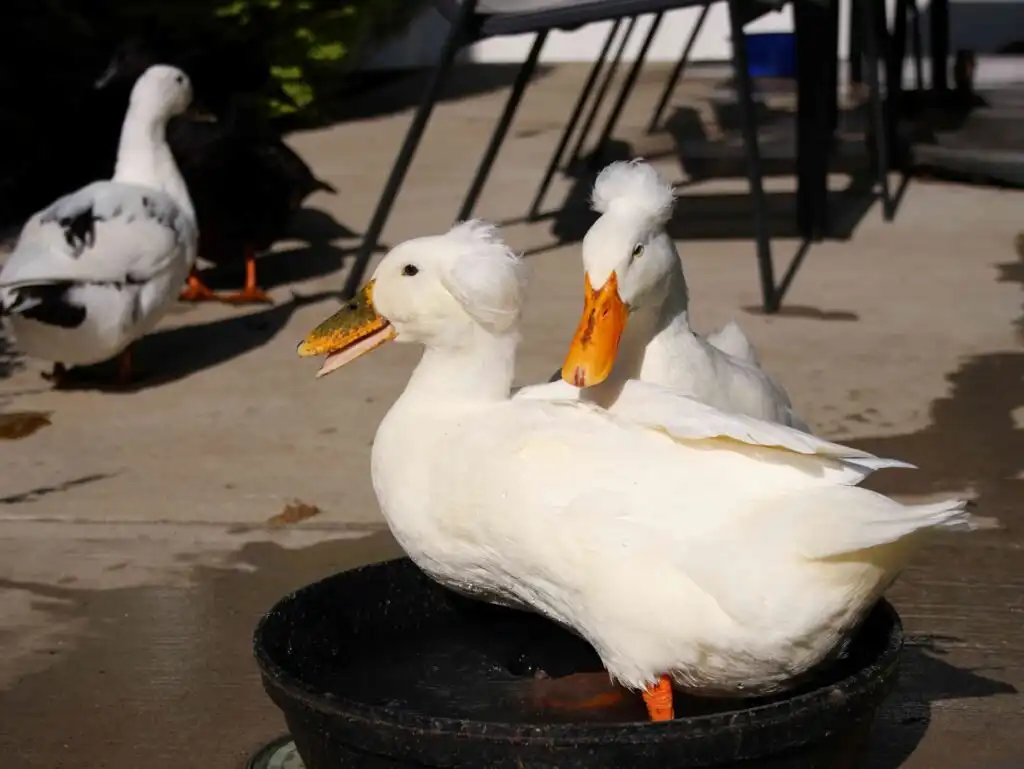
One drake may repeatedly chase, mount, corner, or fight another male. This can happen in mixed flocks as well as bachelor groups, and the intensity may increase during breeding season.
Again, I look at the duck on the receiving end.
A brief disagreement is very different from a duck who cannot approach the food, water, pool, or sleeping area without being chased. Once one duck’s normal daily activities are being restricted by another, I start thinking about intervention.
Vulnerable Ducks May Need Extra Protection
I am particularly cautious when the targeted duck is older, smaller, injured, disabled, recovering from illness, or otherwise unable to get away easily.
A flock arrangement that might be manageable for a young, healthy duck can be completely inappropriate for a duck with limited mobility.
This is another reason flock management has to remain flexible throughout the ducks’ lives. The arrangement that worked when everyone was young and healthy may not be the arrangement they need several years later.
Do Not Wait for an Injury to Prove There Is a Problem
One of the most useful things we can do as duck keepers is intervene before blood is involved.
If I repeatedly see the same duck running away, hiding, being cornered, or losing access to resources, that is already information I can act on.
I do not need to wait for an open wound to confirm that the situation has gone too far.
Depending on the circumstances, I might separate the drake temporarily, create different flock groups, rotate access to shared spaces, add additional food and water stations, or move compatible ducks together.
Sometimes a small management change is enough. Other times, the ducks make it very clear that a particular combination simply does not work.
The Individual Duck Always Comes Before the Ratio
This brings us back to one of the most important principles of drake management:
A good drake-to-hen ratio reduces risk. It does not guarantee compatibility.
If your ratio says everything should be fine but one of your ducks is clearly struggling, believe the duck.
Change the arrangement.
That is not giving up on your drake. It is recognizing that responsible flock management sometimes means accepting that not every duck can safely live with every other duck.
Should You Rehome a Drake?
Sometimes, despite our best efforts, the flock we have simply is not sustainable.
Maybe you ended up with several males when your supposedly female ducklings matured. Maybe your property does not allow you to create separate enclosures. Or perhaps one drake requires a level of separation and rotation that you realistically cannot maintain long term.
In those situations, rehoming a drake can be a responsible choice.
It does not mean you failed him.
Responsible duck keeping also means recognizing the limits of the space, time, and resources we have available. If keeping every duck means another member of the flock is repeatedly injured or chronically stressed, something needs to change.
Unfortunately, Drakes Can Be Difficult to Rehome
This is one of the harder realities of keeping ducks.
There are generally far more unwanted drakes than there are homes looking for them. People often want females for eggs, and established mixed flocks may already have as many males as they can safely accommodate.
That means finding a good home for a drake can take time.
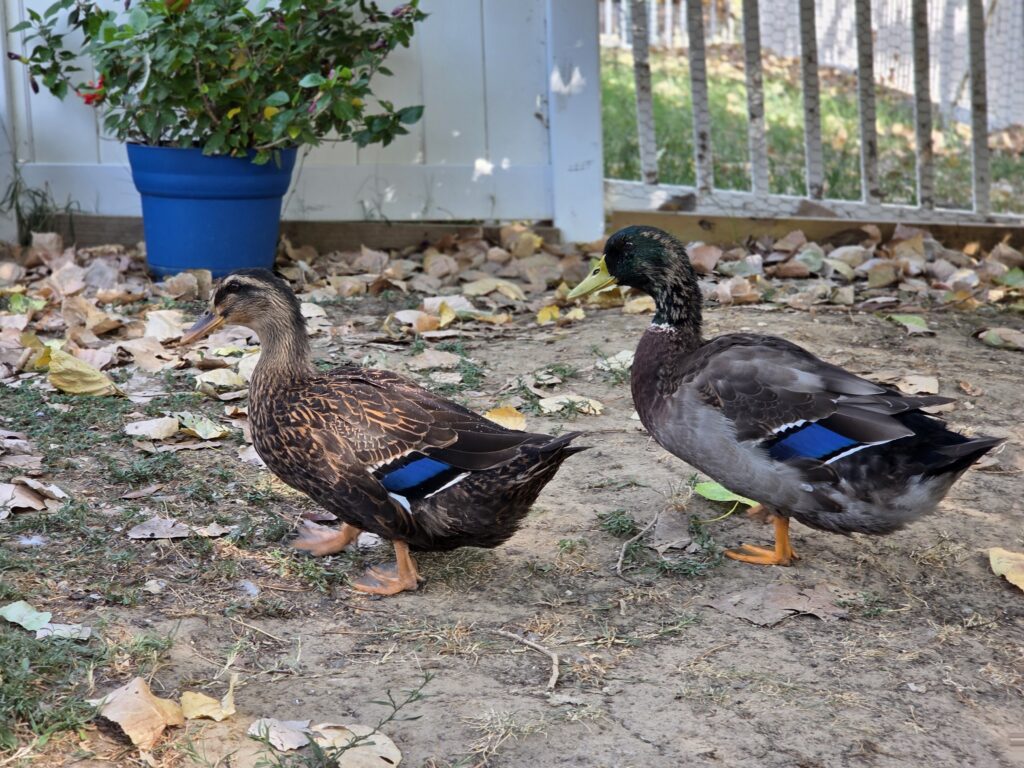
This is also something I wish more people understood before hatching ducklings. Unless you are working with sex linked genetics or purchasing reliably sexed birds, roughly half of the ducklings you hatch can be expected to be male over many hatchings. Every one of those boys will eventually need an appropriate place to live.
Hatching is adorable.
Figuring out what to do with six hormonal teenage drakes a few months later is considerably less adorable.
Look for the Right Home, Not Just Any Home
If you decide to rehome a drake, I would ask questions about where he is going.
Does the person already keep ducks? What is their current drake-to-hen ratio? Are they creating a bachelor flock? Do the ducks have secure nighttime housing? What predator protection is provided? What happens if the new drake does not integrate successfully?
If you are rehoming a bonded pair or group, I would also consider whether separating those ducks is actually in their best interest.
The goal is not simply to get the drake out of your yard. The goal is to find him a safe, appropriate home.
Never Release a Domestic Drake Into the Wild
A pond full of ducks can look like an easy solution when you are desperate to find a home.
It is not.
Domestic ducks should never be dumped at a park, neighborhood pond, lake, or other outdoor location and expected to fend for themselves. Many domestic breeds are poorly equipped to escape predators, migrate, or reliably find adequate food and shelter. Abandonment can also create welfare problems for existing duck populations.
If you cannot keep a drake, seek an appropriate private home, rescue, sanctuary, or other experienced caretaker instead.
Rehoming is finding a new caretaker. Releasing is abandonment.
Rehoming Is Not the Only Option
Before deciding that a drake absolutely has to leave, consider whether your setup could be modified.
- Could you create a bachelor group?
- Could you divide your run?
- Could the drakes and hens live separately during breeding season?
- Could you rotate groups through your yard?
- Would adding a secure adjoining enclosure make long-term separation manageable?
Sometimes a relatively simple change in infrastructure completely changes what is possible.
But there is also no virtue in keeping every duck at all costs if the resulting arrangement compromises their welfare.
Think About the Boys Before You Add More Ducks
Perhaps the biggest lesson here comes before there is ever a problem.
When buying ducklings, ask whether they are sexed and how reliable that sexing is. When hatching eggs, have a realistic plan for the males before you put those eggs in the incubator or under a broody duck.
And if your flock is already balanced and peaceful, think carefully before adding more ducks simply because ducklings are irresistible.
I understand the temptation. Believe me.
But those tiny fuzzy ducklings grow remarkably quickly, and some of them are going to become drakes.
Responsible drake management begins long before the first spring hormones arrive.
What NOT to Do With a Hormonal Drake
When a drake becomes difficult to manage, you will find plenty of advice online about how to show him who is boss.
I am not a fan of that approach.
A hormonal drake is not plotting a takeover of your backyard. He is responding to instinct, reproductive hormones, his social environment, and the other ducks around him. Our goal should be to manage those factors, not punish the duck for being a drake.
Do Not Hit, Kick, or Physically Punish Your Drake
This should be obvious, but unfortunately, physical punishment is still sometimes recommended as a way to deal with aggressive poultry.
Do not hit, kick, throw, or otherwise hurt a drake because he chases you, mates excessively, or fights with another duck.
Aside from the obvious welfare concerns, physical punishment does not address the reason the behavior is happening.
If hormones, competition, or an unsuitable flock structure are driving the problem, changing the flock arrangement is far more meaningful than punishing the bird.
Be Cautious With Advice About Dominating Your Drake
You may also encounter recommendations to pin a drake to the ground, hold him down, or otherwise physically demonstrate that you are dominant.
I would not make physical domination the foundation of drake management.
If a drake is directing aggressive behavior toward people, our first priorities should be safety and understanding the circumstances in which the behavior occurs. Creating distance, using barriers, changing routines, and safely moving the bird when necessary are very different from intentionally frightening or hurting him to establish dominance.
And when the problem is how a drake behaves toward other ducks, dominating him yourself does nothing to change the underlying flock structure.
Do Not Let Them Fight It Out
Ducks do need to establish social relationships, and brief chasing, posturing, or squabbles do not necessarily require us to intervene every time.
But there is a major difference between a disagreement and a sustained fight.
If two drakes are repeatedly attacking each other, one cannot escape, or injuries are occurring, separate them.
Waiting for them to work it out can turn a manageable situation into a veterinary emergency.
The same applies when several males pile onto one female. That is not a situation where I stand back and let nature take its course.
Do Not Punish Normal Mating Behavior
Mating itself is not bad behavior.
A drake mating with a receptive female does not need to be corrected simply because the behavior looks rough to us. Duck mating can certainly appear rather dramatic.
What we need to evaluate is frequency, intensity, and the effect on the other duck.
Can the female walk away? Can she rest? Is she maintaining good feather condition? Is she being injured? Is she repeatedly being pursued by several males?
The goal is not to stop every mating attempt.
The goal is to prevent excessive mating pressure and injury.
Do Not Assume Your Ducks Will Sort Everything Out
There is a persistent idea in animal keeping that we should avoid interfering because animals will naturally establish their own hierarchy.
Sometimes they do.
Sometimes one gets hurt.
Domestic ducks live in an environment we created. We decide how many males and females live together. We determine the size of their enclosure. We control where the food, water, shelters, and pools are located. We decide which ducks have access to one another.
That makes flock management our responsibility too.
Do Not Blame the Drake
Perhaps most importantly, try not to turn a management problem into a character judgment.
We casually describe drakes as mean, nasty, aggressive, or bad when their behavior becomes difficult. I understand why. Watching a beloved hen being chased or injured is upsetting.
But assigning human motives to the drake does not help us solve the problem.
Your drake is not a bad duck because his hormones are raging.
At the same time, hormones are not an excuse for allowing another duck to suffer.
Those two ideas can exist together.
We can have compassion for the drake while protecting the hen. We can understand that a behavior is natural while deciding that it is not safe in our particular flock. And we can separate ducks without treating that separation as punishment.
That, to me, is the heart of responsible drake management:
Do not blame the duck. Change the situation.
From Our Flock: How We Manage Simon During Breeding Season
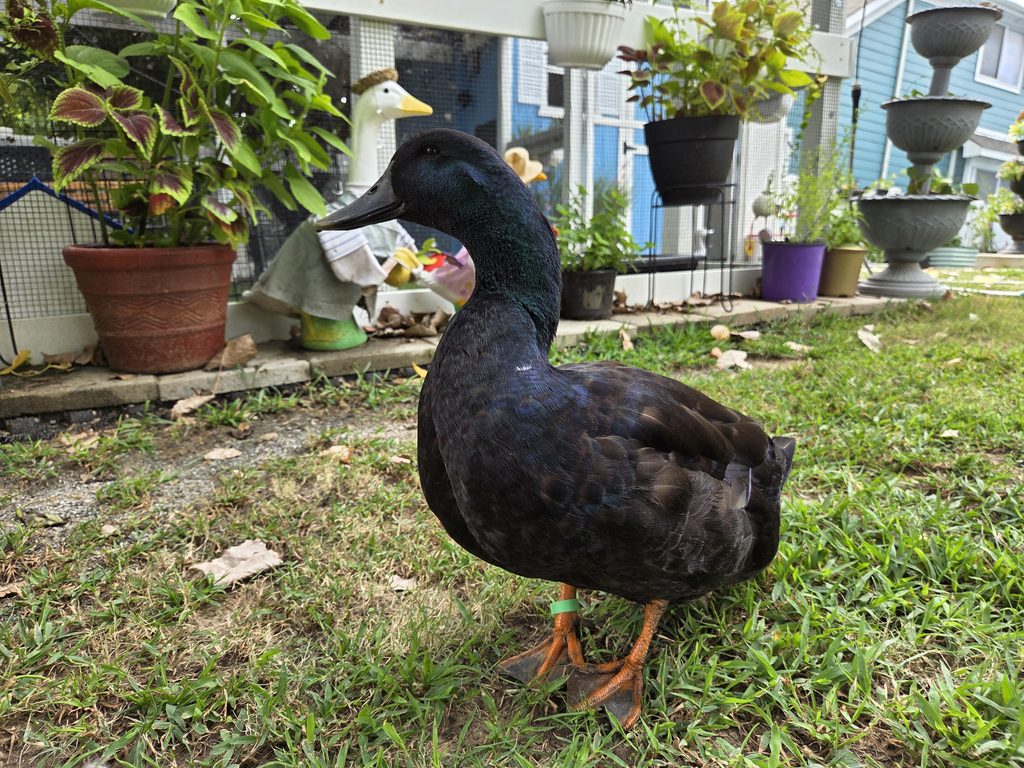
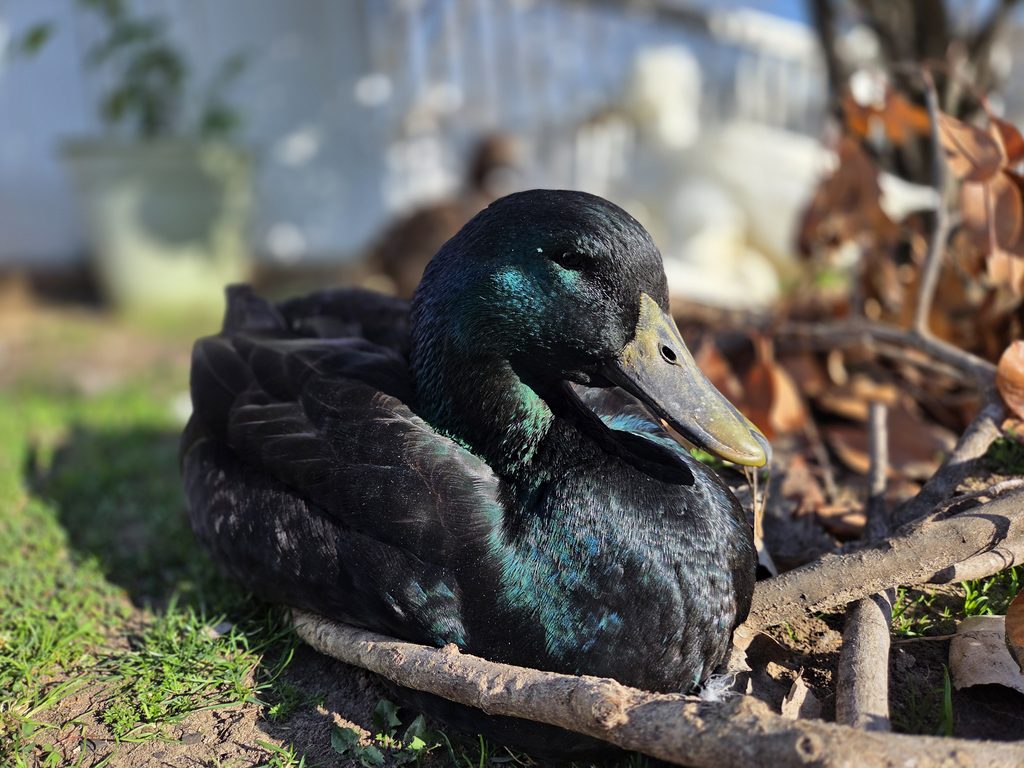
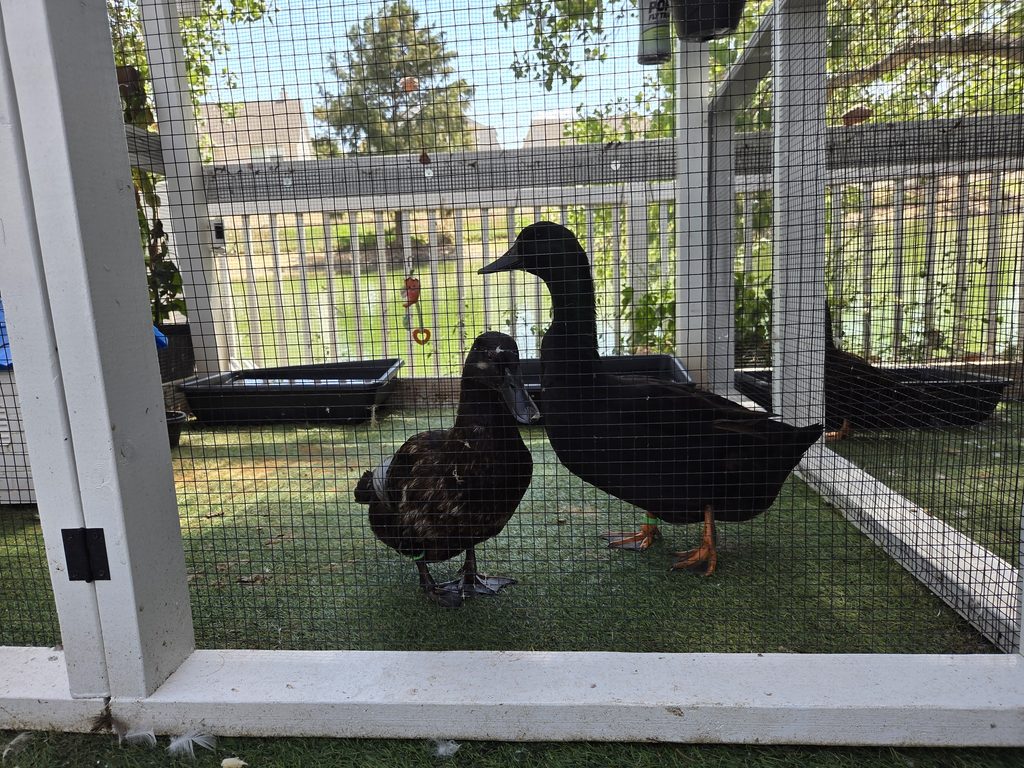
For most of our years keeping ducks, we had only one drake: Simon, our Cayuga boy, living with five girls. On paper, that sounds like an excellent flock ratio.
And for much of the year, it works.
But once spring arrives, usually around March here in North Texas, Simon’s hormones kick into high gear. He becomes much more interested in the girls and tends to focus his attention especially on Muffin and Emma.
At that point, I do not wait for one of the girls to become injured before doing something about it. We separate Simon.
Our Temporary Solution Became a Seasonal One
For a while, we used one of those foldable metal exercise fences to divide our run. It worked well as a temporary solution and gave us the flexibility to separate Simon whenever his behavior became too much for the girls.
But after doing this repeatedly, we realized something.
This was not really a temporary problem.
Simon predictably becomes more hormonal every spring, and the separation may be necessary for several months. Instead of rebuilding a makeshift divider every year, we decided to design our duck setup around the reality of the flock we actually have.
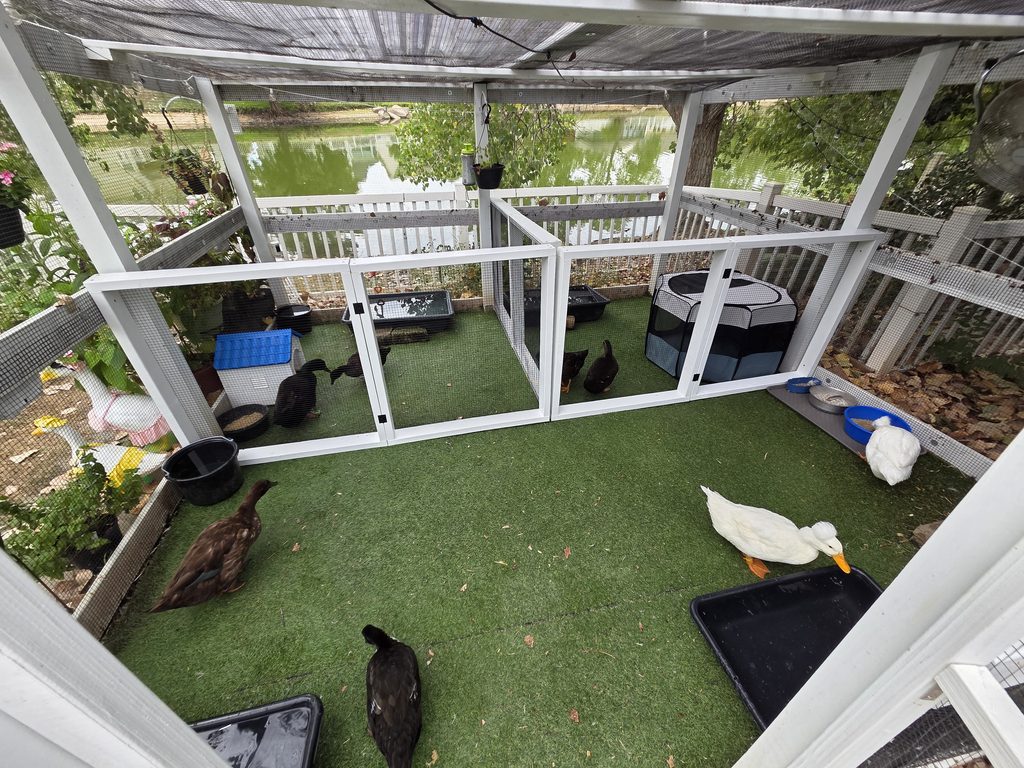
This summer, we built a permanent separation inside our run, complete with a gate. It looks much nicer, is easier for us to manage, and allows us to divide the flock within minutes whenever necessary.
Simon has everything he needs on his side, including food, water, shelter, space, and access to the things that make a duck’s day a good one.
But most importantly, he is not alone.
Simon Has Ronja
Ronja and Simon have always gotten along particularly well.
Simon is much gentler with her than he can be with some of the other girls, and Ronja absolutely adores him. So when Simon needs to be separated from Muffin, Emma, and the rest of the flock, Ronja stays with him.
That arrangement actually seems to benefit both of them.
Ronja does not always get along particularly well with Krümel and Muffin, so being on Simon’s side of the run gives her some peace too. Instead of thinking of it as poor Simon being separated from the flock, I see two compatible ducks getting their own space where they can relax together.
And honestly, Ronja seems quite pleased with the arrangement.
Sometimes Good Flock Management Means Separate Flocks
I think this is an important example because our solution is not particularly dramatic.
We did not rehome Simon.
We did not decide he was a bad drake.
We did not keep adding females in the hope that eventually there would be enough girls to absorb his attention.
And we certainly did not expect Emma and Muffin to simply tolerate months of unwanted attention because Simon’s behavior is natural.
We changed the environment.
Simon gets to be Simon. Emma and Muffin get a break from him. Ronja gets her beloved boyfriend and some peace from ducks she does not particularly enjoy living with. Everyone can still see and hear the rest of the flock, and we can change the arrangement again when the season and their behavior allow it.
Is it a little more work for us? Absolutely.
But that is part of keeping drakes.
Sometimes responsible flock management does not mean finding a way for every duck to live happily together in one big group.
Sometimes it means recognizing which ducks are happiest together and giving them the space to be exactly that.
Frequently Asked Questions About Drake Management
How many female ducks should you have per drake?
A commonly recommended starting point is about four to six female ducks per drake, but there is no perfect ratio for every flock. Individual temperament, breeding season, available space, and whether a drake favors one particular hen all matter. Even with a seemingly ideal ratio, watch your females for excessive feather loss, injuries, hiding, or persistent attempts to escape the drake. Your ducks’ behavior and condition are more important than the number on paper.
Can male ducks live together without females?
Yes. Male ducks can live together in an all-male bachelor flock, and many do very well without females. Drakes need appropriate duck companionship, but they do not need access to hens. However, bachelor flocks are not guaranteed to be peaceful. Hormonal behavior can increase during breeding season even when no females are present, and some males may need to be temporarily or permanently separated if fighting or persistent targeting occurs.
Why does my drake suddenly become aggressive in spring?
Increasing daylight and seasonal reproductive activity can cause noticeable changes in drake behavior. You may see more mating attempts, chasing, guarding, mounting, or fighting between males. A drake who was easygoing during fall and winter may therefore behave very differently during breeding season. This does not necessarily mean his personality has permanently changed. Seasonal separation or flock rotation may be necessary until his hormonal behavior decreases.
How long should I keep my duck in drake jail?
There is no set amount of time. Drake jail is simply temporary protective separation, not a punishment or training technique. A few hours may be enough to give hens a break in some situations, while other drakes may require daily, seasonal, or longer-term separation. If your drake immediately resumes relentless mating or fighting whenever he is released, repeatedly extending his timeout is unlikely to solve the problem. You probably need a different flock arrangement.
Will neutering a drake stop hormonal behavior?
Surgical neutering is not a routine management option for drakes. Unlike neutering a dog or cat, reproductive surgery in birds is considerably more complicated because of their internal anatomy and associated surgical risks. If hormonal behavior is creating serious welfare problems that cannot be managed through separation or flock restructuring, discuss the individual situation with an avian veterinarian rather than attempting to solve it through breeding or behavioral advice alone.
Good Drakes Need Responsible Keepers
Drakes can be challenging. They can also be funny, affectionate, beautiful, deeply bonded members of our flocks. I would never want the difficult moments of breeding season to define them.
When a drake starts chasing hens, mating excessively, or fighting with another male, it is easy to label him as aggressive or mean. But I think we owe our boys a little more understanding than that.
They did not choose their hormones. We chose their living situation.
That does not mean we should excuse behavior that puts another duck at risk. Quite the opposite. If a hen is being overmated, a drake is being bullied, or one duck cannot eat, rest, swim, or simply exist without being pursued, we need to intervene.
A healthy drake-to-hen ratio can help. Bachelor flocks can be wonderful. Seasonal separation, flock rotations, separate runs, and good old drake jail can all have their place. Sometimes rehoming is ultimately the most responsible option.
The right solution is the one that keeps all of the ducks involved safe and gives them a good quality of life.
Simon is still Simon when he moves to his separate section of our run every spring. He is not being punished, and I am not angry with him for being hormonal. He gets his own space, everything he needs, and Ronja happily keeps him company. Meanwhile, Emma, Muffin, and the other girls get some much-needed peace.
That is what successful drake management looks like in our flock.
It may look completely different in yours.
Further Reading & Resources
- How to Handle Aggressive Drakes: Expert Tips for a Peaceful Flock
- How Ducks Establish Pecking Order (and How to Manage Conflicts)
- The Emotional Reality of Keeping Ducks (No One Talks About This)
- Do Ducks Get Lonely? How to Keep Your Pet Ducks Happy and Social
- Pet Ducks: How Many should I have? And where do I get them from?
Connect deeper with your flock. Discover more about duck psychology and social dynamics in the Community & Behavior Hub.